
TL;DR
The short version
Most orgs point AI at work they already do and measure it in time saved. That caps the upside. The bigger move is opportunity technology — work that was impossible before — and counting value in what gets reinvested, not hours freed.
Astra made the split visible: power users bounce between models for coding while excitement clusters on video, 3D, and interactive builds. Blank-page anxiety is the binding constraint. Thought starters, steal-cool-from-other-jobs, what-if machines, and expertise-as-product turn the frame into weekend experiments.
Built on Nathaniel Whittemore’s AI Daily Brief series on opportunity vs efficiency, including the 2026-09-17 thought-starters episode.
Efficiency does old work faster; opportunity does new work at all
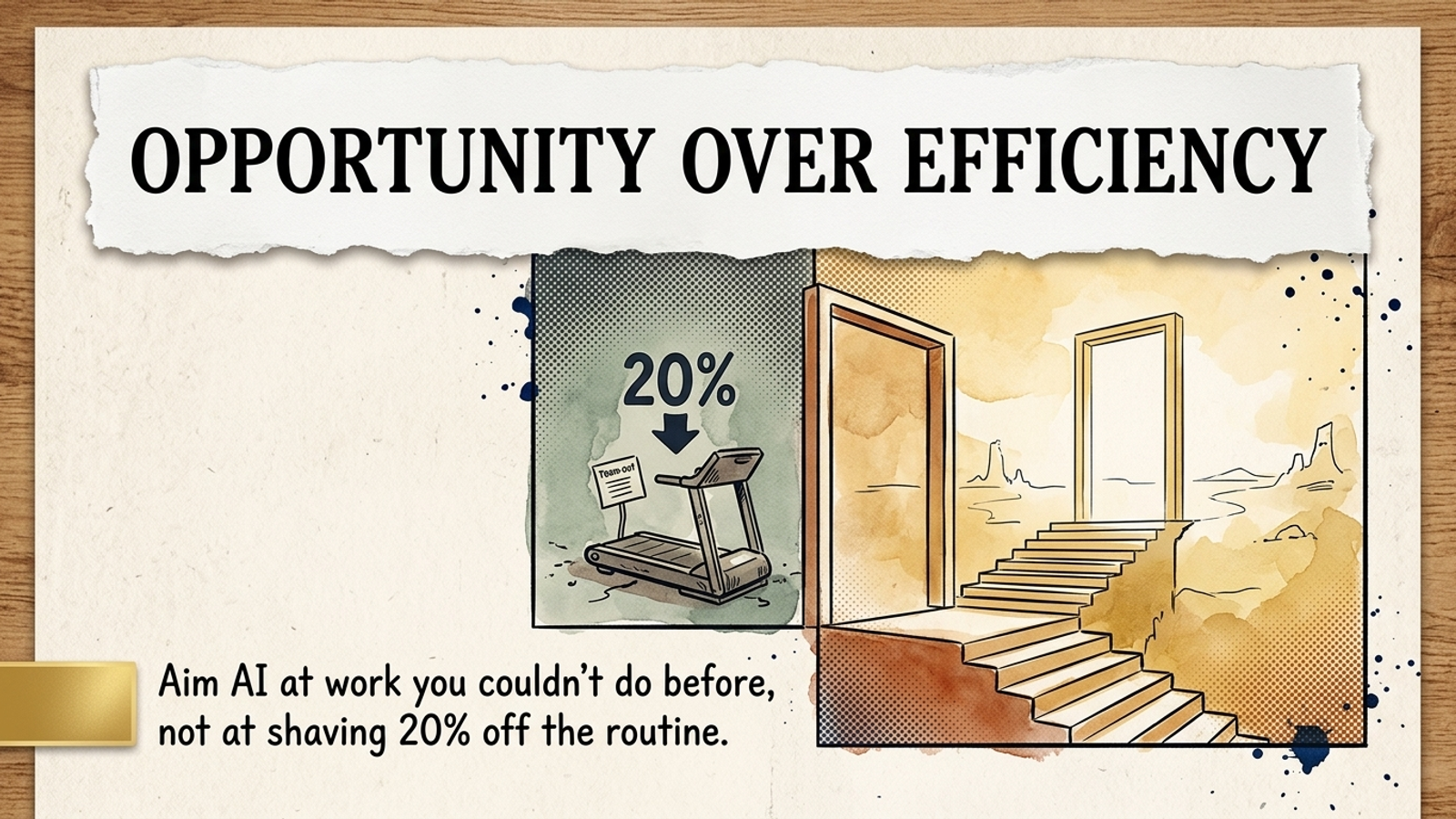
The two framings pull in different directions. An efficiency technology compresses the time on work you already do — worthy, but bounded; there's only so much of a task to shave. An opportunity technology raises the ceiling on what you can attempt at all, including things a non-technical person could never have tried before, like building an agent.
The trap is measuring AI purely as efficiency. Under that lens the win is the time saved, and the freed hours quietly refill with more of the same. The reframe is to spend those hours on orthogonal, previously-impossible work — the value lives in the reinvestment, not the saving.
The frame also scores a single model release
It's not only an adoption lens — it's how to read a launch. When GPT-6 Astra shipped in September 2026, Nathaniel Whittemore's verdict was that it "is not a model of AI efficiency… it's a model of AI capabilities… about expanding what you can do." The tell is the question people ask first: "does it beat my current model at my daily tasks?" is the efficiency question, and it's the wrong one.
It's also why the benchmarks looked underwhelming. Astra scored 61 on the Artificial Analysis Intelligence Index — tied with the older GPT-5.6 and behind Fable 5.1 — because that index rewards fact recall over agentic computer use. Benchmarks measure the efficiency domain, so they systematically undershoot a capability release.
The value landed where nothing could go before: driving a real computer, and one-shot 3D and design work. That's the third instance — after image generation and AI coding — of a new capability handing non-specialists a whole discipline overnight.
Astra is ridiculously good at spatial reasoning, 3D, computer work, math, agents, and coding — but ask her to make a nice website and Claude still comes out noticeably better.
Dan Dries
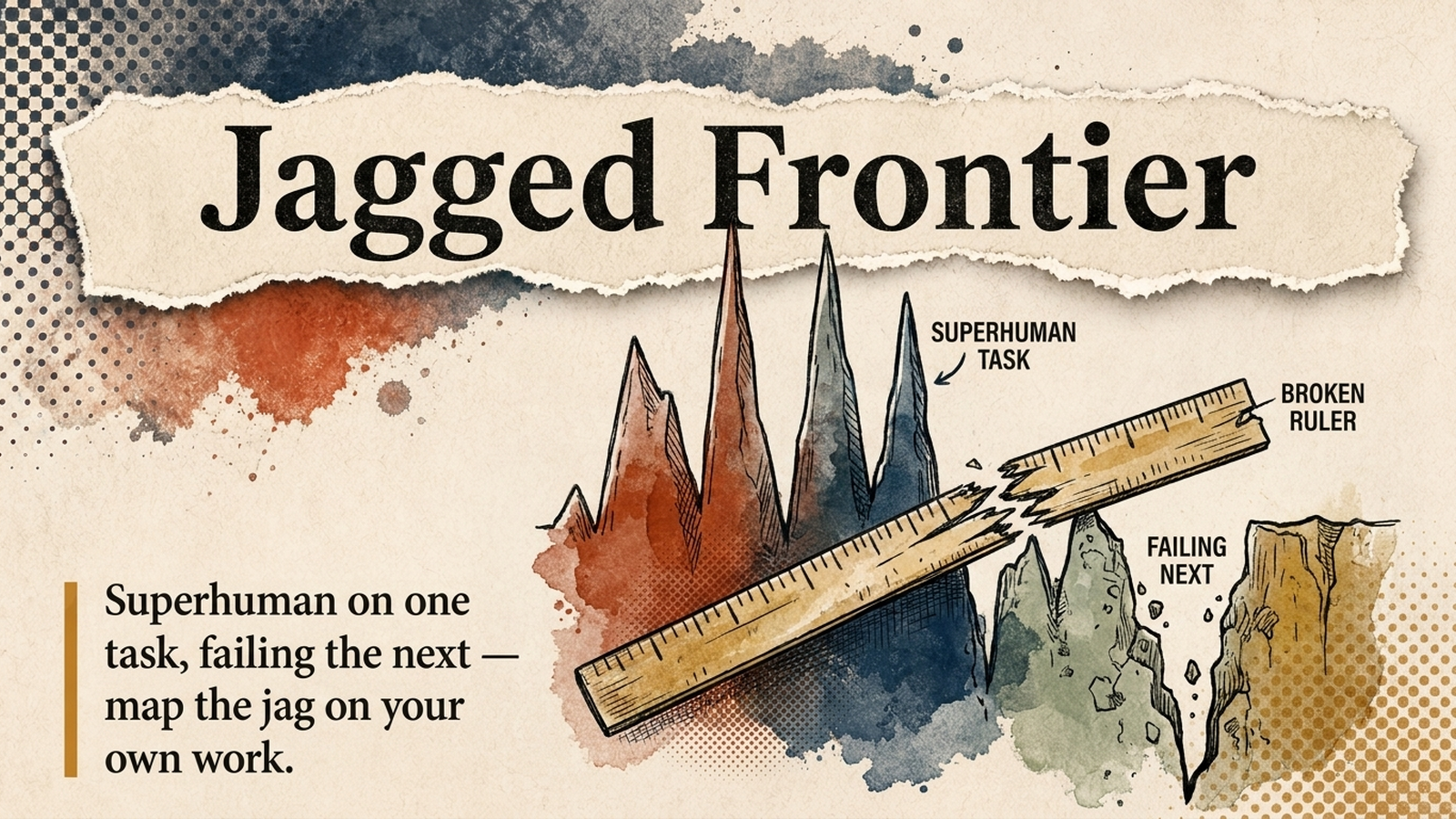
The catch keeps the frame honest: opportunity value is domain-specific, not universal. Senior engineers found Astra's everyday Python and front-end work weak — worse than the incumbent. A capability model can be a superpower in one domain and a step backward in another, which is why efficiency-vs-opportunity is a per-domain judgment, not a blanket verdict. (Most head-to-head numbers here are OpenAI's own; only the Intelligence Index score and the release facts are third-party.)
Automate the workflow, not the task
The biggest gains don't come from speeding up individual tasks — they come from redesigning whole workflows: cutting handoffs, approvals, and legacy tooling you only notice by sitting next to the person doing the job. Uber's takeaway from running agentic pods across sixteen business functions was blunt about where the leverage is.
The workflow becomes the unit of automation, not the individual task. The best AI opportunities are rarely visible from the outside — you discover them by sitting next to the people doing the work, building with them, not for them.
Praveen Neppalli Naga, Uber CTO
That's why internal PR for AI moves so little. The leverage is "internally deployed vibe coders" — an internal turn on the forward-deployed-engineer model — who pair with a function and change what the work is, not just how fast it runs.
Whittemore's later sharpening names the failure directly: the skeuomorphic trap — porting the form of pre-AI work instead of its function. "Founders who AI existing workflows will lose," the way early mobile apps kept a trash-can icon; Uber didn't digitize the dispatcher's desk. Efficiency AI makes the old workflow cheaper; opportunity AI invents the one that was never possible. Protect that lane, and don't prematurely ROI-gate it — ROI tests bias teams toward efficiency and starve the experiments that surface the bigger prize.
The bottleneck is enablement, and efficiency-only framing has a cost
"Agents are here, agentic readiness is not." Capability is arriving faster than institutions can absorb it: in one sponsor survey, most organisations had taken some action on agents, but only a small fraction of workers actually used an agentic tool and fewer still could even define an agent. (These figures are self-reported and come from an episode sponsor — directional, not neutral data.)
There's also a cost to getting the framing wrong. Chasing output over excellence trains detachment: 43% of workers admitted submitting AI content they suspected was low-quality or wrong. Efficiency-only AI corrodes the relationship to effort — the opposite of the appetite for hard thinking that becomes the real differentiator when intelligence is cheap.
The efficiency-only frame has a sharper failure mode under quarterly pressure: AI washing — faking AI progress, often through layoffs justified by efficiency that doesn't exist yet, then quietly reversed. Whittemore's later restatement is blunt: firms that view AI strictly as an efficiency technology rather than an opportunity technology might eke out a few headline wins, then get pummeled by those that treat it as a redesign moment.
The blank page is the blocker
New models may regress on old jobs and explode on new ones. Astra’s coding anecdotes — “smartest and dumbest,” mood swings, higher spend — sit beside excitement on video, 3D, and interactive builds people weren’t doing before. Efficiency becomes table stakes; winners invent orthogonal opportunities.
People do not generally walk around with some complete inventory of all the things they might do or that they might make.
Nathaniel Whittemore, The AI Daily Brief
Remedy: thought starters you can personalize, steal cool work from other jobs, turn proposals into shared what-if instruments, and package expertise as a product others can work through. The episode’s companion at play.aidailybrief.ai is the meta-example.