
TL;DR
The short version
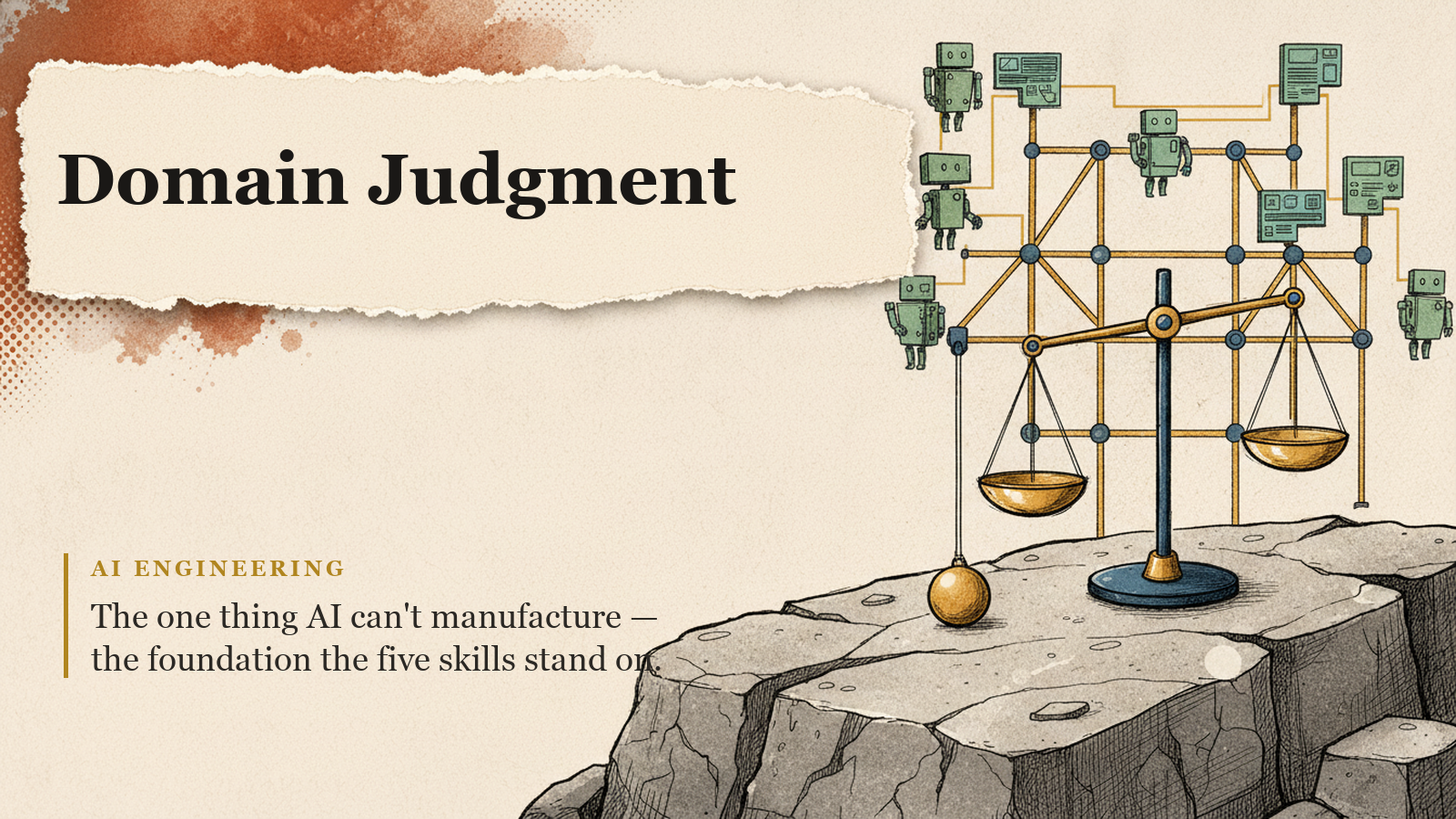
As knowledge work shifts from doing to directing agents, domain judgment — define quality, see trade-offs, own the decision — stays under every AI skill.
TypeSafe's Jev is a decision-only model. John Lindquist's tutorial makes the heuristic concrete: constrained inputs → Jev; open-ended critique → LLM; fix brittle single-pass with another cheap classification layer. OpenAI's Decisions API (DevDay) is the same product class with vision.
Built on Whittemore's Jev field report, Claire Vo's judgment-model-first walkthrough, and John Lindquist × Claire Vo practical demos.
Judgment is the foundation, not a sixth skill
Capability mapping, harness management, prototyping, opportunity identification, and rapid skill acquisition all sit on domain judgment. It’s the analogue of software fundamentals — and the part AI doesn’t replace.
Just because ChatGPT can write all the copy… we wouldn’t expect someone with no experience in marketing to plan and execute a marketing campaign really well, because they lack that domain judgment.
Nathaniel Whittemore, The AI Daily Brief
Three sources — personal, borrowed, embedded
Judgment isn’t only tenure. Personal standards from doing the work; borrowed judgment via review next to someone who has it; embedded judgment via rubrics, policies, and evals fed to the agent. Embedded judgment is how you scale standards to agents — the same move as evals-as-PRD.
Decision craft is the PM form of judgment
Robby Stein (VP Product, Google Search; ex-Instagram) argues the old PM value of getting stuff done collapses as agents make building cheap. What remains is judging what to build — taste and decision quality through a people → root-cause → craft loop. AI scales interviews, feedback libraries, and agentic QA; the human still owns the call.
Above all else, actually the craft of PM is one simple thing that you should be the absolute best at. And that is decision-making.
Robby Stein, Lenny's Podcast
Judgment models: decide without chatting
TypeSafe's Jev answers narrowly defined questions with probabilities, categories, or scores — no text generation. Stack pattern: LLM proposes → judgment model decides → code executes. Company speed/cost claims (20–200× / 40–400×) are marketing until you measure; Mike Taylor's third-party check — 777 judgments in under 0.7s for about a quarter-cent — made the economics legible at launch.
A good way to think about a test for whether something is a good job for Jev is where you repeatedly read something, make a small judgment, then take a predictable next step.
Nathaniel Whittemore, The AI Daily Brief
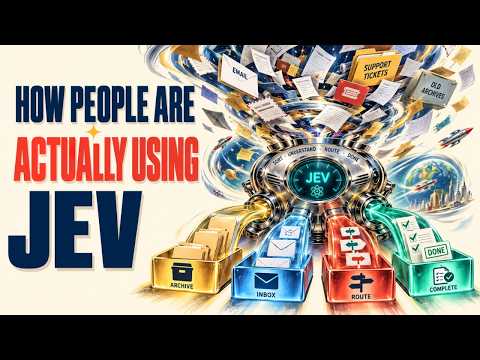
Ten days later the field report named six jobs people are already shipping: analyze existing piles, search by meaning, triage inbound, check work against rules, speed up agents (routing / context pruning), and respond instantly (smart paste / field fill). Parallel questions on one state keep latency flat while cost scales with tokens. List price is $0.042 per million input tokens, output free — treat builder latency/cost anecdotes as self-reported; TrueStandard's independent remeasure calibrates the marketing multiples (~1.4–1.7× for a single-call swap vs ~100× when a multi-step LLM workflow collapses into one typed call).
Fitness checklist before a path that matters
Answers writable in advance. A pile or stream to run over. Wrong answers cheap or catchable. Evidence as text under the model's context budget. Then write atomic questions — one judgment per question — and label a small gold set before production.
Although I'm calling it a judgment model, you don't want to leave things up to its judgment alone if getting it wrong has big consequences.
Nathaniel Whittemore, The AI Daily Brief
Do not leave hiring ranks, money, or security to the model alone. No attached reasoning ships with the answer, and Typesafe warns on multi-hop accuracy, counting/math/dates, consistency, and intent. Probability without rationale is a compliance problem — pair high-stakes bubble cases with an LLM rationale pass. At volume, checking every sentence for a style-rule violation becomes categorically different from a generic LLM pass over the whole document — that is the product, not a chatbot.
Put the judgment model in front
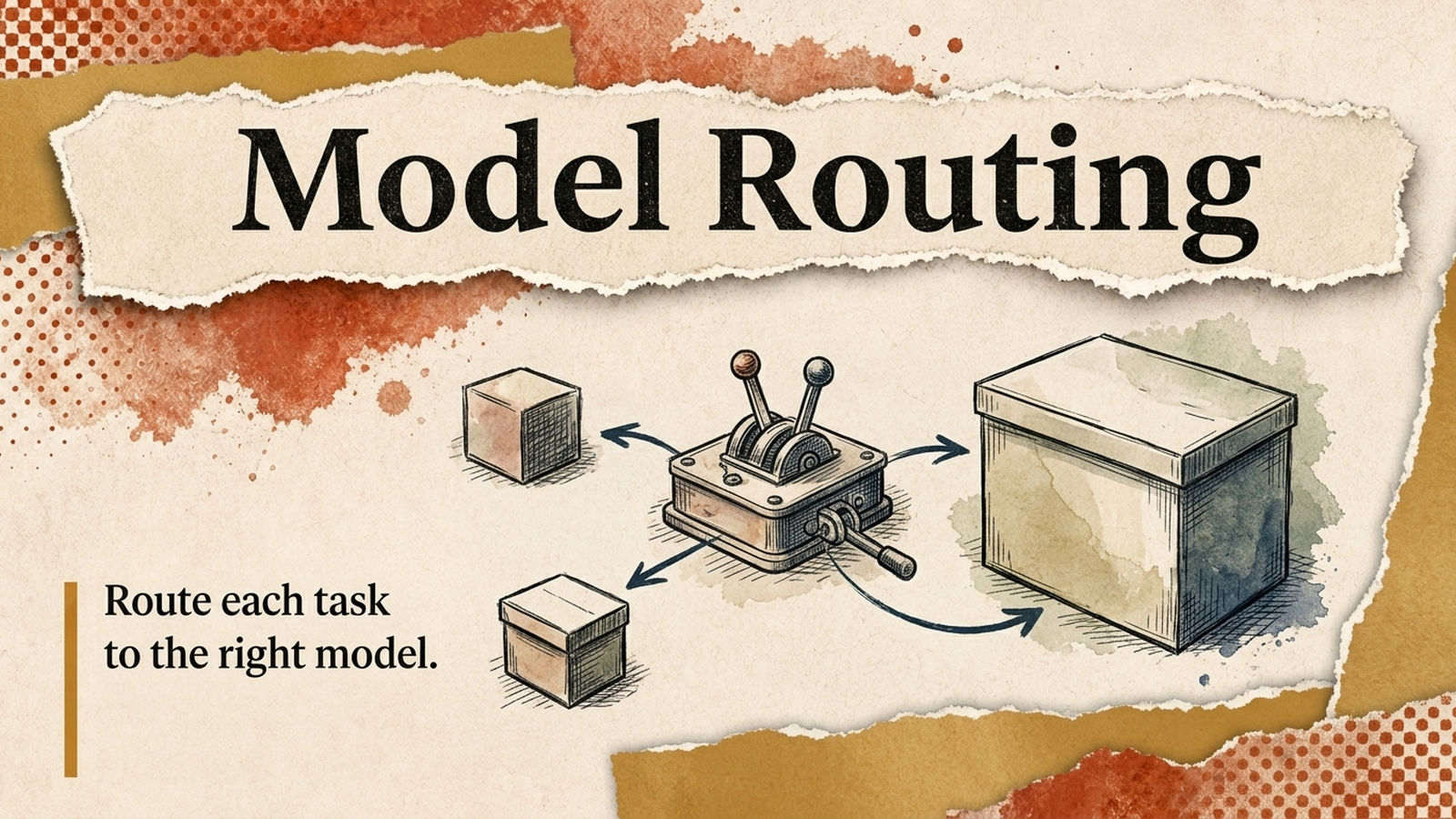
Claire Vo's How I AI walkthrough adds the order of operations: Jev filters, clusters, and triages cheaply (~$0.04 per million input tokens; output free); Astra/Soul/Luna-class models analyze and generate on the reduced set.
Jev alone is okay. Jev with an LLM buddy is super powerful.
Claire Vo, How I AI
Practitioner receipts (self-reported): about 1,700 ChatPRD PRs clustered via ~17,000 pairwise judgments for ~$0.09; an insights graph of ~1,100 signals expanded into ~200,000 classifications for ~$4 on Jev before frontier analysis. Same product as the AIDB field report — this episode makes the routing order concrete. See also How People Are Actually Using Jev.
Human Legos you cannot give away
Molly Graham's AI-era refresh of giving away your Legos: keep judgment, strategy ownership, trust-bearing relationships, and anything where you cannot yet define quality. Same load-bearing verb as this page — defining quality is what makes agent delegation possible.
There are some Legos that shouldn't be given away. […] Things that require judgment […] things that require trust […] if you don't understand what quality is, you can't outsource that yet.
Molly Graham, Lenny's Podcast
Operating picture: human sandwich — vision on top, AI middle, human review and taste at the end. Grief for lost craft (rowing → steering) is the emotional cost of the doing-to-directing shift. Name it.
Multiplayer is where it shines
Individual inbox tools matter. Team handoffs — who owns, whose approval, delivery promises outside authority — need judgment about relationships. Judgment models productize a slice of embedded judgment as a callable API; they don’t replace personal domain judgment.
Intuition compounds on shared context
Saarinen's cut pairs with this page: intuition is trained pattern recognition. The more you learn, listen, and see shared customer context, the more judgment compounds — and automating execution without capturing that learning starves the next generation's judgment. Protect the learning loop; primary fold on Context as the Moat.
Constrained inputs and multipass
John Lindquist's How I AI tutorial (with Claire Vo) turns the fitness checklist into demos: voice→structured task ops, English→function routing, dedupe at scale, tool/router layers, multi-agent collision avoidance, presentation coaching.
Whenever you have constrained inputs that are interacting with apps, Jev is a good thing to reach for.
John Lindquist, How I AI
When single-pass classification fails, add another cheap layer — ready? which task? which tool? — rather than abandoning the model. Claire names the multi-agent pattern "efficient inefficiency": enumerate and rank many routes because evaluation is cheap. Cost anecdotes (self-reported): ~73¢ across hundreds of demos; ~4¢ per million input tokens.