TL;DR
The short version
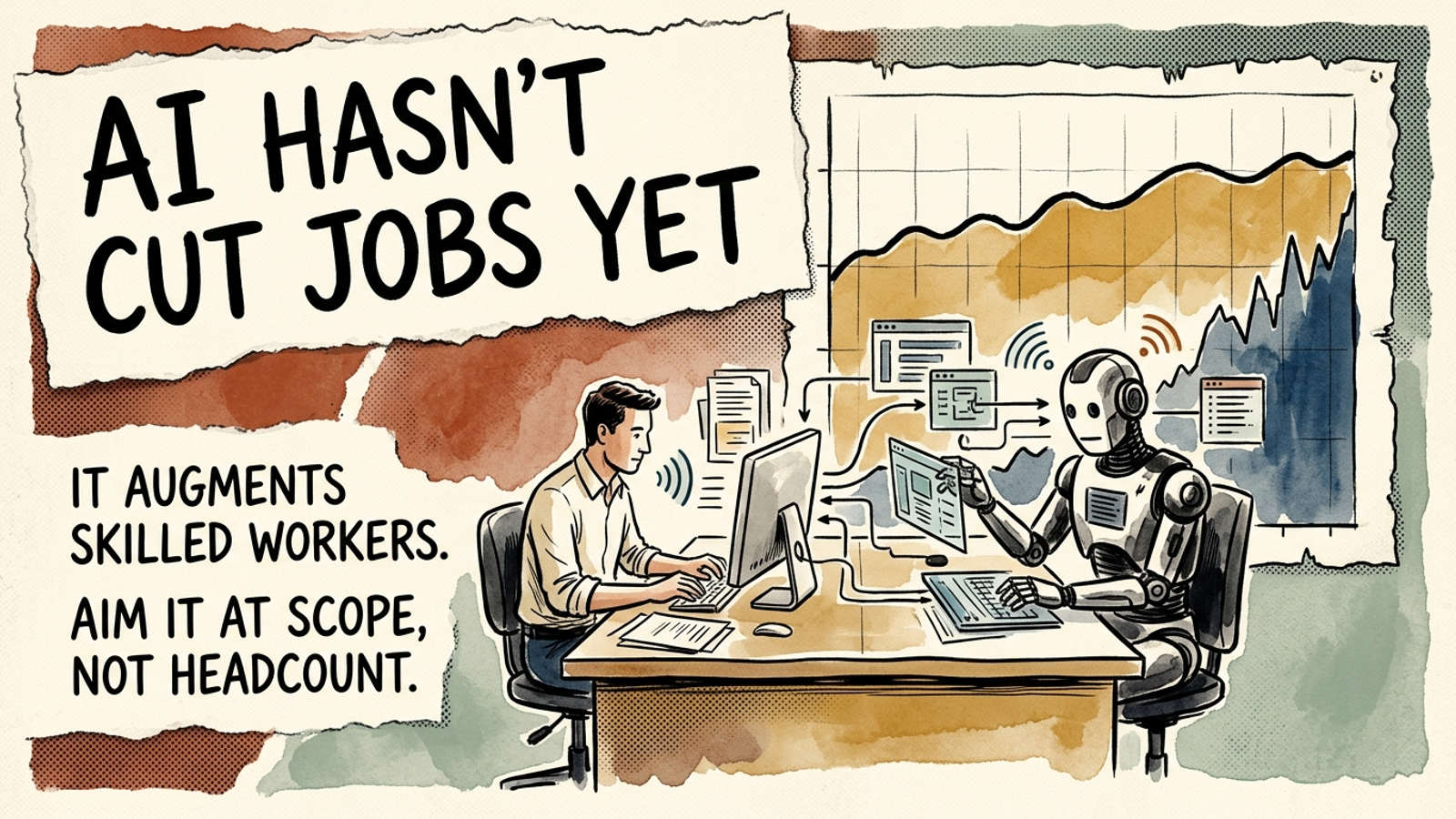
AI doesn't take the jobs — it commoditizes the parts of expertise you can train on, and the value moves to what's different: judgment, taste, and coordination. The more you automate, the more expert human work there is to do.
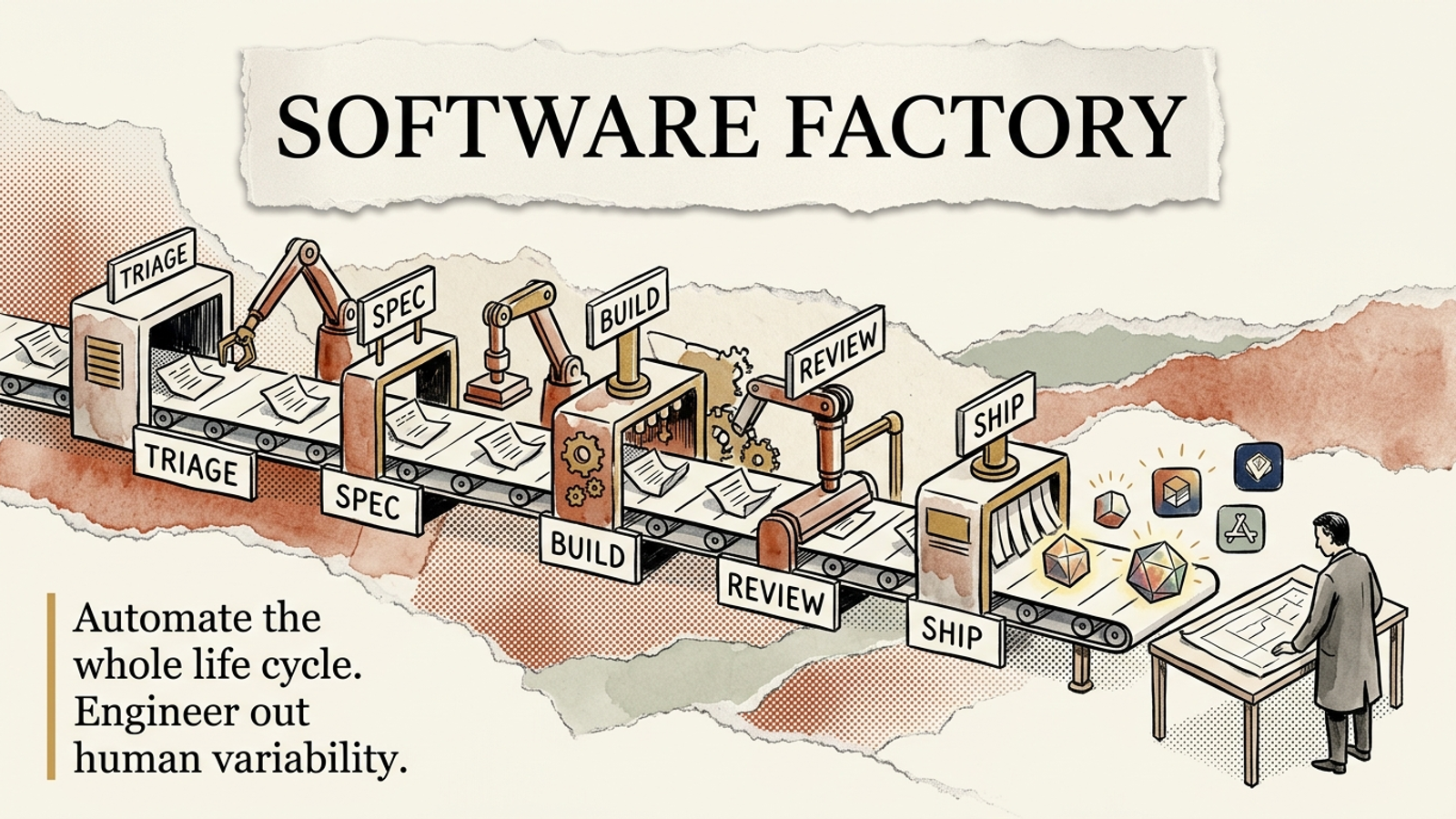
The AI Daily Brief reads through Every's Thesis Statements — 100 leaders writing on work after automation. The operating lesson: don't bolt an agent onto your old workflow. Invent the one that was never possible before.
Built on Nathaniel Whittemore's AI Daily Brief episode "The Future of AI and Work" and Every's Thesis Statements project.
More automation, more expert work
"Will AI take all our jobs?" is the boring question. The useful one: once AI absorbs the repeatable layer of work, what's left for humans — and where does the value go?
Dan Shipper's thesis sets the frame — AI commoditizes "the residue of human expertise," whatever is explicit enough to train on. When default model output gets cheap, demand shifts to what's different, and different is where human experts live. There's a practical reason it holds: models know work that has already been done; humans are alive to the specific customer, codebase, and conversation in front of them right now.
Someone still has to point the agent at the right thing, judge whether the output is good, and turn it into a real decision. Every runs a team of about 30 and hasn't replaced them with agents — because the further an agent gets from a human in charge of making it work, the worse it works.
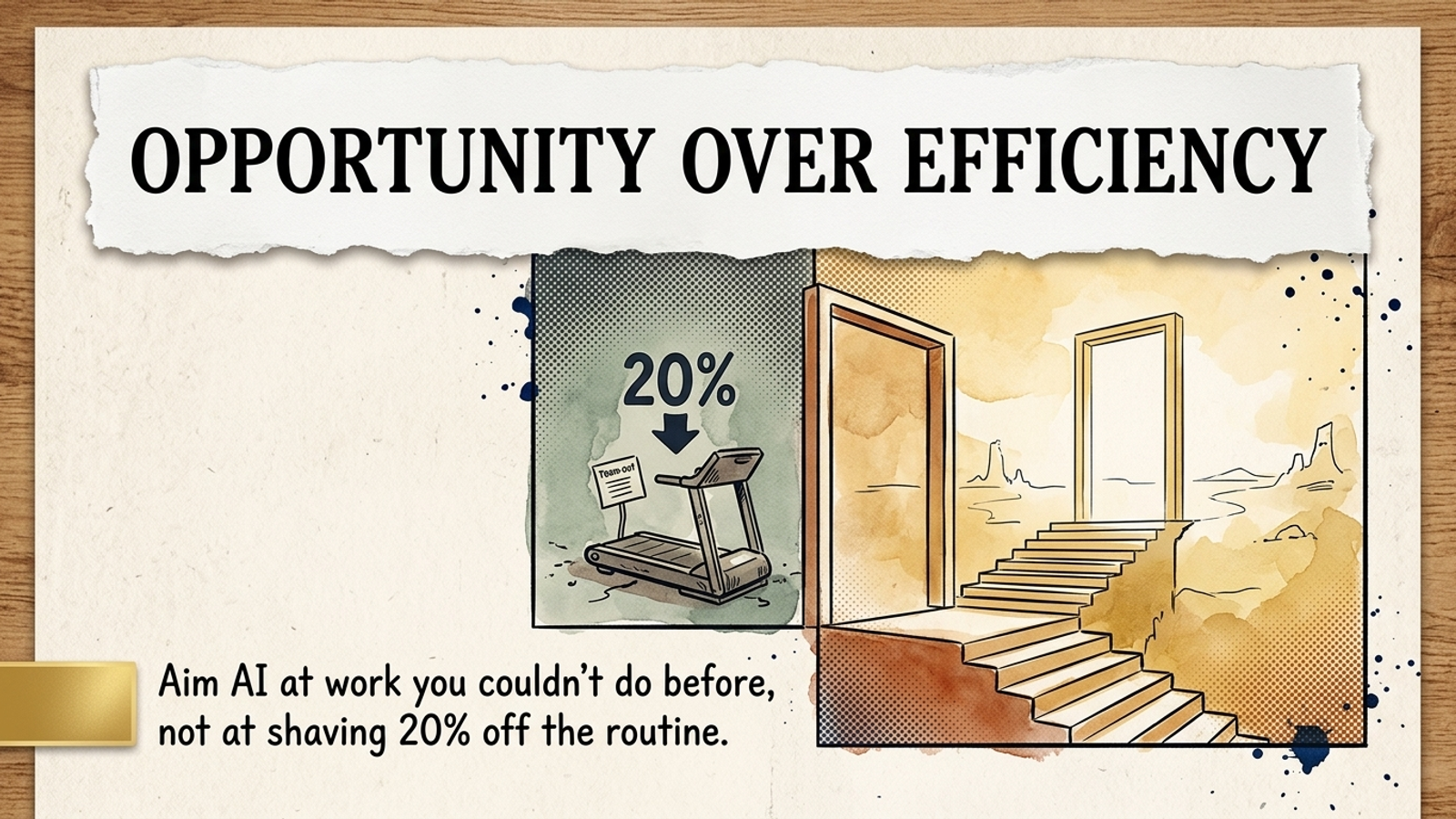
Efficiency AI is fine. Opportunity AI is the point
Sumit Singh's warning: "founders who AI existing workflows will lose." Bolting an agent onto yesterday's process is the skeuomorphic move — like the early mobile app that drew a trash-can icon instead of asking what a phone in everyone's pocket makes newly possible. Uber didn't digitize the dispatcher's desk.
The AI Daily Brief splits this in two. Efficiency AI does the same work faster and cheaper — a fine place to start. Opportunity AI asks where you can go that you couldn't before. The trap is that ROI gates quietly kill the second one: if every project must justify itself against last quarter's process, teams drift toward "the same old things, a little cheaper" and never find the bigger room.
The bottleneck is coordination, not the model
Once agents are in the mix, a new problem appears. As one thesis puts it, "the company with the best clock will beat the company with the best model." Agents operate in seconds, teams meet weekly, finance plans quarterly, leadership revisits strategy yearly — every layer living in a different present, on a different version of reality.
Tina He takes it further from the customer's side: agents are ruthless, rational buyers. An agent will cancel your $30,000 CRM at 2 a.m. because it delivered only $12,000 of value — no meeting, no negotiation. The winners build for machine-to-machine reality: headless infrastructure, and boring toll-road layers like compliance and routing that agents can't route around. As models converge, the edge stops being the model and becomes the system that connects decisions to outcomes.
What stays scarce
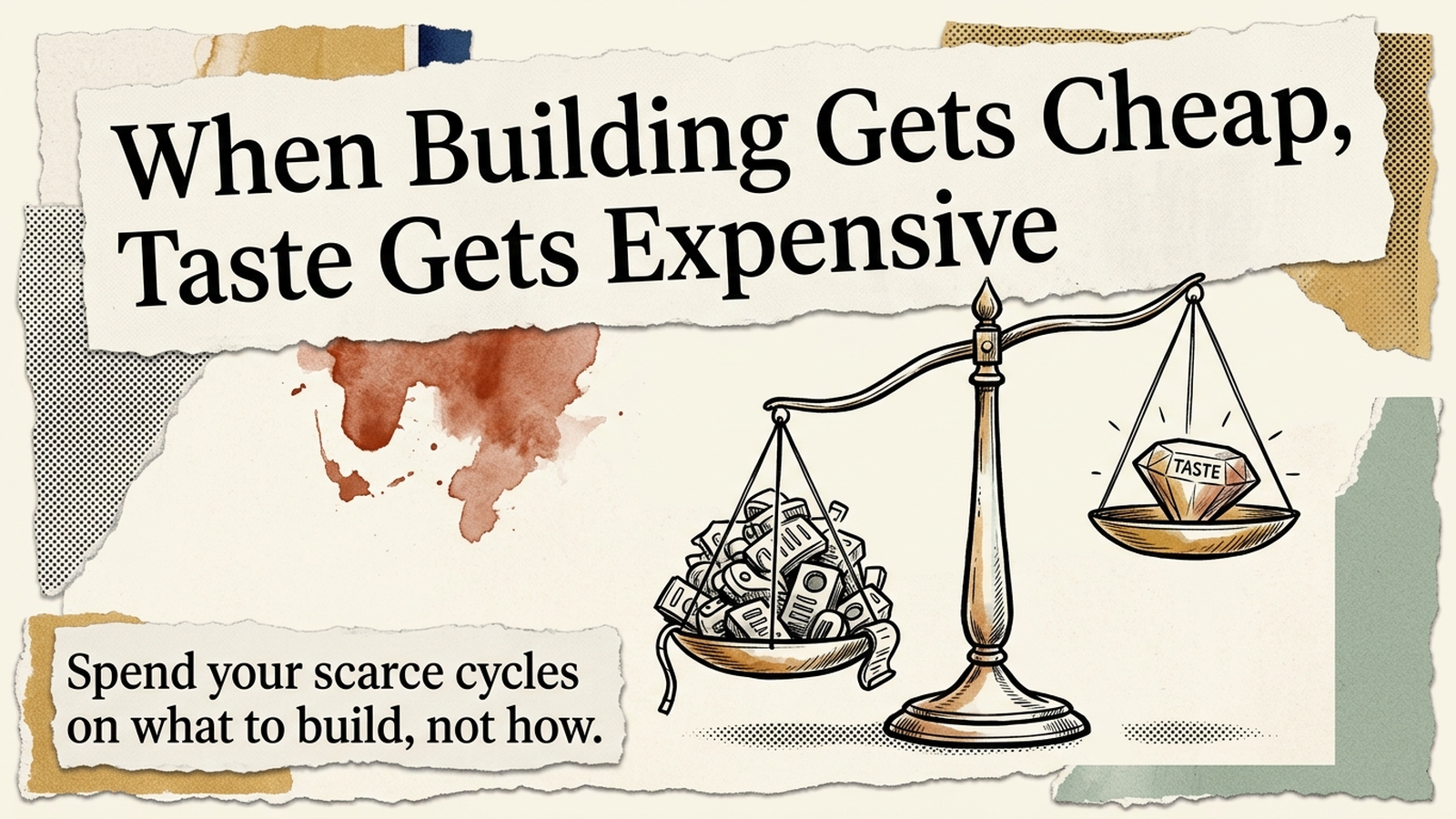
If knowledge is cheap, what's valuable? Joe Hudson's answer is "wisdom work" — discernment and judgment that can't be copy-pasted. Bethany Crystal's is "weirdness" — the quirks the optimized web trained out of us, now an advantage again. Sari Azout's is the sharpest.
AI can tell us what is probable, but it cannot tell us what is worth wanting.
Sari Azout, Sublime
That's the real handoff. Automation gives your attention back. The only question is whether you reinvest it in manufacturing more busywork — or in the squishy skills that decide which work was worth doing.