
TL;DR
The short version
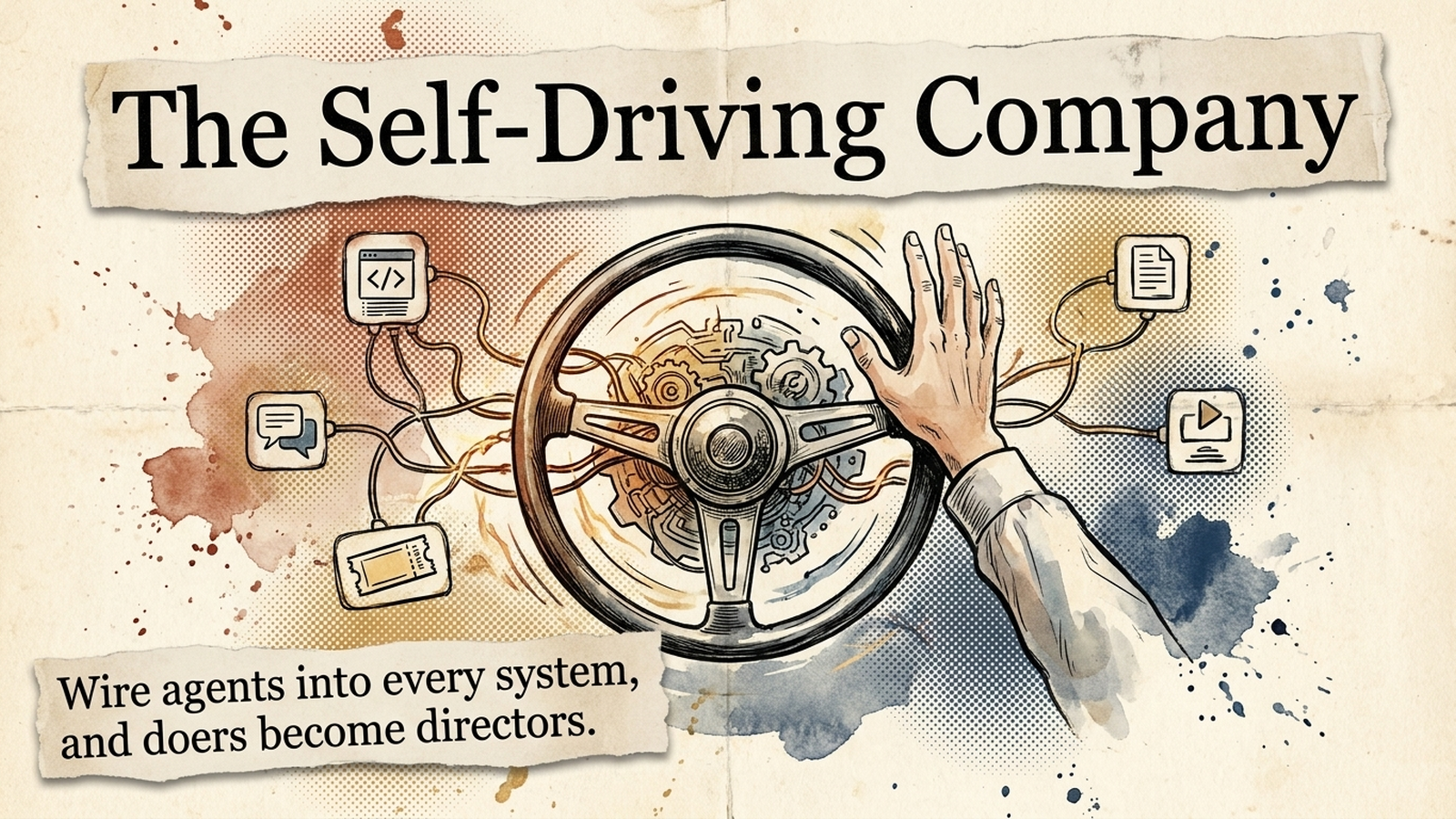
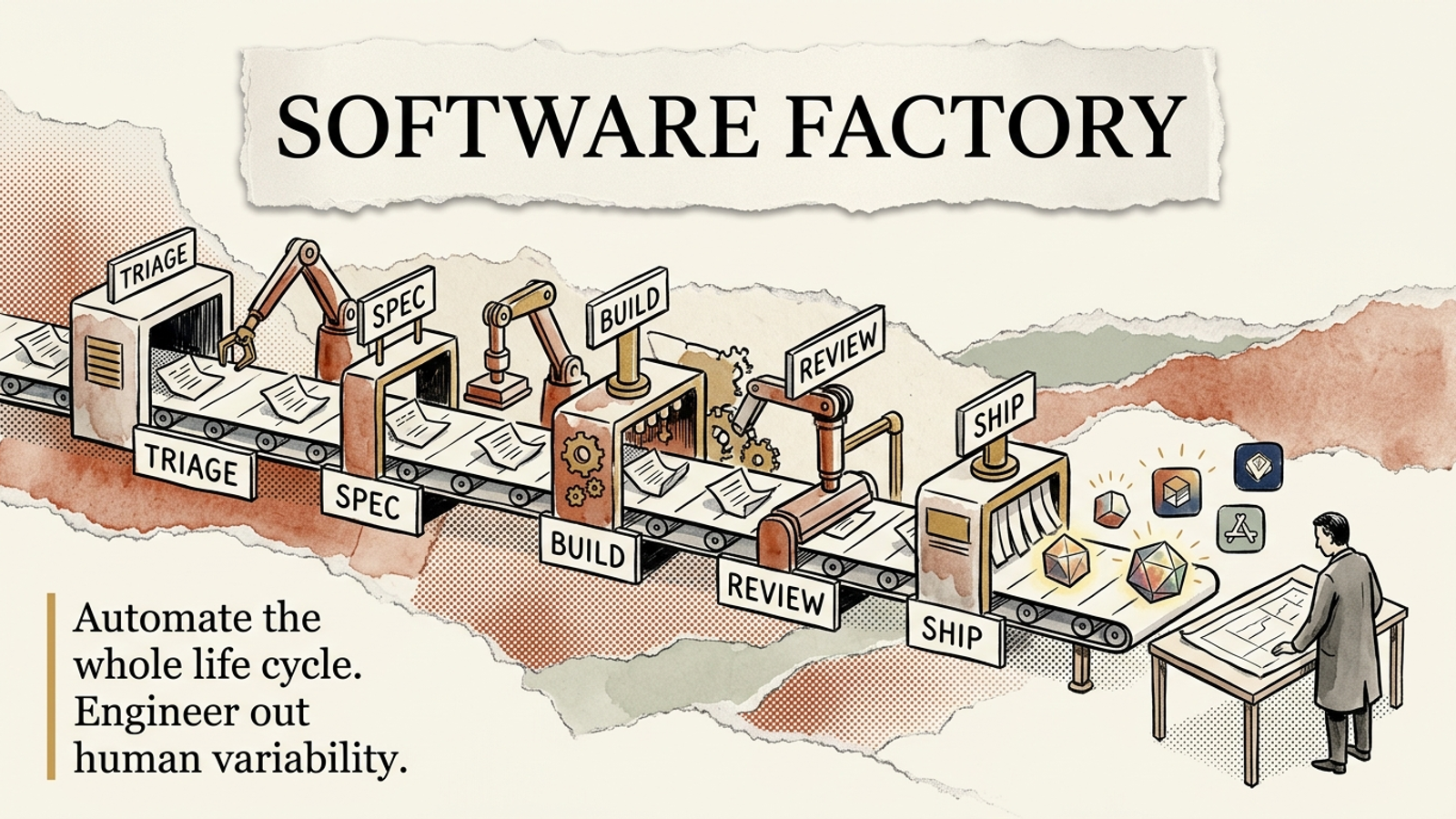
The software factory is the enterprise pattern where a forward-deployed team automates the entire software life cycle — triage, spec, implement, review, ship, monitor — as one governed pipeline. Engineers the system so human variability is minimized rather than maximized.
Ramp CPO Geoff Charles names the operating model: identify → define → build → review → test → coordinate → improve, with successive agents (Glass, Inspect, Review Buddy, Testo, Gadget) as each prior step accelerates. Warp's Wilson is the product noun for the same shape. Treat Ramp's self-reported coverage metrics as directional only.
Built on Nathaniel Whittemore / The AI Daily Brief, Zach Lloyd / How I AI, and Geoff Charles / Lenny's Podcast (Lenny & Friends Summit).
The unit of work moved from the task to the life cycle
The pattern isn't "agents write code." It's automating triage, spec, implement, review, ship, and monitor as a single pipeline, with forward-deployed teams standing it up inside the enterprise against its real systems, data, and constraints.
The design goal inverts the usual framing. A factory treats inconsistent human judgment as the thing to engineer out — because variability carries cost, governance, and security risk in a regulated enterprise. The human moves to the outer loop: direction, evals, exception-handling. The inner loop is standardized. This is the opposite of "give everyone a copilot."
Hold a live counter-read, though. Nathaniel Whittemore, reading Every's Thesis Statements, calls the AI-era build a software company, not a factory: a factory's hard problem is defect reduction, but a company's is keeping humans and agents aligned to a single vision — "closer to Warhol's Factory than Ford's." It doesn't negate the pipeline; it names its limit. Standardizing the inner loop removes variability, but the residual human work is coherence — taste and direction — which isn't a variance problem. Engineer the inner loop like a factory; run the outer loop like a studio.
Structure is the point
The factory is the enterprise answer to the year's meta-lesson — that raw autonomy without a system around it degrades into noise.
Last year was the year of let the agents rip. This year was the year of realizing that autonomy without structure creates as much slop as leverage.
Tyler Brown
The pipeline, evals, and permissions are what convert agent autonomy into reliable output at scale. The factory is a harness at organizational scale: the pipeline, not the model, is the differentiator.
A coding pattern that generalizes to every function
Marketing, sales, finance, and support each have a life cycle — intake, draft, review, ship, monitor — that the same factory shape automates. The software team is just the first to build it because it lives closest to the models.
Warp Factories: the noun, as code
Lloyd doesn't love the "factory" label — Marty Cagan reportedly hates it too — but uses it for what the market standardized on: harnessing agents into an organized, cloud-centralized SDLC rather than laptop silos.
What is a software factory? For us at least, it's an actual noun. It's like a product concept where it consists of a bunch of repos, a bunch of like MCP servers, like a bunch of configuration and then a bunch of agents… and it's all defined in code.
Zach Lloyd, How I AI
From the builder side: tagging Wilson in a public Slack channel triggers triage, Linear issue creation, implementation, PR, and computer-use verification (often a screen recording). Triggers can also auto-ingest from Sentry or start in Linear/GitHub. Public + cloud is the shift — multiple people watch/steer the thread; managers get a centralized control plane.
Ramp: bottleneck hunting across the whole loop
Charles frames software delivery as an F1 race: the driver is only a fraction of outcomes; the system around them is the limit. Pit crews cut tire changes from roughly a minute to under two seconds by removing bottlenecks — not by working harder. AI removes the coding bottleneck and immediately creates the next one: specs, reviews, QA, coordination, human attention.
AI simply removes the bottleneck but moves it.
Geoff Charles, Lenny's Podcast
Ramp's iterated internal agents: customer-insight over Gong/Zendesk, Glass for definition with org context, Inspect for coding, Review Buddy for PRs, Testo for browser QA, Gadget for org Q&A and launches. Self-reported adoption numbers (Inspect on most PRs, Review Buddy auto-handling the bulk, Testo bug yield, Gadget answering most PM questions) are directional operator claims — not audited benchmarks.
We need to obsess a little bit less about the product that we're delivering and a little bit more about the factory that helps us build products faster.
Geoff Charles
Constraints are not bottlenecks: pick one dimension to be world-class. And agents only scale if the organization is legible to them — roadmaps, specs, tickets, and customer context as formal records agents can query and write back to.
Don't become the factory — Saarinen's cultural cut
Same Lenny summit as Warp/Ramp factory talks, opposite cultural warning: obsessing over software factories can scale output while specializing roles until teams stop knowing what they're doing.
You can build the software factories […] but […] Don't become a software factory.
Karri Saarinen, Lenny's Podcast
Hold both: engineer the inner loop like a factory (pipeline framing above), and protect the outer-loop learning that Saarinen calls the real product. Primary home for the context thesis is Context as the Moat.