TL;DR
The short version
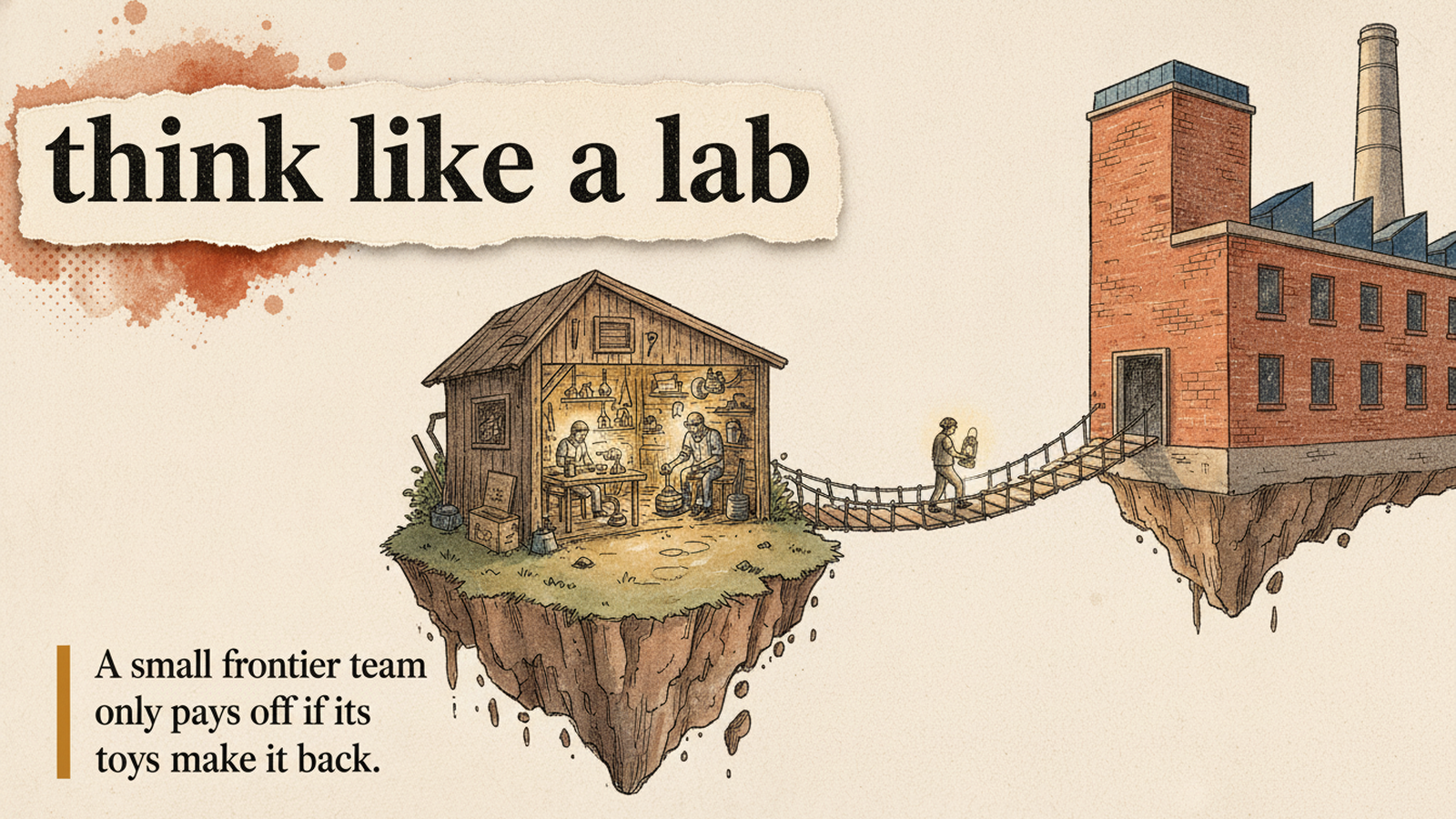
A labs team is a tiny, independent group whose job is to live at the AI frontier: try every new model, notice what just became possible, kill most of it fast, and carry the few winners back into the main business.
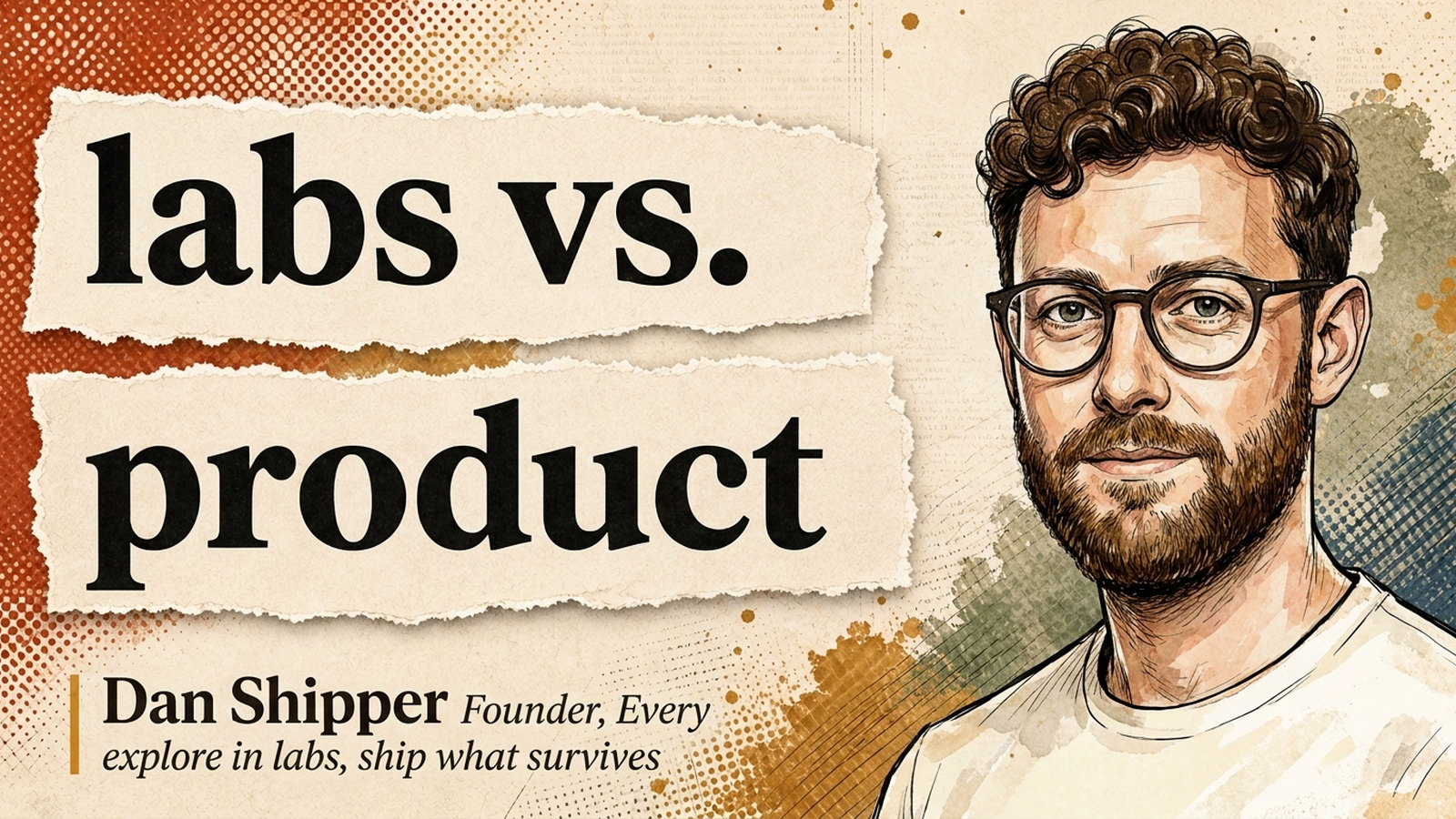
Exploring and shipping pull in opposite directions, so you split them. Dan Shipper makes the case for the split; Josh Woodward, who runs Google Labs, supplies the mechanics and the warning. The ideas aren't the hard part. The bridge back to the core is.
Built on Josh Woodward (VP, Google Labs) with Lenny Rachitsky on Lenny's Podcast, 11 Oct 2026, and Dan Shipper (Every) at the Lenny & Friends Summit, published 24 Sep 2026. Team sizes, cadences and counts are their own descriptions of how they work.
Split exploring from shipping
Ask the same people to map a moving frontier and ship a coherent roadmap and you pull them in opposite directions. Exploring is divergent and mostly disposable. Shipping is convergent and customer-facing. Shipper's rule of thumb: a lab throws away about 90% of what it makes, and product should expect to adopt about 10% of it.
Keep it small. Shipper wants a "two slice team," one or two people at most. Woodward says new Google Labs teams used to be five to seven people and are now two or three, maybe four. AI makes a one-person lab a real option.
Where the ideas come from
Not from the calendar. Woodward says good ideas "very rarely" come from design sprints. They come from small groups who can't stop hacking on something, often over a weekend. "You can't microwave good ideas."
What Labs does schedule is attention. It keeps a running list of what's almost possible, and when a capability crosses over, a team forms around it. It also keeps a doc of 82 predictions that start "we believe the future is…", expecting most of them to be wrong.
Judge by eyes, kill fast, plan short
Early product-market fit is a human signal. Woodward reads it in whether people's eyes light up and they lean in, not in DAU over MAU or D7 retention. Fall in love with the problem, not the product: it usually takes three to five pivots.
The team usually knows before the leader knows.
Josh Woodward, Google Labs
So make room for the uncomfortable call. Woodward praised a Gemini PM who recommended not launching a feature after early tests. Shipper adds a way to make the dead 90% still pay: turn it into public writing, early-adopter programmes and capability briefings for the product team.
Plans get shorter too. Labs plans on a rolling six months, about the gap between model releases, and the best teams hit a meaningful milestone in 50 to 100 days.
Hire for unlearning rate
Woodward's hiring signal is how fast someone drops what they learned when a test says otherwise. Alongside it he looks for "explosive endurance," going hard over years in named seasons, and for how fast a person builds trust, because more products mean more ad-hoc teams.
Everyone builds now, including strategy, ops, BD and marketing people. But he calls "everybody's a builder" overhyped: keep your major.
The bridge back is where labs die
Woodward's reading of history is blunt: a big-company lab usually fizzles after three or four years, or the company can't commercialise what it makes. That's his read of the books, not a study. His three rules for avoiding it:
- Give it independence. It can't be nested under an existing business unit; it reports to the CEO or sits at enough distance.
- Be clear which game it plays: graduate features into existing products, or invent new categories.
- Use it to make "good trouble" in how the company works, not just in products. Labs piloted Google's builder job ladder.
Shipper's version is a pipeline with promotion gates: lab, then internal dogfooding, then early customers, then the main product. Something moves up when people use it and come back, when it's about ten times better than what exists, and when it's affordable at scale.