TL;DR
The short version
The people paying for consumer AI are mostly power users buying tools to build, create and work, and a few of them spend a lot. More than 95% of Americans pay nothing. Reaching them will take different products and different business models, not a better subscription pitch.
On The AI Daily Brief, Nathaniel Whittemore uses a16z's seventh Top 100 Gen AI Consumer Apps list to ask whether the households not paying for AI are an opportunity to come or will never pay at all. His answer is a bit of both, and the split is the useful part.
Built on Nathaniel Whittemore's 7 October episode of The AI Daily Brief and Olivia Moore's a16z report, with household figures checked against PNC Research.
The spending data shows a power law
For the first time, a16z's list ranks apps by what US consumers actually spend on their cards, using YipitData. That is panel data, not company revenue, and it misses anything an employer pays for.
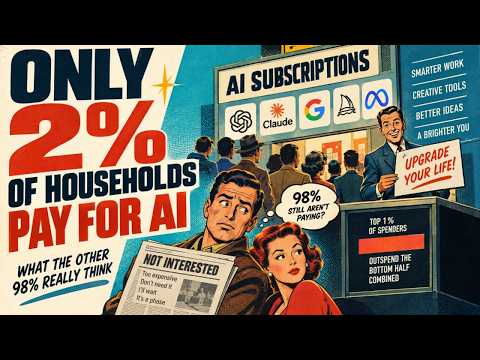
The shape is extreme. The top 1% of AI payers account for 19.5% of observed spending, more than the bottom half of payers combined (16.6%). They average $903 a month. The median payer spends $25, and that figure has barely moved.
a16z Top 100 Gen AI Consumer Apps, 7th edition (YipitData US consumer-card panel)
Those top spenders are prosumers. They over-index on n8n, fal, Manus, Higgsfield, Figma and HeyGen: tools to automate, build and create. a16z's summary is that consumer AI has found its first real market in "people who pay — often a lot — for tools that help them build, create, and get work done."
The "98% don't pay" number is already out of date
The episode's headline figure, 98% of US households not paying for AI, traces to bank card data: 2.2% of PNC's own households paid for a GenAI subscription in May 2026. That is one bank's customers, not a national sample.
a16z's newer Yipit panel puts the share at 4.5% of US consumers paying for ChatGPT, Gemini or Claude in August, up from 2.1% a year earlier. The direction holds. More than 95% still pay nothing. But the base is doubling, not frozen.
The fight is about utility, not access
The reaction Whittemore collected split cleanly. Optimists said it's early. Ruben Hassid pointed to how long cars, computers and smartphones took to reach half of Americans. Microsoft's Nicolas Bustamante said even paying friends use ChatGPT for "the same handful of basic things".
The critics went after the use cases. One X user took apart the flight check-in demo: it takes one tap, you would have to check the agent's work anyway, and most American adults didn't fly last year. The sharper point was about who is building:
What's happening is tech people routinely mistake their own unusually high travel, high email, high admin lifestyle for a universal human workload.
X user "Habibi Slap", read on The AI Daily Brief
Whittemore doesn't buy "people are too lazy". He does see a pattern. The people using AI assertively bring entrepreneurial energy to their work and lives. "They are, in short, high aspiration. And not everyone is."
Power users have no ceiling. Everyone else needs another model.
Low paid penetration doesn't sink the industry's financial case, for two reasons. First, there is no SaaS-style cap. "This is not SaaS where the upper bound is the most premium account that costs $100 or $200 a month," Whittemore says. Power users can spend thousands a month and still come out ahead.
Second, consumer AI doesn't have to be about productivity, and it doesn't have to be paid for by subscription. Suno ranks seventh on a16z's spending list, and Whittemore says much of its paid use is entertainment: people making ridiculous songs for family and friends.
Then there is advertising. ChatGPT ads launched in February and reached a $1 billion annualised run rate by the end of August. On 5 October OpenAI added visual ads alongside image generation, pitched at 1.2 billion weekly users.
a16z's own count shows how lopsided the market is. Of 44 AI-native products on its web list, 84% sell subscriptions and 14% run ads. Its white-space chart finds no AI app in the top 100 for streaming, marketplaces, social, travel, personal finance, jobs, real estate, gaming or dating. Those are the categories the last two internet eras were built on.
Where this leaves builders
Whittemore's closing caution cuts both ways. It is "too easy for early adopter types to say, 'We're so early'" when the numbers disappoint. It would also be a mistake to assume today's adoption is where consumer AI stays.
The practical split is clear. If your users build, create or sell, price for the power-user curve and expect a long tail of heavy spenders. If your users are everyone else, the product probably isn't a productivity subscription. It might be entertainment, ads or a cut of transactions an agent completes on their behalf.