TL;DR
The short version
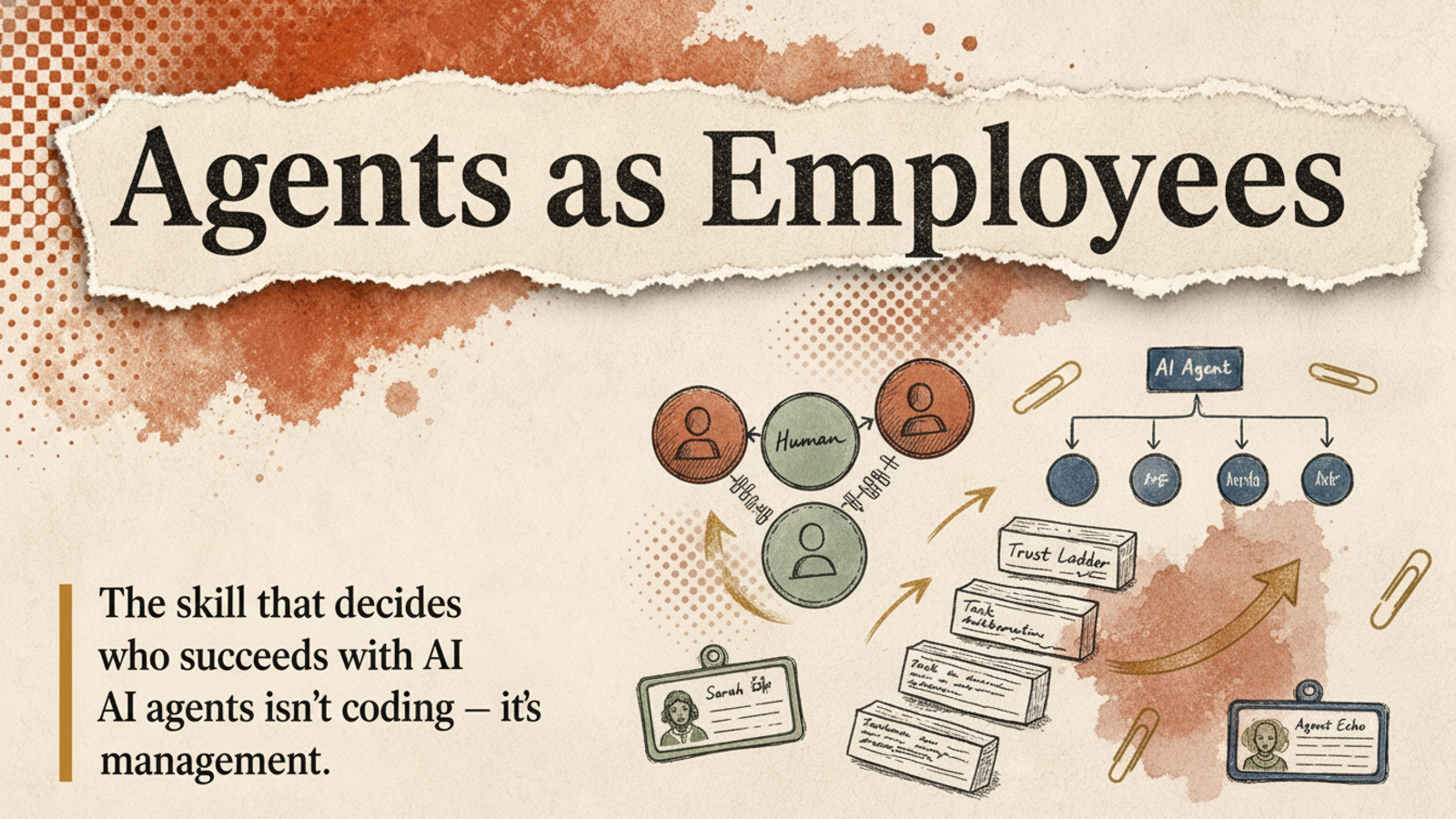
When agents are wired into every system a company runs, employees stop performing the steps and start setting the direction. Replit calls the result a self-driving company: people still choose the destination, but they don't drive every mile.
The eye-catching metrics matter less than the mental model. This is The AI Daily Brief unpacking Replit CEO Amjad Masad's post — the real claim is that AI is no longer a personal productivity tool but a change in the shape of the org itself.
Built on Nathaniel Whittemore's AI Daily Brief episode and the original Replit post by Amjad Masad and Scott Kennedy.
A self-driving company still has a driver
Replit reports that in six months, per-engineer code output roughly tripled while review times, reversions, and incidents held flat. Under the surface, agents now investigate production incidents, review pull requests, analyze business data, triage support tickets, and research sales accounts.
The name is doing real work. A self-driving car still has a passenger who picks the destination. A self-driving company still has people who decide which problems matter, make the hard trade-offs, and own the outcome. They just stop doing every step to get there.
People don't feel like they've been automated. They feel like they've been promoted.
Amjad Masad, Replit
Start where the work is verifiable
The obvious question is whether this only works for engineering-native companies. One lesson holds regardless: start with engineers — not because they're comfortable with the tech, but because their work has a clean pass/fail signal.
When code runs, it does something verifiably wrong or it doesn't. A bad marketing campaign might just be a word that hits the brand oddly — real, but hard for an agent to catch. That verifiability is why engineering self-drives first and fuzzier work follows. It's a sequencing rule, not a ceiling.
The prerequisite nobody markets
Here is the part the post breezes past. The unlock is not having an agent that can do things. It's having that agent wired into everything the company already runs — GitHub, GCP, Linear, Notion, Slack, Zendesk.
Without cross-org system access, there is no self-driving company. An agent with no reach is a chatbot. The productivity story is downstream of an integration story, and that drags security, permissions, and audit logging along with it. Most organizations that try this will stall here, not on the model.
Loops are the actual engine
The mechanism underneath everything is the loop: give an agent a goal, the systems and data to pursue it, and a way to check whether it's succeeding. Then let it run.
Loops stop being a team trick and start being the spine of a self-driving company at one moment — when the loop connects to live customer data, so the goals themselves update in real time. Replit's cleanest example is its AI team's continual-learning system: it reads user feedback, proposes improvements, and validates the wins with benchmarks and A/B tests. That, not the code volume, is the load-bearing claim.
Read the numbers with the incentive in view
The figures are striking. Every one is Replit's own internal metric — unpublished and externally uncheckable. Plausible, but self-reported.
Replit's own internal metrics — self-reported, not independently verified.
Two counterweights are worth holding. Lines of code correlate near zero with actual productivity, so more code is not more value. And a METR randomized trial found experienced developers were 19% slower with AI tools while believing they were faster. Replit is also selling the tooling it describes — the post is a case study and a pitch at once.