TL;DR
The short version
The job stopped being "pick the best model" and became "route each task to the cheapest model that clears the bar." Leaders still standardizing on one frontier model are paying premium rates for work open models now handle — and misreading spend charts as proof nobody wants the good stuff.
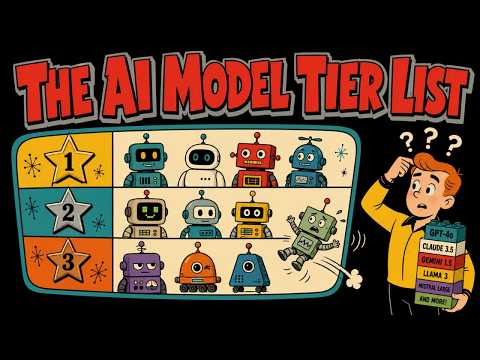
On The AI Daily Brief, Nathaniel Whittemore uses a viral model tier list as a hook for the real shift: the unit of analysis is the stack, not the model. Open-weight models are taking token volume while frontier models keep the economics.
Built on The AI Daily Brief episode "The AI Model Tier List" by Nathaniel Whittemore (2026-08-26).
The question changed under you
For two years the only question that mattered was who was in the lead — Anthropic, OpenAI, or Google, and whether the leader was better enough to justify switching. That question is now the wrong one.
Every serious model has crossed a capability threshold where it can do most of what you need. So the game moved to efficiency: which model for which task, and how you wire them together. Whittemore calls this the model stack, and it's showing up at individual, team, and enterprise levels at once.
If you run a team, this is a budgeting and architecture decision you now own — not a vendor preference you can defer.
The "best model" chart is measuring the wrong thing
A Financial Times chart made the rounds claiming Anthropic's newest model had drawn limited sales. The read was tidy: enterprises looked at the price and passed.
It was wrong, and the way it was wrong is the lesson. The data came from the Ramp AI Index, pulled from Ramp's own token and cost-management product — where users are already trying to minimize spend. Selection bias baked in. Worse, the newest model shipped with a 30-day data-retention requirement tied to safety checks; for many enterprises that single infosec fact is a hard no, regardless of price.
So a chart that looked like "the market rejected frontier intelligence" actually showed "cost-conscious users avoided a model with a data-retention flag." Make model decisions off headline spend charts and you'll draw the wrong conclusion about your own stack.
What AT&T actually did
The concrete version of doing this well is AT&T. Per VP of Data Science Mark Austin, the plan is to hold spend with OpenAI and Anthropic flat and shift volume to open models — which already serve 40% of employee AI queries, targeting 60–70%.
The mechanism is a router: a layer in front of many models that sends each request to the cheapest one meeting the quality bar. Frontier models still handle hard tasks like generating code; simpler jobs like summarizing a pull request go to an open model. Switching to open weights also let AT&T host inference in its own data centers, often cheaper than renting cloud compute.
AT&T via The Information / PYMNTS; Vercel AI Gateway (Cryptobriefing).
The pattern worth copying: not "open or frontier," but a graded stack where task difficulty decides the spend.
Volume goes open, value stays frontier
The market is splitting along the same line. On Vercel's AI gateway, closed-vs-open token share flipped in two months, from roughly 72/28 to 38/62 — yet open models captured under 9% of the spend while closed models took the majority of revenue.
Most likely end state is that closed frontier tokens are 60 to 90% of economic value, but only 15 to 25% of tokens.
Gavin Baker, investor
Open models win utilization; frontier models keep the economics because premium intelligence commands a premium. For a leader, both budgets are real: you run most volume cheaply and still pay up for the small slice of hard work where the best model earns its rate.
What to copy, and the boundary
The practical version:
- Stop standardizing on one model. Pick a frontier model for hard, high-stakes work and a strong open model for the routine bulk.
- Put a router in front of them so task difficulty, not habit, decides where a request goes.
- Track cost and quality per task type, the way AT&T did, so the trade is a number, not a vibe.
- Check retention and infosec terms before capability. A model you can't legally use is a zero.
The boundary: this is a working operator's frame drawn from tech-forward companies whose data leans that way, and most enterprises move slowly. A viral tier list is still the wrong tool — models now compete on capability, cost, token efficiency, and speed at once, and a single ranking flattens all of it. You're not ranking models. You're composing them.