TL;DR
The short version
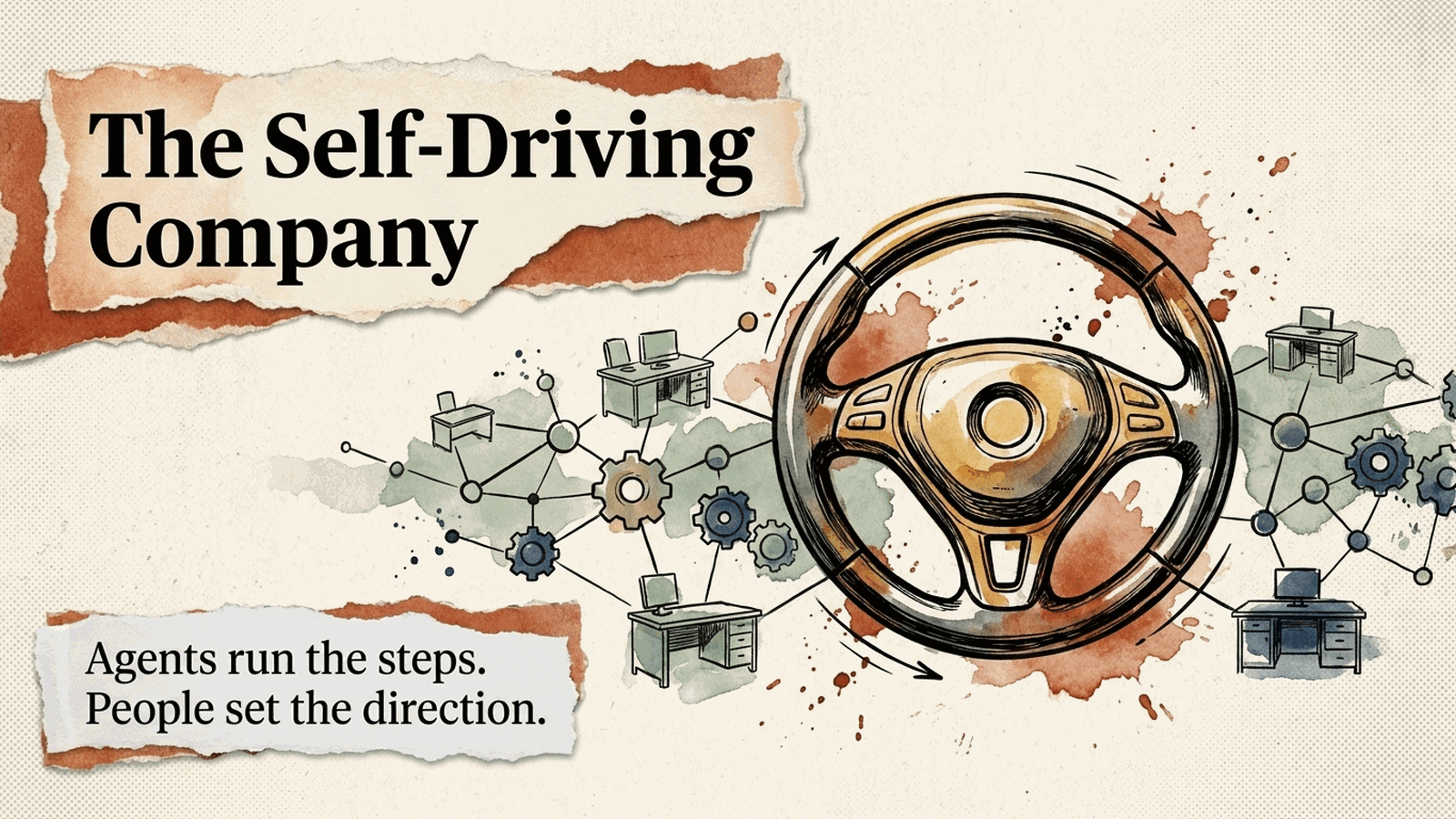
A self-driving company wires AI agents into every system it runs — code, review, incidents, data, support — so employees stop performing the steps and start setting the direction. The line that matters: it is not the zero-human company. Humans still choose which problems count, hold the taste, and own the outcome. "People don't feel like they've been automated. They feel like they've been promoted."
The prerequisite is unglamorous cross-org system integration; the engine is the agentic loop — goal, system access, verifiable endpoint. Replit's own write-up, read and unpacked by Nathaniel Whittemore, reports tripled per-engineer output with quality flat — every figure internal and self-reported.
Built from The AI Daily Brief's reading of Replit CEO Amjad Masad's essay "The Self-Driving Company." Metrics are Replit's own internal, unaudited numbers.
Doers become directors
The shift is not an individual productivity tool. It is a structural redesign of how work flows: humans still pick the destination — which problems matter, what good looks like, who is accountable — they just stop performing every step to get there. The employees who thrive are the ones who think in outcomes and set direction, not the ones who were fastest at the steps.
People don't feel like they've been automated. They feel like they've been promoted.
Amjad Masad, Replit
That is the whole distance between this and the zero-human company. The endpoint here is a redirected human, not an absent one. If your version of the story ends with nobody in the room, you have described a different, more speculative thing.
Integration is the whole prerequisite
The unlock is not "an agent that does stuff." It is an agent wired into GitHub, GCP, Linear, Notion, Slack, Zendesk — the systems that actually run the company. Without that access there is nothing for the agent to drive.
This is why engineering self-drives first, and not only because engineers are comfortable with the tools. Software has a machine-checkable right and wrong — a bug fails visibly, tests pass or they don't, an incident resolves or it doesn't. Fuzzier work like marketing lacks that signal, so it self-drives later. Autonomy scales exactly as far as the task has a verifiable endpoint.
Loops are the engine
The pattern that matters is a loop: goal, then the systems and data to pursue it, then criteria to check whether it is succeeding — run on repeat with minimal human steps. Full self-driving arrives when those loops plug into live customer data, so the goals themselves evolve in real time.
Replit's clearest example is its self-improving Agent: a continual-learning loop that reads user feedback, proposes changes, and validates them with benchmarks and A/B tests. "Continual learning" here means a product loop closed by evals — the human-set benchmark is the guardrail — not model weights rewriting themselves online.
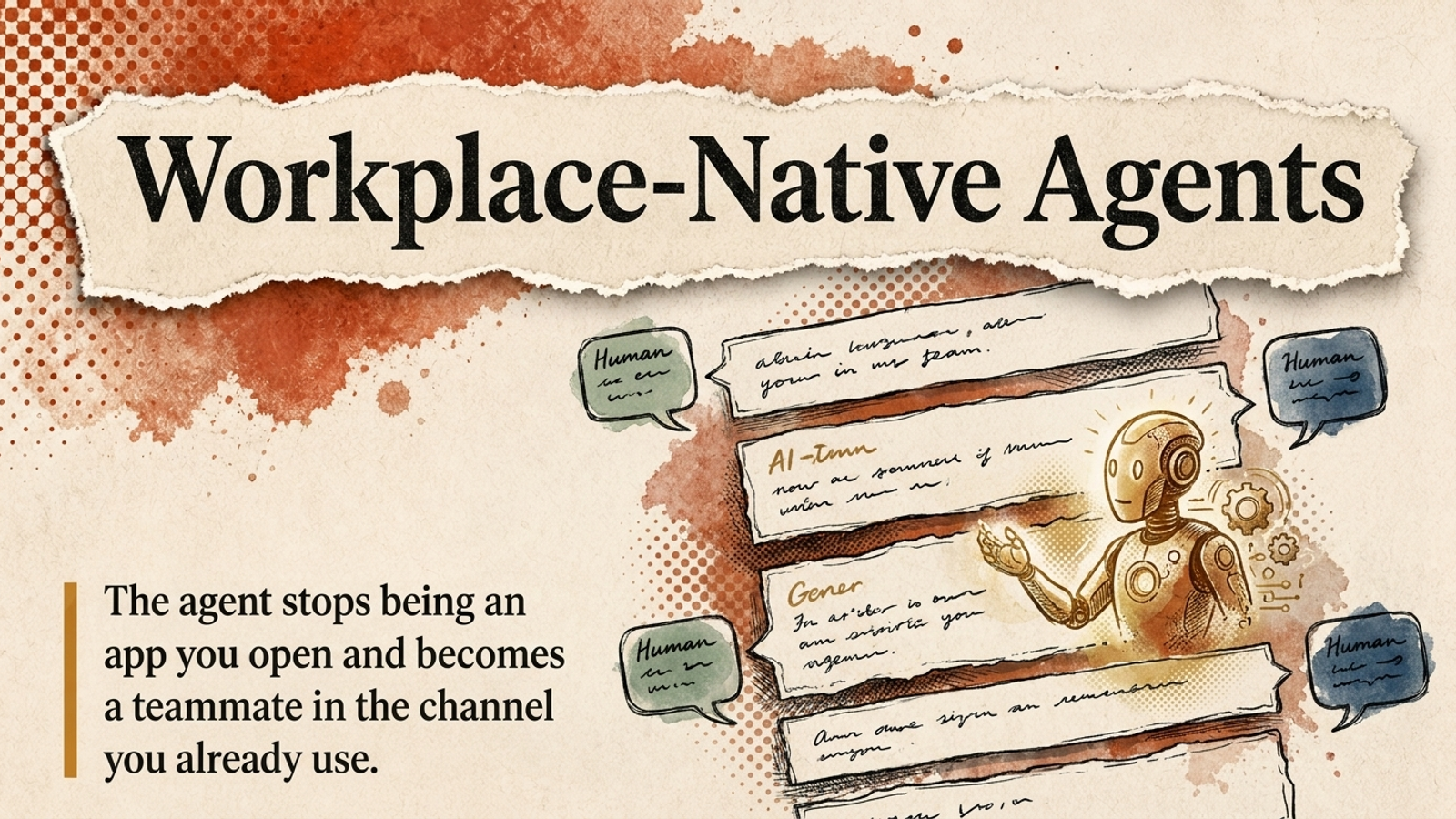
Adoption followed the same show-don't-tell logic. Replit spread agent use by making engineers' agent interactions visible in Slack; other teams opted in after watching it work. Pull, not push. And self-driving buys new problems, not no problems — more code created a review bottleneck they then solved with agent-assisted review. You trade your old constraints for better ones.
The company as a stack of loops
Anish Acharya (a16z) gives the model its org chart. Agents are just models in a loop with tools and memory, and company-building becomes a cascade of them — a loop per person, per function, per business unit, up to loops running large parts of the company. The general manager's job becomes optimizing the loop of loops.
The human floor is the same one this concept defends. A loop climbs to a local maximum and plateaus, so people stay for the exceptions and the leap to the next hill.
The loop will help you climb to the local maxima, but then it plateaus. And you need somebody to actually help you land at the base of the next hill.
Anish Acharya, a16z
The reassurance against a headcount-zero reading is economic, not sentimental: most jobs aren't intelligence-bound — a data center of PhDs wouldn't dominate FedEx or Domino's — and so far AI expands roadmaps rather than cutting them. As one executive put it to Acharya, "two years of roadmap happens in three months." Read the surrounding optimism as a venture stance; the loops-per-function operating model is the part that transfers.
Read the numbers with the incentive in view
Every figure below is Replit's own internal, unpublished metric — plausible, but externally uncheckable, and Replit sells the tooling it is describing.
Replit, "The Self-Driving Company" — internal metrics, unaudited
Independent research cuts the other way. The METR randomized trial (early 2025, 16 experienced developers, 246 real tasks) found AI tools made developers about 19% slower while they believed they were roughly 20% faster. Lines of code correlate near-zero with actual productivity. So read the shape — a redesign of how work flows — not the multipliers. The load-bearing question is whether the loops-plus-live-data pattern generalizes past software, where a verifiable endpoint is harder to draw.