TL;DR
The short version
The US government just decided which ~100 organizations get Anthropic's Mythos back and which trusted partners get OpenAI's GPT-5.6. The models will probably return for everyone soon. The precedent — that frontier access is granted, not bought — is the part that won't.
For operators, the lesson is concrete: any capability a letter can switch off is a dependency. Coinbase already responded by defaulting to cheaper open-weight models and halving its AI bill. The move is to decouple from any single frontier vendor before you're forced to. Built on The AI Daily Brief's 2026-06-29 episode.
Source: The AI Daily Brief by Nathaniel Whittemore. Reporting on the Mythos restoration and GPT-5.6 corroborated by NBC News, OpenAI, and The Information.
The relief is hiding the real news
On a Friday, Commerce Secretary Howard Lutnick let Anthropic re-release its cybersecurity model, Mythos 5, to about 100 vetted US organizations. The same weekend, OpenAI previewed GPT-5.6 — its Sol, Terra, and Luna tiers — but only to a small group of trusted partners, also at the government's request (NBC News; OpenAI).
The instinct is to read this as good news. The models are coming back. Be patient.
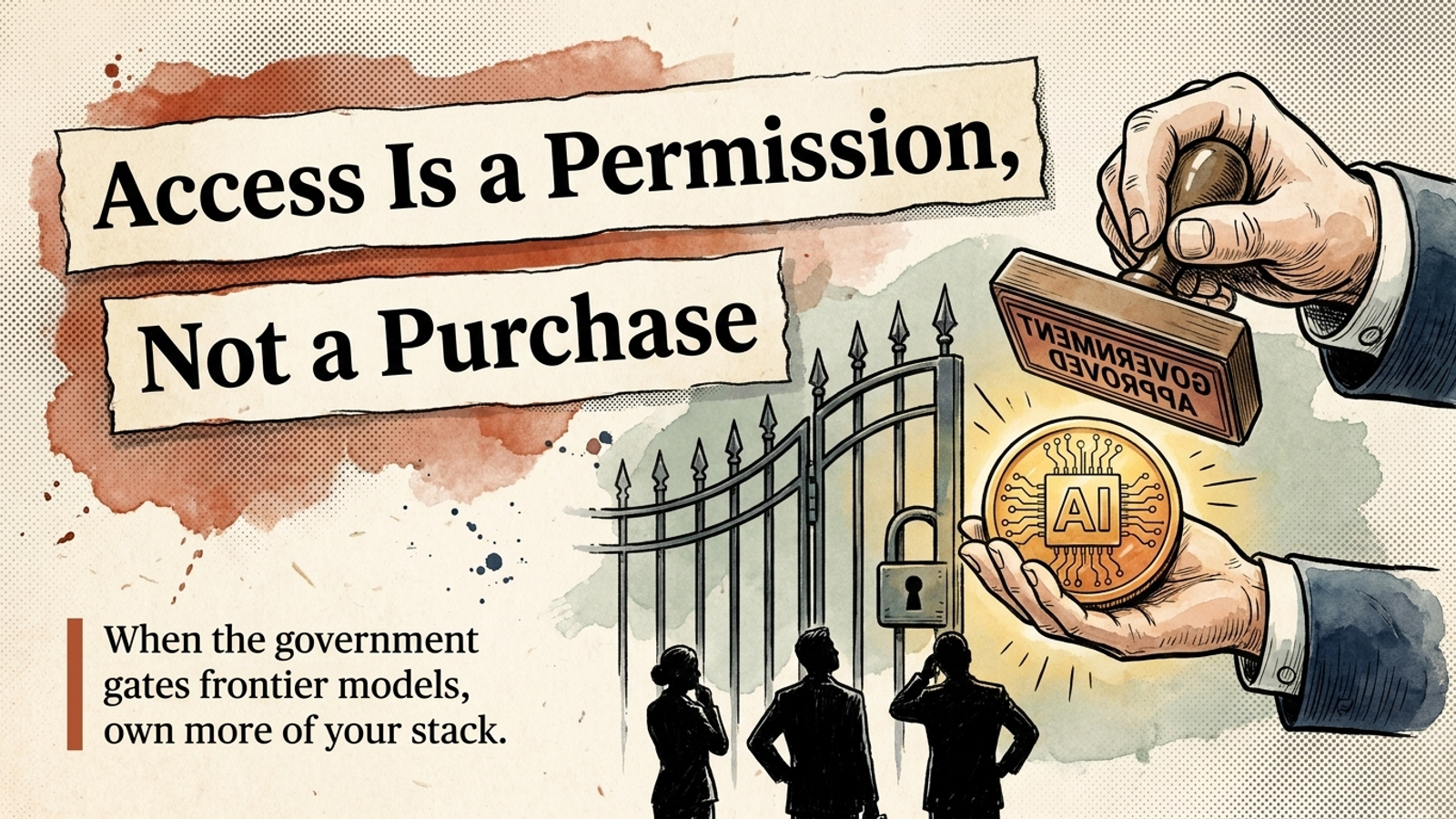
That instinct misses what changed. Lutnick's letter restores access while reserving "the right to reevaluate and adjust the scope of license requirements." There is no law behind it, no executive order, no published standard or appeals process. Frontier models are now subject to a licensing regime that exists entirely at one official's discretion. The models returning doesn't undo that — it confirms it.
Our new AI policy is that the White House decides ad hoc for whatever reasons it likes who does and does not get access to frontier intelligence.
Zvi Mowshowitz, quoted on The AI Daily Brief
"Coming back" doesn't mean "coming back to you"
A licensing regime sorts people into two groups: the listed and everyone else.
Roughly 100 organizations got Mythos back, many of them Fortune 500 firms inside Anthropic's Project Glasswing. GPT-5.6 went to a partner list shared with the administration in advance. If your company isn't on a list, the capability that existed last week is now something you apply for.
Forecasters are probably right that broad release follows within weeks — the commercial pressure is too strong to hold. But the danger was never the week-long delay. It's a year from now, when a review that took days takes six months because a red team argued a model could be jailbroken in some novel way.
The pressure that breaks the wall is cost — and it's already moving
Here's the part leaders can act on today. While the policy debate played out, Coinbase quietly rewired its AI stack. It set its default model to open-weight Chinese models — GLM-5.2 and Kimi 2.7 — and routed engineers to them through an internal gateway. The result: AI spend cut roughly in half while token usage kept growing (Analytics India Mag).
GLM-5.2 runs around $1.40 per million tokens against $5 for a US frontier model. And it's no longer a toy: reports have it matching Mythos on some cybersecurity bug-finding, though analysts call that framing overstated (The Information; Zvi Mowshowitz).
NBC News; Analytics India Mag
The strategic bind writes itself. The US gates frontier access to keep an edge over China. Every gate also makes the cheaper, ungated, open-weight alternative more attractive — to your own engineers, and to every buyer choosing a default AI stack.
What to copy
Three moves, none of which require predicting the policy:
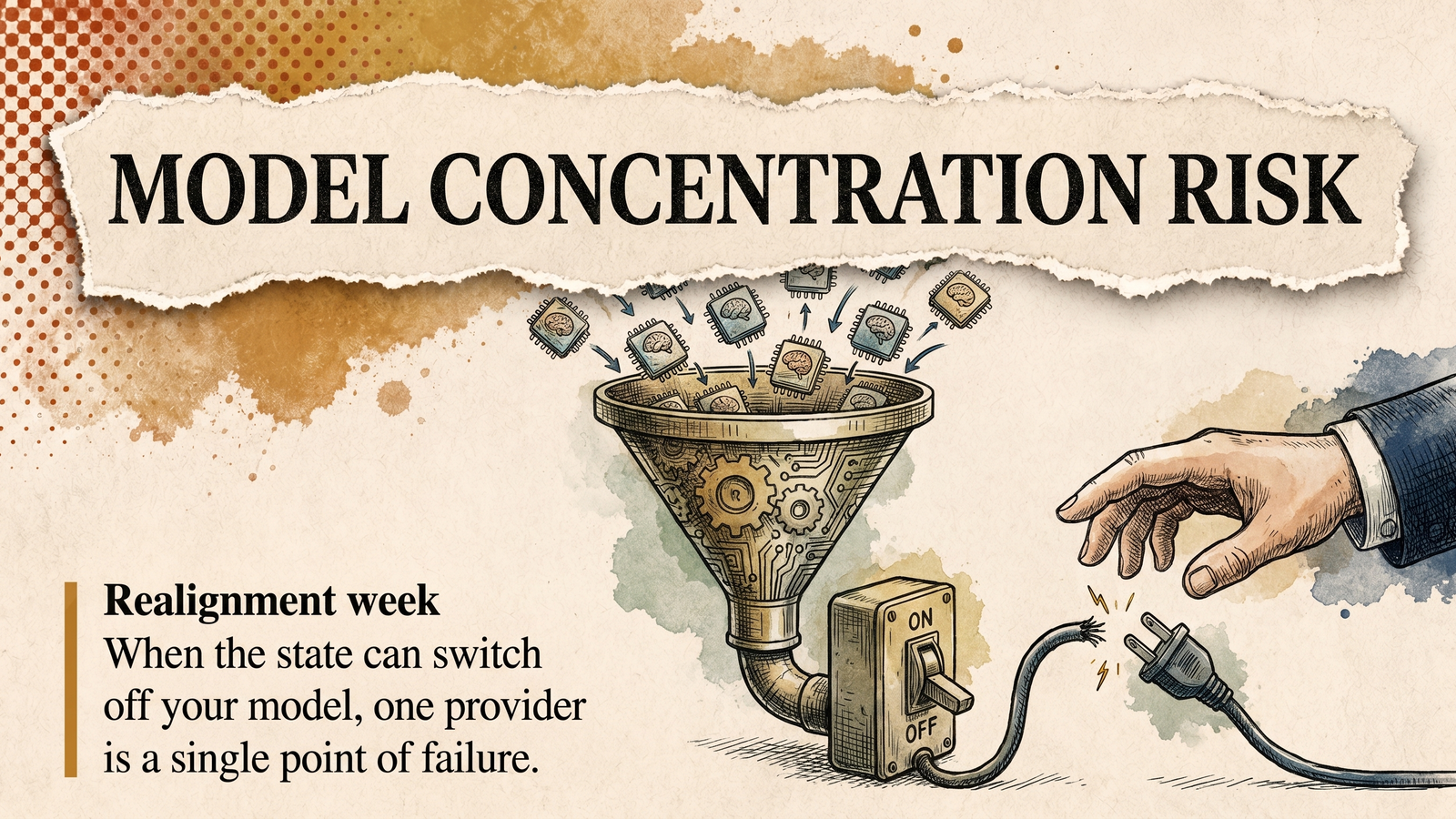
- Decouple from any single frontier vendor. Route through a gateway so model choice is a config change, not a rewrite — that abstraction is why Coinbase could switch defaults overnight.
- Make the cheap default the good default. Most work doesn't need the flagship; Coinbase found 91% of its engineers never hit a usage cap. Reserve frontier calls for the tasks that actually need them.
- Treat frontier access as a privilege you might lose. If your roadmap assumes uninterrupted access to a specific model, build the fallback before you need it.
The public fight looks like it's about which models get released. It isn't. It's about who decides — and from here on, whoever holds that power gets better at keeping it.