TL;DR
The short version
More capable models don't create value on their own. The people who thrive with AI point it at work that was impossible before, not at work they could already do — and the organizations that win build the conditions for that instead of waiting for it to happen.
Riffing on David Brooks' Atlantic essay, Nathaniel Whittemore argues the differentiator is your relationship to mental effort. But where Brooks is fatalistic, the operator's move is to redefine the 'AI champion' as someone who shows what's newly possible, and to automate the workflow, not the task.
Built on The AI Daily Brief episode 'How to Help People Thrive with AI' (Nathaniel Whittemore), which reads from David Brooks' Atlantic essay and Uber CTO Praveen Neppalli Naga's 'agentic pods' thread.
Enablement, not models, is the bottleneck
The week's story was models, models, models. Whittemore's counter was blunt: all the models in the world won't help if people aren't supported in learning to use them.
The numbers back him up. In one industry survey, 69% of organizations had taken some action on AI agents — but only 16% of workers actually used an agentic tool, and fewer than one in ten could define an AI agent in their own words. The gap isn't capability. It's enablement. (That survey came from an episode sponsor, so read it as directional, not gospel.)
AI is making work more intense, not lighter
The comforting story was that AI would hand us free time. The research points the other way. Brooks cites work-tracking data showing that when people adopted AI, their days got more crowded: messaging time more than doubled, business-software use climbed, and focused, uninterrupted work actually fell. People don't bank the time AI saves. They spend it taking on more.
Whittemore has a name for the trap: the infinite backlog. Once you can duplicate yourself through agents, downtime starts to feel illegitimate — agents don't sleep or take weekends. The real limit just moved, from how much you can do to how much planning and oversight you can support.
Brooks says only the marathoners survive. He's half right.
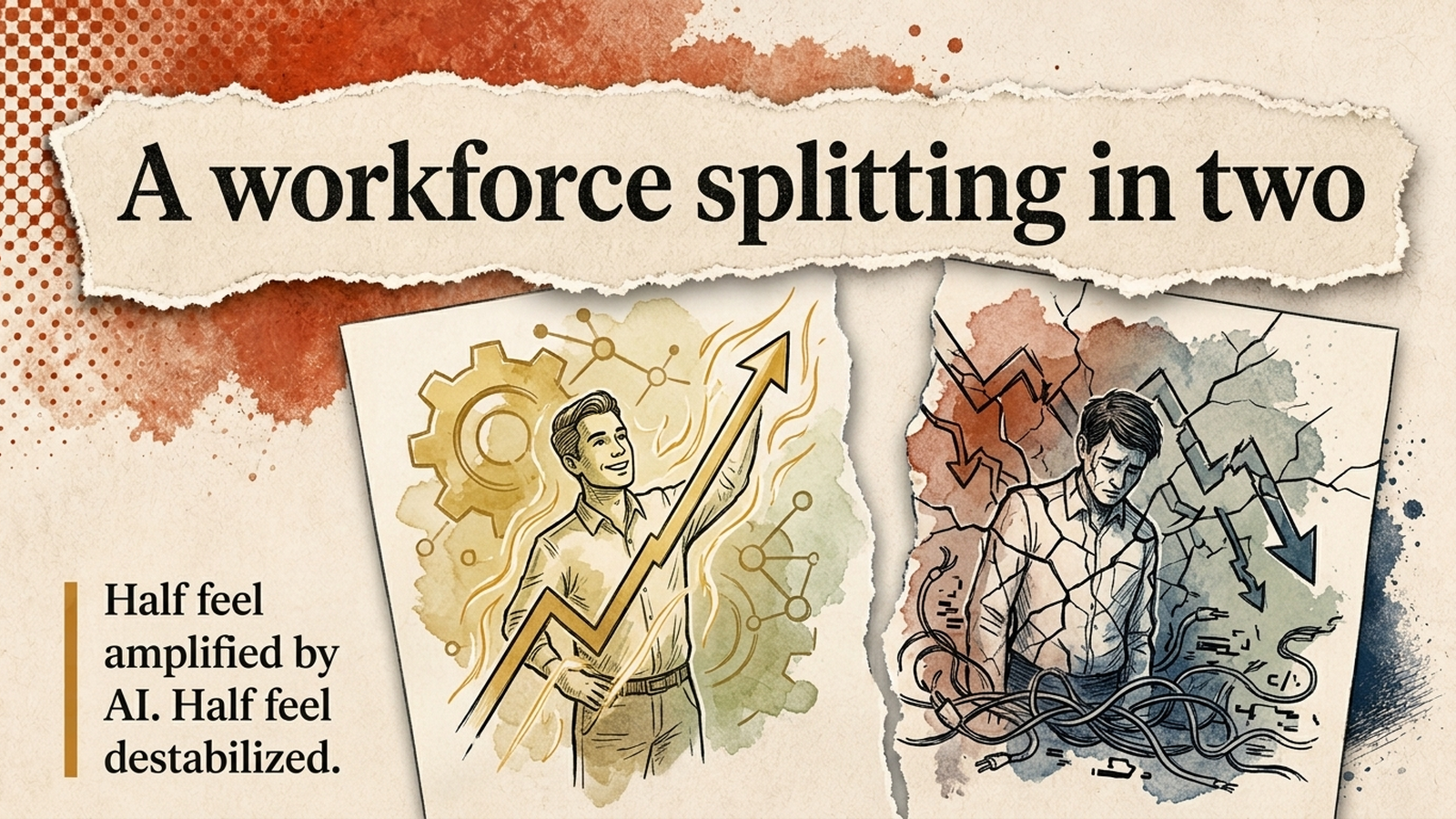
Brooks' thesis is sharp: what will separate people isn't how smart they are, but their relationship to mental effort. He sorts everyone into productive passengers who use AI to think less, reluctant optimizers who mean well but get pulled into over-reliance, and mental marathoners who use AI to stretch. His worry has evidence behind it.
Both figures traced to primary sources; see digest for full verification.
But Brooks leans fatalistic, as if the marathoners are the only ones who make it. That's where the operator should disagree. Motivation isn't fixed. Most workplaces have never actually asked much of people — we hand out discrete buckets of tasks, for often unclear reasons, and call success finishing them on time. Support people properly and far more of them can thrive than the 'born marathoner' framing assumes.
Point AI at what you couldn't do before
Here's the move Brooks misses. The instinct is to use AI to do familiar work faster. The bigger prize is using it to do things that weren't possible before.
Think about a non-technical person building their first agent. It takes real humility: asking AI how to do something, screenshotting the answer, asking a second AI what those words mean, hitting an error, shipping something fragile, and fixing it in public. Mental elasticity, like physical fitness, comes from doing uncomfortable things you haven't done before. AI didn't change that. It raised the ceiling on what you can even attempt.
What leaders should actually copy
Two operating lessons follow. First, redefine the 'AI champion.' Most programs treat champions as internal PR — people who tell colleagues how good AI is. The leverage is showing, not telling. Whittemore's version is the 'internally deployed vibe coder': someone who pairs with a business function to change what the work is, not just how fast it runs.
Second, automate the workflow, not the task. Uber's CTO described 'agentic pods' — an AI-proficient engineer embedded with a domain expert for two weeks: shadow the work, find the highest-impact opportunity, build the agent together, validate, ship. Across 16 functions they cut jobs like financial pacing reports from two days to ten minutes. (These are the company's own figures.)
The best AI opportunities are rarely visible from the outside. You discover them by sitting next to the people doing the work — building with them, not for them.
Praveen Neppalli Naga, Uber CTO
The trap is stopping at the two-week productivity win. If a report drops from two days to ten minutes, the value isn't the saved time. It's what newly agent-fluent business people do with the rest of it — and that usually isn't more of the same work. It's new, orthogonal work that was always dreamed but never possible before.