TL;DR
The short version
On Every's AI & I, staff writer Katie Parrott describes the method behind her output — and almost none of it is about prompting. High-taste output from AI comes from the context you build once, the fresh inputs only you can supply, and a system that records every correction.
For anyone directing AI toward work that has to meet a quality bar, the pattern is three moves: build reusable context once, bring the fresh evidence the model can't reach, and capture every edit so the tool improves.
Built on Katie Parrott's interview with Natalia Contreras on Every's AI & I; quotes and timestamps traced to the episode, guest and claims verified against her Every author page and essays.
The leverage is in the context, not the prompt
Katie Parrott is a staff writer at Every who produces a volume of work that reads like a small agency. Her turning point came as a freelancer, when she delivered close to a month's content in about two weeks. What made it possible wasn't a clever prompt — it was giving the model a foundation first: brand messaging, audience specifics, product details.
She frames the setup as building an environment: it feels effortful early, then you run fast once it exists. The failure mode she names is the opposite habit — asking the model to "write a blog post about X" with nothing to go on. What comes back is generic, because "what the model already knows is commoditized information." The model is capable; it just has nothing specific to be capable about.
Codify the recipe; bring the fresh ingredients
The most useful distinction in the interview is between two layers of context. The first is stable and reusable, so it gets codified once: style guides, audience personas, review frameworks. The second is different for every piece, so you supply it fresh each time. Parrott calls this closing the "last mile" — AI works from data that predates its knowledge cutoff, so the human's job is the unique research, the third-party study, the lived experience the model cannot reach.
The model is the kitchen... but you need the individual ingredients to be fresh and good to produce good work.
Katie Parrott, Every — AI & I
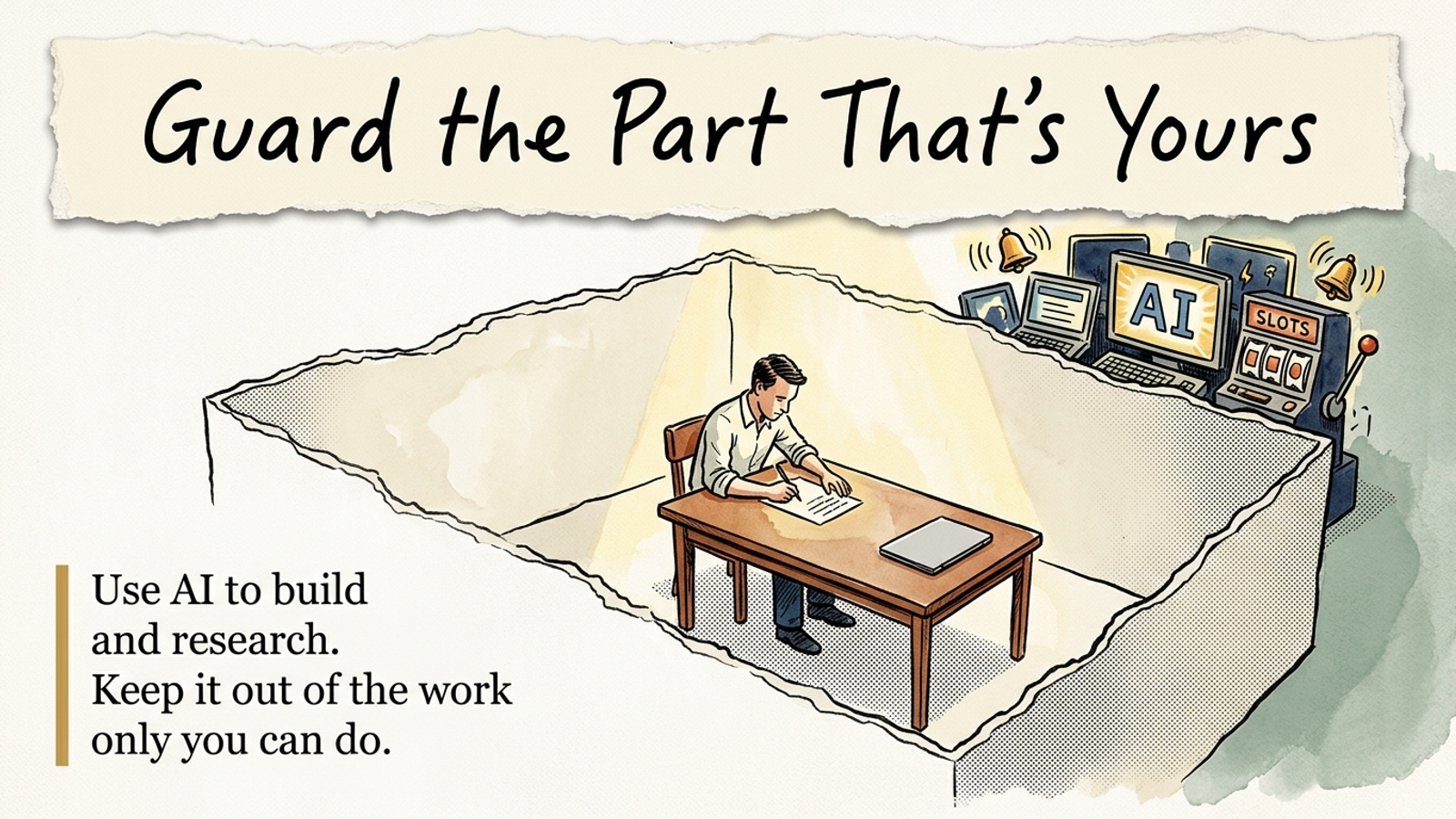
For a leader, this is the line between what belongs in a shared, versioned system and what belongs to the person doing the work. Standards, examples, and guardrails are infrastructure. Judgment and fresh evidence are not delegable. Parrott describes context as "a fenced-in place for the model to play" so outputs stay directionally right instead of confidently wrong.
Turn every edit into a system that compounds
The episode previews Compound Writing, a plugin Parrott forked from Kieran Klaassen's Compound Engineering. The idea it borrows is the important part: you should only have to give a piece of feedback once — codify it the right way and it persists, so next time the AI makes a better decision.
She built the editing step as reusable lenses drawn from writers she admires: one turns Kurt Vonnegut's eight rules for short stories into a review skill; another turns Hitchcock's suspense principle into a check for whether a passage makes the reader lean in. Each correction becomes a durable asset rather than a one-time note.
Two practices keep the system cheap to maintain. First, she has the model interview her to produce context instead of writing docs by hand. Second, she checks work in both directions — Codex once flagged five security vulnerabilities in an app she'd built, caught before they shipped. Different tools as different reviewers, feeding one system.
What this means for a leader
Parrott is blunt that this is not a shortcut. "Writing with AI is harder than you think," she notes; the plugin is "a gym" — a way to get better, not a way to skip the work.
One caveat worth holding: this is an Every staff writer, on an Every podcast, promoting an Every plugin. The craft principles stand on their own; treat the specific tool as the marketing it partly is. The method is the takeaway, and the method is tool-agnostic.