TL;DR
The short version
Writer Craig Mod uses AI hard — rebuilding software for himself and running research — but refuses to let it touch his prose. He protects that core with physical barriers: a separate internet-blocked writing laptop, no phone in the bedroom, no internet until after lunch.
Two ideas transfer past writing: put AI on the scaffolding of the work and keep it off the core, and judge output by whether you're still maintaining it, not by the demo. From Every's AI & I with Dan Shipper.
Built on the 8 Jul 2026 episode of Every's AI & I, Dan Shipper in conversation with writer Craig Mod (of the newsletters Roden and Ridgeline).
A power user who won't cross one line
Craig Mod is not an AI skeptic. On Every's AI & I, the writer and photographer behind the newsletters Roden and Ridgeline describes rebuilding Quicken for himself, cloning a $67,000-a-year newsletter vendor down to about $150 a year on Amazon's email infrastructure, and building his own private social network. He runs coding agents for twenty hours at a stretch and can't stop watching them work.
And he will not let any of it near his prose. That combination is the interesting part. Mod isn't drawing the line out of fear or unfamiliarity — he's used AI enough to know exactly what it does to him, and what it would cost.
AI is a slot machine, so he builds walls
Mod's word for working with AI is "dopamine driven." A slot machine. He believes you can do incredible work with it and that it will pull you out of deep attention if you let it.
So he doesn't rely on willpower — he engineers his environment. He keeps a separate laptop just for writing that blocks everything. His phone has never slept in his bedroom. He stays offline until long after lunch, because the moment he touches his phone he feels "the chemical shift" that kills deep focus. No meetings before noon.
If I don't create these barriers, I will lose connection with this other part of me that I think is the most valuable part of me.
Craig Mod
The lesson generalizes past writing. If your real value is a kind of thinking that needs uninterrupted attention, treating AI as always-on taxes exactly that. Mod's fix isn't in-the-moment discipline — it's removing the option.
What AI is allowed to do
Inside those walls, AI does plenty. Mod uses it as a research assistant — find every source written about a building, fill in the facts he marks "TK," look up who drummed on an album. He uses it as a cultural-sensitivity check, testing how he writes about the atomic bomb at Nagasaki.
But the writing itself stays his. "The point is being in the mess of the writing," he says. Research and checks are inputs to that mess; they aren't the mess itself.
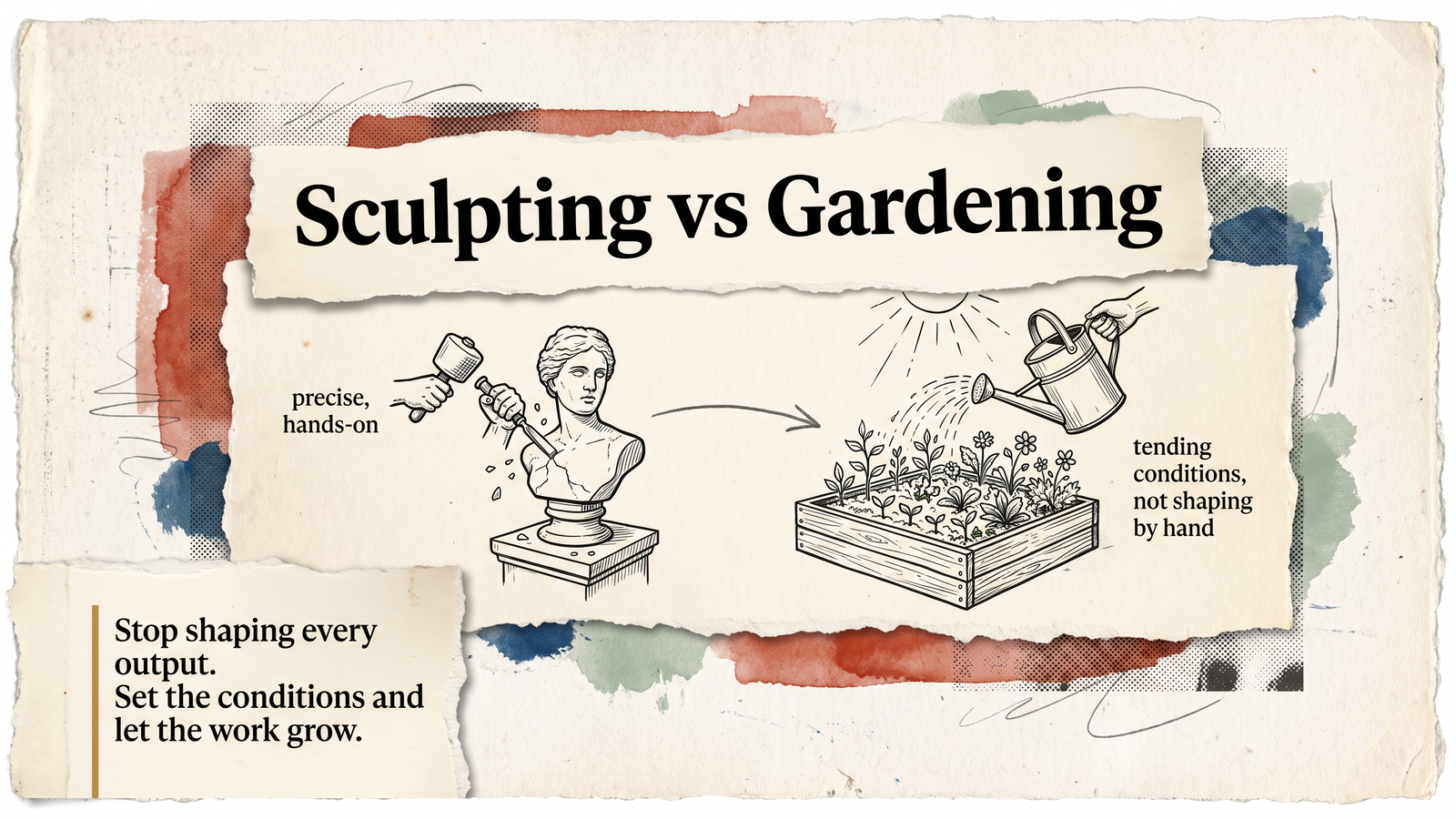
The distinction is worth copying: AI on the scaffolding of the work, human on the core. The trick is being honest about which is which. For Mod, the sentence is the core. For you it might be the architecture decision, the customer read, the taste call. Name it, and you know where AI helps and where it quietly hollows things out.
The new bar isn't building. It's maintaining.
Mod's second idea reframes what "impressive" even means now. A decade ago he had a friend who spun up a company a month, striking because you knew he'd built each one himself. Today anyone can one-shot an app in a weekend, so the feat signals nothing.
He pairs it with a warning borrowed from Kevin Kelly, who makes a book's cover before writing it to test whether he actually wants to. AI makes it dangerously easy to have "the veneer of having done the thing" instead of doing it. Ask which one you're producing.
Build tools that feed the mission
The last rule ties it together. Mod won't build software for its own sake — it has to feed back into his actual purpose, writing and publishing. Automating his newsletter archiving made him want to publish more. A searchable index of his member Q&As made him want to host more of them. The tool earns its place by increasing the core work, not by being clever.
That's the test worth taking from a writer who codes for hours but keeps his sentences off-limits. Use AI to remove friction from the work that matters to you. Protect the part only you can do. And measure output by whether you're still tending it a year later — not by how fast you shipped the demo.