TL;DR
The short version
A famous AI hedge fund imploded and semiconductor stocks sold off hard — the same week OpenAI and Anthropic posted some of their best revenue months yet. If you watched the tickers, the AI trade was breaking; if you watched revenue, it was accelerating. Both were true at once.
The reconciliation: last week's weakness was market mechanics — a 4x-levered fund forced into liquidation, a Korean margin-call cascade, a risk-off macro rotation — not a change in AI demand. Nathaniel Whittemore's neutral read holds up; his stronger "demand only goes up" conviction is contested. The operating lesson sits in between: when AI names sell off, check whether the demand story actually changed before you treat the price as the message.
Built on Nathaniel Whittemore on The AI Daily Brief, with figures traced to primary sources (CNBC, Nikkei, Fortune, Goldman).
The revenue kept climbing while the stocks fell
Anthropic disclosed a $47B run rate in May (Series H). By late July, OpenAI's CFO told staff a single month's annualized revenue had topped all of Q2 (CNBC). The hyperscalers echoed it in earnings.
Q2 2026 earnings — CNBC, Fortune (all figures verified)
Andy Jassy's line was blunt: even at $220B in spend, "we will still not have enough capacity to meet all the demand we have in 2026" (Fortune). That's the part the sell-off didn't touch. Lab revenue is the upstream variable — it justifies the capex and the debt behind the data centers. When it's rising, the build-out has a floor.
The fund blew up on leverage, not on being wrong about AI
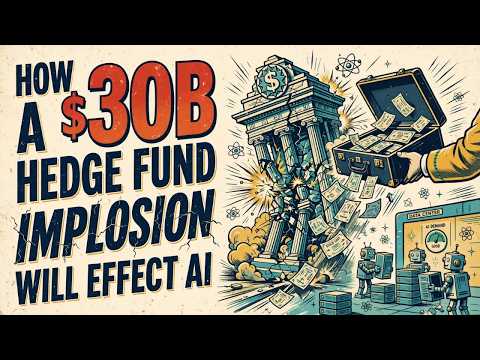
The week's loudest story was the liquidation of Situational Awareness, the fund run by Leopold Aschenbrenner — author of the 2024 essay that put AI on Wall Street's radar (Axios). It ran about 4x leverage, and reporting confirms both the leverage and the forced sale to Citadel (CNBC).
The mechanism: leverage means controlling far more in positions than you hold in equity. When the positions drop, a lender issues a margin call — post more collateral or sell. If you can't fund it, you become a forced seller into a falling market, which pushes prices lower and triggers more calls. It's a spiral, and it moves in days. Because SEC-registered funds report their holdings, rivals knew exactly what this one had to dump and could short it — a predatory move traders call "shooting against a fund" [21:56].
None of that is a signal about whether AI is a good bet. It's what over-leverage does when the market turns.
The debt scare is real, but it isn't 2008
The other bear argument is off-balance-sheet debt. Nikkei estimates five US tech giants carry roughly $1.65T in data-center obligations parked in special-purpose vehicles — per-project shell companies — rather than on their own balance sheets (Nikkei Asia). The instinct is to call it subprime.
The analogy breaks on one point. In 2008, the damage came because CDOs were treated as Treasury-equivalent collateral inside the interbank settlement system; when that broke, everything seized. This debt is disclosed in footnotes and sold to private-credit firms, insurers, and pensions — bad for those holders if data centers default, but not wired into the plumbing that turns a loss into a systemic crisis.
Financial crises are never about equity drawdowns by themselves. It's when defaults start cascading through the collateral system that there's a major problem.
Nathaniel Whittemore, The AI Daily Brief
The closer parallel to the fund blowup isn't LTCM or Bear Stearns — both touched core market infrastructure — but Archegos in 2021: a levered bet on tech stocks that hurt its lenders and rattled markets without becoming systemic (The Trade).
What this means for reading the next scare
Separate the price from the fundamental. Much of last week's weakness came from things with nothing to do with AI: a Fed on hold, macro jitters, and a Korean margin-call cascade where roughly 1.2M leveraged retail accounts were called and hundreds of thousands liquidated (Goldman via 36Kr). When the forced selling ended, the same names ripped back.
Hold the honest, narrow version: recent AI-stock moves have been driven more by leverage and macro than by any change in AI demand — that's well-supported. The stronger claim, that demand only goes up from here, is conviction, not fact, and credible skeptics contest exactly the revenue and margin numbers the bulls lean on (one example).