TL;DR
The short version
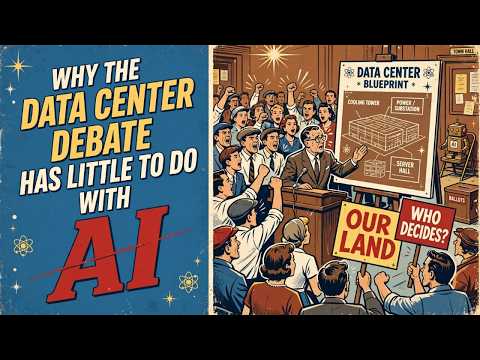
The revolt against AI data centers is mostly a proxy fight. People feel a world they didn't choose is being imposed on them, and a data center is the tangible thing to push back against. AI is the avatar, not the grievance.
Companies keep losing because they run a democratic process like a backroom business deal. The fix is empathy, a concrete case for why data centers improve people's lives, transparent project-by-project negotiation, and real budget for community buy-in.
Built on Nathaniel Whittemore's The AI Daily Brief and the reporting of Jasmine Sun and Ezra Klein it draws on.
The obvious read is the wrong read
The easy story is that people hate data centers because they hate AI. Watch the fights up close and that story falls apart.
In Nathaniel Whittemore's reading of the debate, the backlash is mostly a proxy. People feel a world they didn't choose is being imposed on them, and a data center is the tangible thing to fight. AI is the symbol, not the substance.
Journalist Jasmine Sun spent ten days talking to union leaders, brokers, activists, and local officials. When she asked organizers whether they used AI, most said yes, to draft an email or make a meme. They didn't think it was evil. They thought it was a widget that didn't justify the disruption.
It's a trust problem wearing an AI costume
The real fuel is distrust, and the industry keeps pouring it on.
The clearest example is the NDA. A development shows up in a small town, and non-disclosure agreements stop council members from confirming it's even a data center, who the customer is, or how much power it will draw. But whispers leak, rumors hit social media, and the officials who signed the NDAs can't get ahead of the narrative.
It's not Skynet, it's the oligarchy.
Jasmine Sun
Communities also carry scars. Sun points to Foxconn's Wisconsin plant: 13,000 jobs promised to Mount Pleasant, a town of about 28,000. It delivered closer to 1,000, and the town was left servicing infrastructure debt (CNBC). Most towns haven't lived that story, but everyone has heard one like it.
The numbers make the fight unavoidable
The scale guarantees friction. Texas alone is carrying grid interconnection requests that dwarf what the grid could ever serve, the great majority of it data centers, so it is physically impossible to build it all. That queue doubled in six months, which is part of why Governor Abbott hit pause with new audits.
ERCOT queue as of 29 Jul 2026, via Market Business News. Peak demand ~91 GW (22 Jul 2026).
The politics are just as tangled. Opposition unites left and right, and moratoriums create a free-rider problem: states blocking data centers still want the AI service, exporting the grid and water costs to states willing to host the boxes.
What actually works
Whittemore's argument is that builders can't control the political weather but fully control how they engage it, and right now they're doing an abysmal job. Three moves change that.
Start with the general why. The only defensible answer for why a data center gets to exist is a concrete account of how it improves people's lives. Not "AI is inevitable." Not "if we don't, China will."
Then go specific and transparent. A company doesn't need a town to believe all data centers are good; it needs to earn support for this project on its merits, out in the open. The friction that comes with that is the point, not a bug to engineer around.
Then pay for it. The old model expected tax breaks for showing up. The new one flips: a meaningful share of project budget goes to covering the costs a data center adds and investing beyond that.
The boundary is honest. Some communities won't say yes, and shouldn't have to. But most of this is a failure of understanding and imagination, not a law of nature, which means it's fixable by the people building.