TL;DR
The short version
The AI-risk conversation is moving from apocalyptic doom to grounded economics — and the warnings that start from what the technology actually does are the ones that finally land.
In one week: Anthropic's gravestone-filled ad drew mockery, while Stanford's "We Must Act Now" statement, the AI Futures Project's "AI 2040: Plan A", and Demis Hassabis's frontier-AI framework showed the credible new mode — big claims stated with visible humility.
Built on Nathaniel Whittemore's read of the week's AI discourse on The AI Daily Brief.
The ad that reads like satire
Anthropic ran an ad this week that opens on a burning house, gravestones, and surveillance footage. It's a real ad for a real AI company, not a protest spot. Sam Altman quote-posted it and said he thought it was satire; the clip crossed a million views on the joke alone.
The ad is trying to "acknowledge the hard stuff" before pivoting to hope. In practice most people never make it past the gravestones. It's the old failure mode of AI-risk messaging: lead with the apocalypse, lose the room in five seconds. Three other things happened the same week, and together they show the discourse growing up.
Why the doom letters never worked
The template for AI warnings was set in March 2023, when the Future of Life Institute called for a six-month pause on any model more powerful than GPT-4. It leaned on extinction risk — the fear that a smart-enough system ends humanity.
Nothing much came of it. The reason is worth sitting with: the risks it described were so disconnected from what GPT-4 could actually do that most people couldn't connect the alarm to the moment. When your warning depends on a hypothetical superintelligence, anyone looking at the actual tools decides you're not describing their world.
The version that's landing
On July 13, Stanford's Digital Economy Lab published "We Must Act Now," a statement signed by sixteen Nobel laureates and organized by economist Erik Brynjolfsson. It reads differently, and the difference is the point.
It doesn't prophesy extinction. It says AI may become radically more powerful, that this could drive a transformation larger than the industrial revolution on a shorter timeline, and that we should therefore study it hard now. Every load-bearing word is a hedge. It doesn't prescribe X, Y, and Z — it says we need to talk about what to do.
Notice who signed and why. Several economists on the list had predicted large AI job losses, then watched youth unemployment stay roughly flat, and signed not because things got scarier but because reality kept surprising them. Even Altman has said he's "pretty sure AI has been net job creating" — and that this wasn't what he expected.
The same shift shows up elsewhere. The team behind the AI 2027 doomsday scenario returned with "AI 2040: Plan A" — not a prediction but a proposal for a US–China transparency framework to delay superintelligence to 2040. Its own authors put the odds of adoption at 3 to 15 percent. But because it's framed as a plan, people can argue about what to actually do.
We've essentially found a way to make sand think. It's miraculous.
Demis Hassabis, A Framework for Frontier AI
Even Hassabis's optimistic essay lands on "cautious optimism" and a concrete governance ask: a FINRA-style standards body that tests frontier models before release. Optimism with a guardrail attached.
What this means if you communicate about AI
If you lead a team, brief a board, or write anything public about AI, the lesson is direct: anchor the claim to the present state of the technology. The messages that move people this week start from what the tools demonstrably do and reason forward with visible humility. The ones that fail — the gravestones, the extinction letters — start from a future nobody can see and ask you to feel the fear anyway.
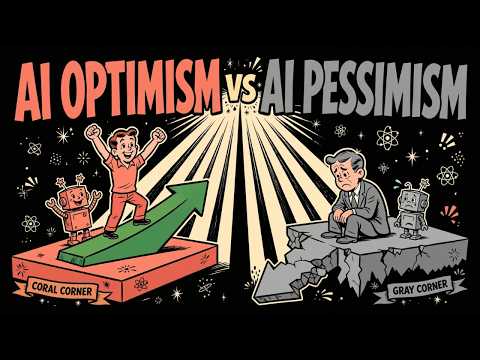
The debate isn't settled — optimists and existential-risk believers still find each other baffling. But the center of gravity moved from "will AI end the world" to "AI is a big deal moving fast and we should get ahead of the economics." That's a debate a leader can actually use.