TL;DR
The short version
A champion network is one of the few AI adoption moves that reliably pays off. It only works when the company writes down what champions are for, nominates people who actually have the time, and owns what happens after certification.
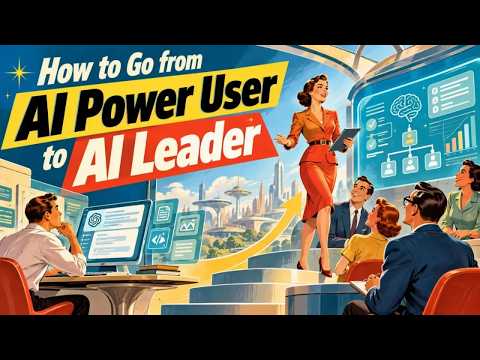
On The AI Daily Brief, Nufar Gaspar argues that what separates a champion from a power user is judgment around the build: picking the right use case, choosing the simplest form, writing the spec, and signing off that it's good enough for users.
Based on Nathaniel Whittemore's Operator's Cut conversation with Nufar Gaspar on The AI Daily Brief (15 Oct 2026), with outside context from MIT Sloan Management Review and a Kent State study.
A champion is a peer plus one
Every team already has one: the person others ping when a new model drops. Someone finds a great way to do something, shows two colleagues, and it never spreads. Gaspar's champion fixes that. They sit inside the team, do the team's work, and are one step ahead on AI, moving peers forward without authority over them.
- Ambassador. Spots use cases, describes them cleanly, and hands them to a central team or vendor.
- Ambassador-builder. Builds for their own team inside a defined scope, then acts like a product manager beyond it.
- Internal FDE (forward deployed engineer). A professional builder inside a business team who takes work from idea to production.
The company has to pick. One of Gaspar's clients wanted champions mainly as a funnel, bringing ground-level use cases to a central team that can't see daily work. Another later retrained them as full builders. Same title, different job.
The company side: four stages
Set the goal. Ask what the network is for and where champions sit on that line. Write down goals, responsibilities and expectations, and agree them with IT and security.
Nominate for time. Look for people who already use AI without being told, whom peers already ask, and whose manager will give them time. Avoid senior self-nominees (put them on a steering committee instead), the busiest person on the team, nomination as a reward, and new joiners who don't know the business yet.
Train on real work. The readiness test: each champion shows one real use case from their own team, built or promoted, by the end of training.
The biggest predictor of whether this succeeds is what happens the day after you certify someone as a champion.
Nufar Gaspar, The AI Daily Brief
Own the day after. That means two sponsors (one who runs communities, from HR or L&D, and one AI-savvy lead who clears approvals and access), a short briefing for champions' managers, and easy entry and exit. In every program Gaspar saw fail to produce value, nobody owned the continuation.
The champion side: judgment around the build
Gaspar argues building is the easy part to learn. The harder skills sit before and after it: identifying use cases (assume cost runs higher and day-one value lower than hoped), sizing ROI against a metric the company tracks, owning deployment on day two, and evaluation. Signing off that something is good enough to hand to users is the core champion skill.
Three pre-build playbooks make that concrete. First, should we build at all, or reuse, buy, or backlog it? Second, what's the simplest form that works: a shared chat setup, a skill, an automation, and only then an agent. Third, write the spec: who it's for (not "everyone"), what it must know, how people will use it, what it must never do, who checks the output, and how you'll know it works.
Why it matters more now
Whittemore raises the stakes. More non-technical staff now use agentic coding tools on their own work. That's powerful, and it creates real security and guardrail problems as capable agents spread into systems they weren't meant to touch. Gaspar's answer is to give those builders enablement, infrastructure and training rather than shut them down, because subject-matter experts pick the right problems.
Outside evidence points the same way, with a warning. Novo Nordisk scaled Copilot from a few hundred users to 20,000 using champion networks plus governance (MIT SMR). But a Kent State study of one Fortune 500 champion program found no significant change in champions' self-efficacy over a short pilot.
Boundary: the playbook comes from practitioners who run a paid AI Champions Bootcamp, which they pitch at the end of the episode. The "highest ROI" claim is their field experience, not a dataset.