TL;DR
The short version
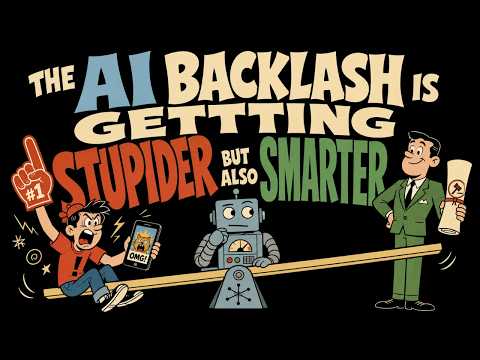
The revolt against AI data centers is mostly a proxy fight. For most opponents AI is "a widget, a toy" — the anger is about agency and eroded trust, not language models. People feel a world they didn't choose is being imposed on them, and the data center is the tangible thing to push against.
Builders can't control the political weather, but they fully control how they engage it — and they're botching it, running a democratic process like a backroom business deal. The fix is a social license to operate: the community's ongoing consent, earned with radical transparency, empathy, and a real community-investment budget. Argued by Nathaniel Whittemore on The AI Daily Brief, built on Jasmine Sun's on-the-ground reporting.
Source: Nathaniel Whittemore, The AI Daily Brief — "Why the Data Center Debate Has Little to Do with AI." Reporting by Jasmine Sun, "No Data Centers In My Backyard."
The fight was never about AI
Strip away the headlines and the data-center opposition isn't a critique of large language models. For most opponents AI is "a widget, a toy" — not Skynet, not evil. The anger is about consent and imposition: a world they didn't choose, arriving in their town as a windowless building that drinks the grid and the water table.
It's not Skynet, it's the oligarchy.
Jasmine Sun
The distrust is earned, not irrational. Foxconn promised Wisconsin 13,000 jobs and a $10B plant in 2017; it delivered roughly 1,000 jobs and left the town servicing infrastructure debt. Every community now pattern-matches the next big-tech promise to that template. As one reporter put it after ten days on the ground: rationally she often agreed with the proponents, but emotionally she empathized with the opposition more.
Builders control the one thing that matters
You cannot control the political context. You fully control how you engage it — and, in Whittemore's blunt assessment, builders are doing "an absolutely abysmal job." The self-inflicted wound is secrecy: NDAs between hyperscalers, developers, and local officials stop city councils from getting ahead of the rumor cycle, so the vacuum fills with conspiracy.
The category error is treating a democratic process like a procurement deal. Friction isn't a bug to engineer around; it's the sound of people being heard.
Friction, slowness, back and forth are what happens when people are actually being heard.
Nathaniel Whittemore
Transparency is now the job, not the press release. Lead each project with the general case for why AI improves lives, then negotiate locally and in the open.
The scale that forces the fight
The demand is physically impossible to fully satisfy, which guarantees the fight happens somewhere. Texas's grid operator is holding a connection queue several times larger than the grid's all-time peak, and it roughly doubled in six months.
ERCOT queue data, via Market Business News (Jul 2026). An interconnection queue is a request list, not a build forecast — many projects are speculative.
Blocking a data center doesn't remove the demand; it exports it. States that pass moratoriums still want the AI service, pushing the grid, water, and land costs onto whichever states will host — a classic free-rider problem. And the opposition is bipartisan enough that it scrambles the usual partisan frames, which makes it hard to negotiate through a party.
The builder's playbook
The burden of proof has flipped. It's no longer enough to assert that AI is important in the abstract; the builder has to explain, concretely, how another data center makes life better for the people who live next to it.
One caution on the source: Whittemore is a committed pro-buildout advocate. His neutral finding — the backlash is about agency and trust, not AI substance — comes from Jasmine Sun's reporting. His prescription is his own advocacy aimed at builders. Both can be true; read the diagnosis and the sales pitch separately.
What actually works: rules that route money and control back
Two more months of polling and case studies sharpened the prescription from be transparent into a concrete, evidenced template — and settled the moratorium-versus-rules fork. Pennsylvania's Josh Shapiro answered the backlash with a detailed executive order, not a blanket ban: binding transparency and environmental terms, bring-your-own-power, community benefit agreements, and a prohibition on the NDAs that make residents feel powerless. Voters back this posture — 57% prefer clear rules to a 23% moratorium, and 78% want builders to cover grid costs.
I will take any set of rules that can be debated and interacted with 100 times out of 100 out of a blanket ban.
Nathaniel Whittemore, The AI Daily Brief
The give-people-stuff template already has proof-points. Cover grid costs, ban NDAs, share the tax windfall, fund local priorities. Quincy, Washington, after two decades of data centers: poverty fell from 29.4% (2012) to 6.2% (2024), with data centers funding roughly 57% of property taxes, a $15M pool, and a $120M school. Loudoun County, Virginia collects about 42% of its local tax base from data centers at a 0.8% rate. OpenAI's Pike County, Ohio commitment pairs a $40 million community grant fund with $84M in coding credits for hundreds of thousands of students. The community-investment budget is now a measurable line item, not a rounding error.
And the uncomfortable finding for anyone who thinks this is a messaging problem: correcting the viral harm claims barely moves opinion. Several are genuinely exaggerated — one widely shared water figure was off by a factor of about 1,000, a real unit error the author acknowledged — yet the objection survives the debunk, because the deficit is trust, not information. Social license stops being something you can argue your way into and becomes something you build, transparently and locally, deal by deal.
Pledges, then no NDAs, then cash — still no verdict
By October 2026 the builder playbook had escalated in three steps. First came the ratepayer-protection pledge: buy or build your own generation so local power bills don't rise. "Turns out that's not enough." Then the industry disavowed NDAs, which had become "exhibit A for people who feel disempowered." Now it's real money: infrastructure, local initiatives, "and yes, even direct payments to citizens. But will that be enough? It remains to be seen."
Sentiment kept hardening anyway. Pew's late-September research found more Americans with mostly bad views of data centers' effect on the environment, home energy costs and local quality of life than in January, with Republicans and Democrats about level. Debunking still doesn't work: the evidence that data centers drive up power bills is thin, yet telling people they're wrong hasn't moved them.
Data centers of course have become the physical manifestation of people's frustration with AI.
Nathaniel Whittemore, The AI Daily Brief
The optimist's read: Americans say they dislike AI and use a lot of it. That gives them a reason to help shape it, and a fight over specific policy beats people shouting past each other online.