TL;DR
The short version
Most people use AI image tools like a slot machine: type a prompt, pull the lever, hope. Every good result is a one-off nobody — including its author — can reliably reproduce.
The fix an operator should copy: turn the good process into a visible object, separate the reusable template from the per-job input, then package the whole thing as a named technique and a one-field app a non-designer can run. The leverage isn't a better prompt. It's a handoff.
Built from a Flora workflow demo on Every's AI & I with Dan Shipper.
The default is a slot machine
Ask for an on-brand image and you'll watch someone retype prompt variations for twenty minutes. Every good result is a one-off. Nobody else on the team can reproduce it, and the person who made it often can't either.
Katherine, a "forward deployed creative" at Flora, calls the underlying work "throwing pasta at the wall and seeing what sticks," and names the cost: it "leads to a lot of burnout, and it leads to a lot of kind of wasted time" [08:21]. That framing is a vendor pitch, not measured data — but the pattern is real, and the fix works regardless of which tool you use.
The fix: make the process a visible object
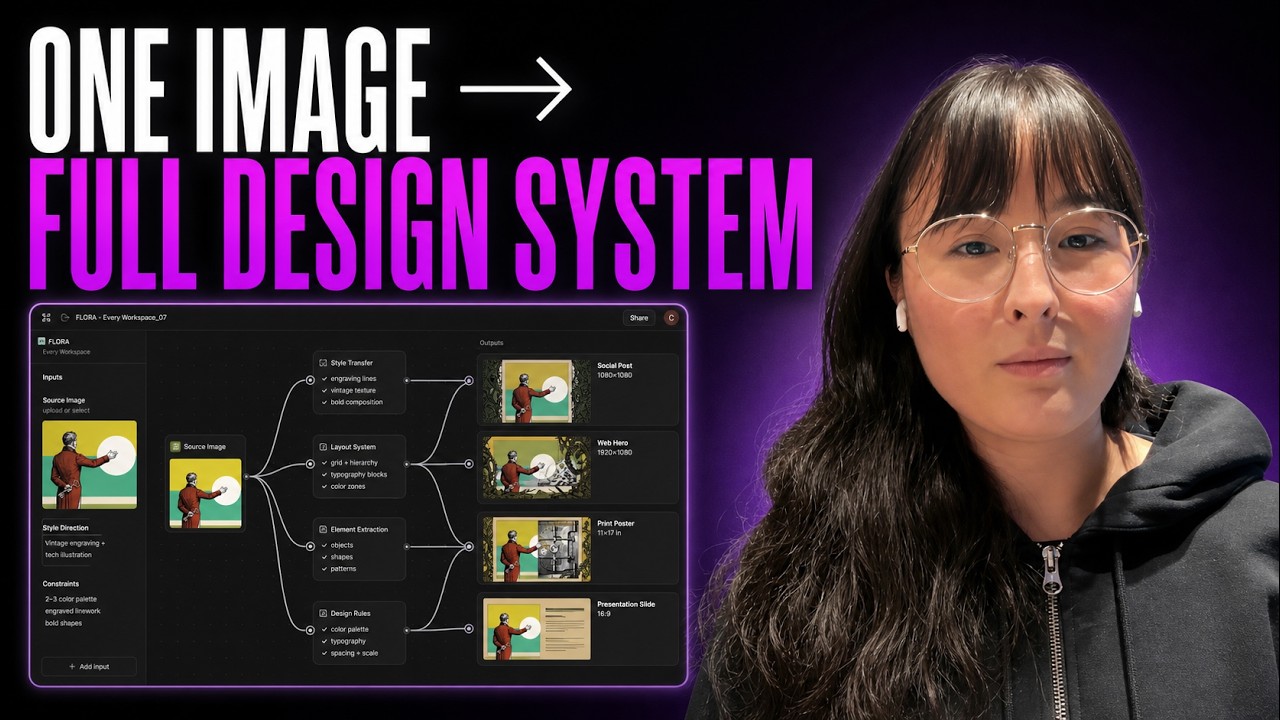
A private, in-someone's-head process becomes something you can inspect, edit, and hand off. Flora is a node-based canvas — a mix of Figma and an AI engine, where each step (an image, a text prompt, a model call) is a node you connect. "A node-based tool really kind of visualizes that [creative process] out onto the canvas" [00:37].
The build has a shape any leader will recognize as good system design. Extract the reusable part: attach a reference image and ask the model to "write a system prompt that would recreate an image similar to the attached ones" [01:44] — that becomes a template. Isolate the changeable part: a separate node holds only the per-job input, which "could be a word... a full article... a two-sentence paragraph" [02:51]. Let the model fan it out: Claude rewrites the template against the input into three numbered prompts, each rendered with Google's Nano Banana Pro (native 4K, per Google's spec) [05:04].
Template plus input plus variation. The stable logic is separated from the thing that changes per request — the same instinct behind any function worth reusing.
The move that matters: codify and hand off
The demo would be a neat trick if it stopped at "nice images." It doesn't — two steps turn a personal workflow into team infrastructure.
First, she packages the graph into a technique — Flora's term for a published, reusable workflow. "Build technique" asks only two questions: what are the inputs (a `theme` text node) and what are the outputs (three image variations) [06:44]. The messy canvas becomes a clean unit with a defined contract.
Second, she opens it as an app — a form where someone enters context, hits generate, and gets on-style images "without even having to open up a canvas or connect a single node" [07:48]. The operator running it never sees the machinery.
> "I want my workflow to be as clean as possible when I turn it into a technique." — Katherine [03:57]
She's building for handoff from the start, not documenting after the fact.
Why an operator should care
Strip away the tool and this is a leadership pattern. You have people producing good work that dies as a one-off because it lives in their head. The leverage isn't a better prompt — it's converting the good process into something with a defined input and output that someone else can run. Teams doing high-concept work "get to codify those creative processes and repeat them over and over and over again" [08:54].
The boundary is real, and the demo hides it. This is a vendor showing capability, not an independent test. It skips the parts that decide survival with a real team: cost per run, whether outputs hold the brand across many topics, and who owns quality control once a non-designer hits generate. The pattern is sound; the "anyone can do it" polish is the sales layer.
So take the move, not the magic. Wherever your team keeps redoing conceptual work from scratch, the question is the same: what's the template, what's the input, and can you hand it off as an app instead of a favor?