TL;DR
The short version
As AI lets everyone do more of everyone else's job, Netflix isn't cutting functions. It's hiring systems thinkers, keeping deep craft scarce, and making AI fluency a baseline expectation that sits on top of talent density.
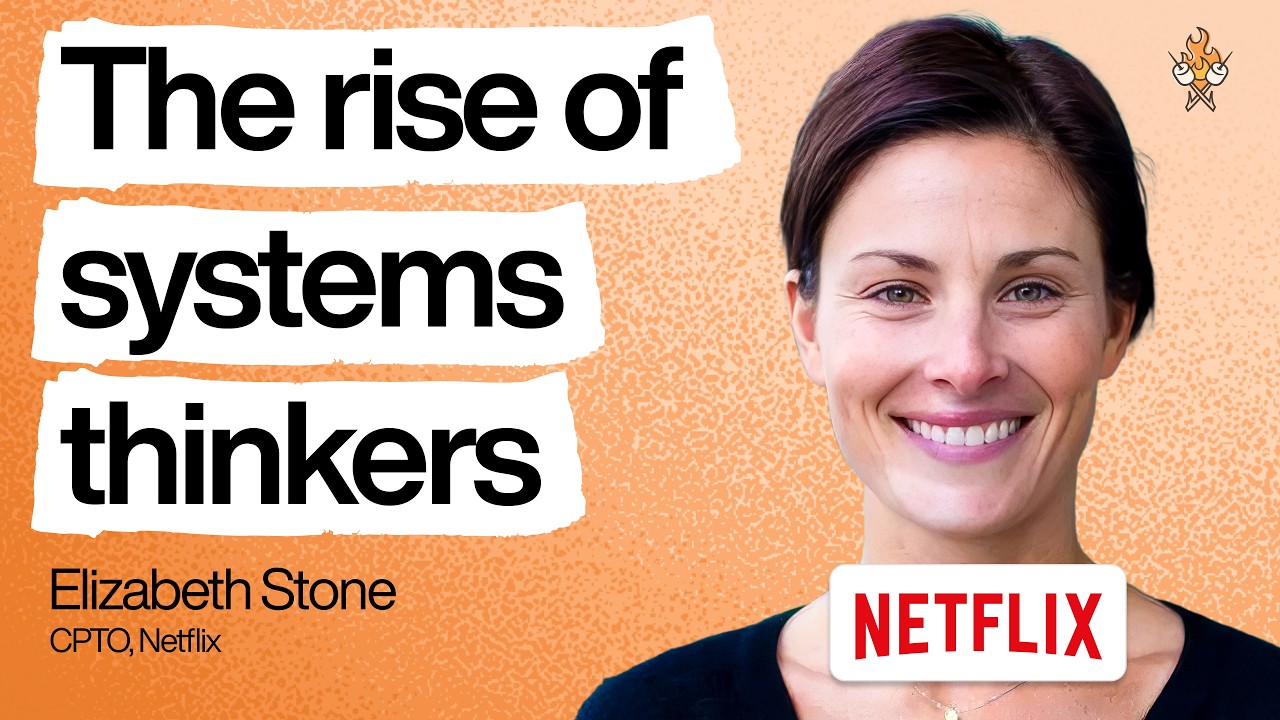
Elizabeth Stone, Netflix's product and technology officer, told Lenny's Podcast that the trait to hire for now isn't a function — it's the ability to abstract across domains and leave a reusable building block behind.
Built on Lenny Rachitsky's interview with Elizabeth Stone (CPTO, Netflix). This is Netflix's CPTO advocating Netflix's own culture — the portable findings are separable from the Netflix-is-special framing.
The trait Netflix now hires for
Elizabeth Stone, Netflix's product and technology officer, was asked what the company hires more of in an AI world. Her answer wasn't a function. It was a trait: Netflix needs more systems thinkers — people who look across all the business domains and abstract that to the building blocks the company is going to need.
The trigger is agents. When work gets done by a shifting mix of humans and agents operating across systems, local teams building their own stacks stops scaling. Netflix's edge used to be exactly that autonomy: local teams shipping fast on paths they built themselves. Stone now wants common infrastructure, source-of-truth data, and paved paths — opinionated default toolchains with guardrails — so that speed doesn't produce a mess.
For a leader, this moves the hiring bar. The question shifts from can this person go deep on X? to can this person see how X connects to everything else, and leave a reusable building block behind?
Blurring roles doesn't dissolve the disciplines
The easy read of AI is that everyone becomes a builder, so titles stop mattering. Stone pushes back. PMs prototype, designers write code, and business stakeholders pull their own insights, but the comparative strengths hold: data scientists still own whether the data can be trusted, PMs still own the what, engineers still own how it scales.
I still find great engineering to be scarce. Great data science to be scarce. Great creativity to be scarce.
Elizabeth Stone, CPTO, Netflix
AI makes people multilingual across functions. It doesn't make craft common. What is trending down is narrow specialization — the days of very narrow, deep specialization feel more limited to her. Netflix now wants people adaptable in multiple directions, keeping a few true experts only where the domain is genuinely rare, like video encoding or playback systems.
Structure teams around templates, not heroics
The design example is the sharpest. Once non-designers can ship UI, the risk isn't slow work — it's incoherence. Stone's word for it is shipping Frankensteins. Her fix is structural: hire designers who build systems and templates so non-designers produce coherent, on-brand work, instead of hiring designers to hand-craft one feature at a time.
That is the org-design lesson under the whole conversation. In a thousand-person org, you can no longer rely on tribal knowledge or on finding the one person who knows a thing. So leaders encode what good looks like — design systems, paved paths, source-of-truth data, guardrails — because that scaffolding is what lets both people and agents move fast without breaking things.
AI fluency gets the same treatment. Rather than rewriting every rung of the career ladder, Netflix laid one expectation across all roles and levels, including senior leaders who don't code: an experimentation mindset, and good judgment about where AI actually helps.
The teachable version: zoom out one click
Systems thinking sounds like something you either have or you don't. Stone offers a drill. For each problem, step out one click and ask what you're assuming about the broader space: will the way I'm building this scale across other cases? Is this even the most important version of the problem to solve?
She adds a manager's variant: do your job in the way that helps your manager do theirs, which forces you to zoom out past your own KPI. The warning attached matters as much as the drill — don't linger in the questioning state, or you stall. One zoom-out, then move.
The method behind the buzzword is old: it's the systems-thinking primer, Donella Meadows' Thinking in Systems, that treats a problem as interconnected parts rather than isolated tasks.
Talent density first, process last
None of this works without the input. The talent density is the non-negotiable — it's what makes it safe to push decisions down and let people take risks.
The counterintuitive part is what a leader should not do. When something breaks, the instinct is to add a process gate. Stone's experience is that added process cost time without improving outcomes. The best people, she argues, don't want checklists. They want a blameless retro and enough accountability to fix it themselves.