TL;DR
The short version
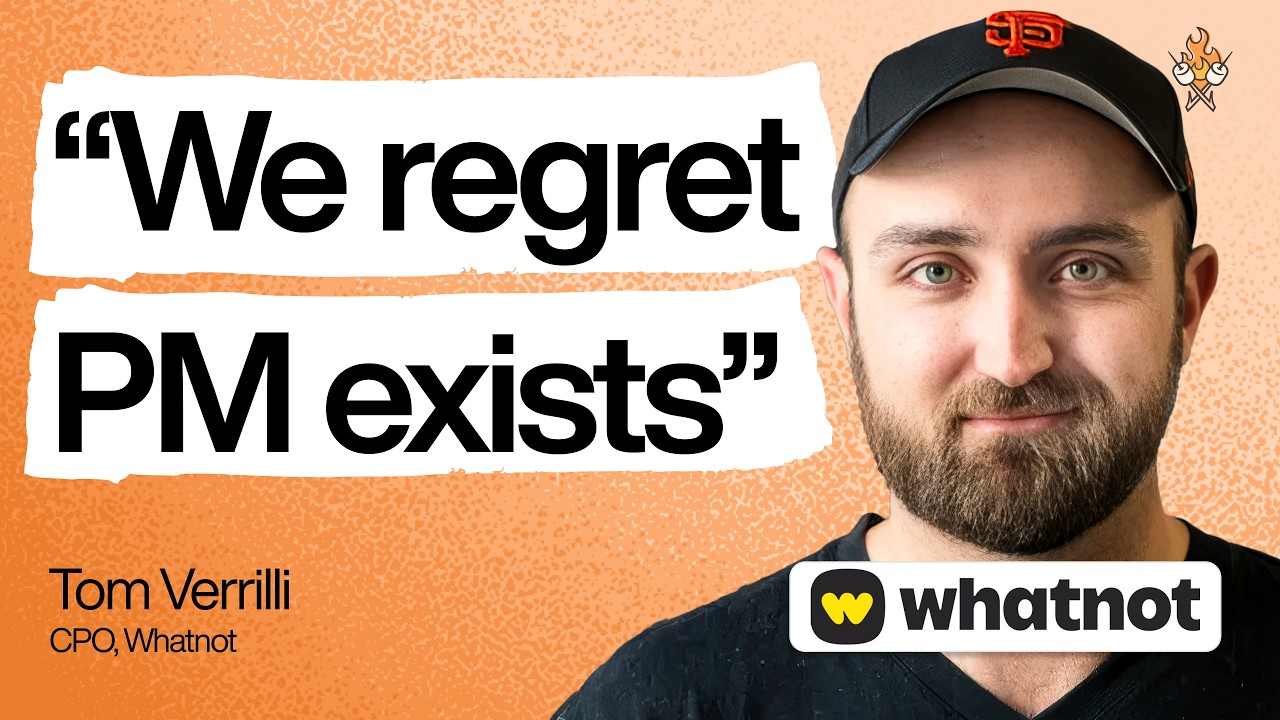
Whatnot built its product team on a deliberately provocative line: "we regret that product management exists." It's a forcing function, not a ban — you add a PM for a specific need, never by default, so engineers and designers keep the reps of making product decisions.
Tom Verrilli, Whatnot's CPO, argues the best product leaders are now going back to hands-on IC work. AI is why it holds together: one senior operator who can query the codebase and pull their own data is more leveraged than three junior PMs plus the alignment meetings that coordinate them.
Built on Tom Verrilli's conversation with Lenny Rachitsky on Lenny's Podcast.
The pod ratio added a layer nobody needed
Whatnot's product team was built on a line that reads like a mistake: "we regret that product management exists." Verrilli means it as a forcing function. You don't add a PM because the org chart has a slot — you add one when there's a specific problem that needs one.
The target is a habit most tech companies never questioned. As teams scaled, a ratio crept in: hire six engineers, add a designer, add a PM. Multiply that across a billion-user product and you have a lot of PMs, many sitting on work that never needed one, like notifications infrastructure.
Hiring so many PMs infantilizes the engineers and the designers who are perfectly capable of making good decisions, but just never had to because there was always a PM to babysit them.
Tom Verrilli, CPO of Whatnot
The muscle atrophies when you outsource the decision
His argument rests on a simple mechanic. Product judgment is a trade, not a qualification — you get good at it by doing it. So every time you insert a PM to make the call, the engineers and designers around them lose a rep. The more you abstract them from the decision, the more that muscle underdevelops.
This is not the usual "engineers don't need PMs" take from a dev-tools founder. Verrilli built deeply consumer products at Twitch and Twitter, the kind everyone assumes require strong PM craft. The claim lands harder coming from him.
Map people to problems, not teams
Whatnot runs around 20 PMs against a business moving serious GMV. They aren't assigned to teams. Every six months, leadership defines what has to be true for the company, names a directly responsible individual (DRI) for each outcome, and allocates from there. A team can go a year with no PM attached even while product work ships.
Hiring reflects the same filter. What's trending down: candidates who spend interviews on "driving alignment" and stakeholder management. Verrilli is direct that this used to be him — a PM "whose specialty wasn't technical or customer-oriented, it was politics." What's trending up: macro and micro thinking in the same person, and specific evidence of building something novel rather than polishing what already existed at a big-name company.
Seniors going back to IC work is the leverage play
The old script rewarded PMs by promoting them out of the work. Whatnot inverts it: managers spend 90%+ of their time on IC work, and Verrilli still spends about half of his. The reason is leverage, not nostalgia. One senior PM across several surfaces makes the trade-off that three siloed PMs would fight about for months.
At Twitch, Verrilli put ads and discovery under a single owner accountable for feed GMV — the war over impressions "solved," because the same person naturally aligned it. He wants Whatnot's bench to look like the roster of ex-CTOs who joined Anthropic as individual builders: senior skill, hands on the work.
The boundary
Verrilli isn't selling this as universal. "Assume at least half of what I've said is wrong," he says, and expects the industry to split — plenty of large orgs will keep the manager-heavy model, and plenty of people are genuinely better as coaches than builders. Top-down only works when leadership actually knows ground truth; without it, you get micromanagement.
The minimum viable version for anyone stuck in the old model: start doing IC work in the role you already have. Get back into scoping the real problem, pulling your own data, reading the code. The durable skill was never the alignment deck — it's understanding the customer, the business, and the tech well enough to translate all three into one fast, correct decision.