TL;DR
The short version
Grok Bot beat rival agents without a smarter model. It won on two product decisions: run every workflow in the cloud so users never think about infrastructure, and give each bot its own computer and credentials instead of sharing yours.
Roman Ugarte, who helped incubate the product at SpaceXAI, argues the edge was removing friction from delegation — competitors could technically do the same things, but Grok Bot made handing off work feel like handing it to a teammate (Lenny's Podcast).
Built on Roman Ugarte's interview with Lenny Rachitsky on Lenny's Podcast. Builder's account; traction figures are self-reported.
The model wasn't the edge
A small, isolated SpaceXAI team took Grok Bot from the first line of code to a working internal product in four weeks, then to a public launch that was three weeks old when Roman Ugarte sat down with Lenny Rachitsky.
Ask him why it worked and he gives away the uncomfortable part first: rival foundation models and coding assistants could technically do the same things. The edge was never capability. It was two decisions that took friction out of delegation.
Lenny's Newsletter episode description
Decision one: erase the line between local and cloud
Most agent tools make you think about where work happens. Is it running on my machine? Does my laptop have to stay awake? If I start it from my phone, is it tethered to something?
Grok Bot's first bet was that users should never ask those questions. You kick a job off from anywhere and it runs in the cloud. The infrastructure disappears.
That sounds small. It is the difference between a tool you babysit and a colleague you hand something to and walk away from. Ugarte's framing: an AI that does 100% of the job feels categorically different from one that gets you 90% there — and you only reach 100% once the user stops managing the plumbing.
Decision two: give each bot its own computer
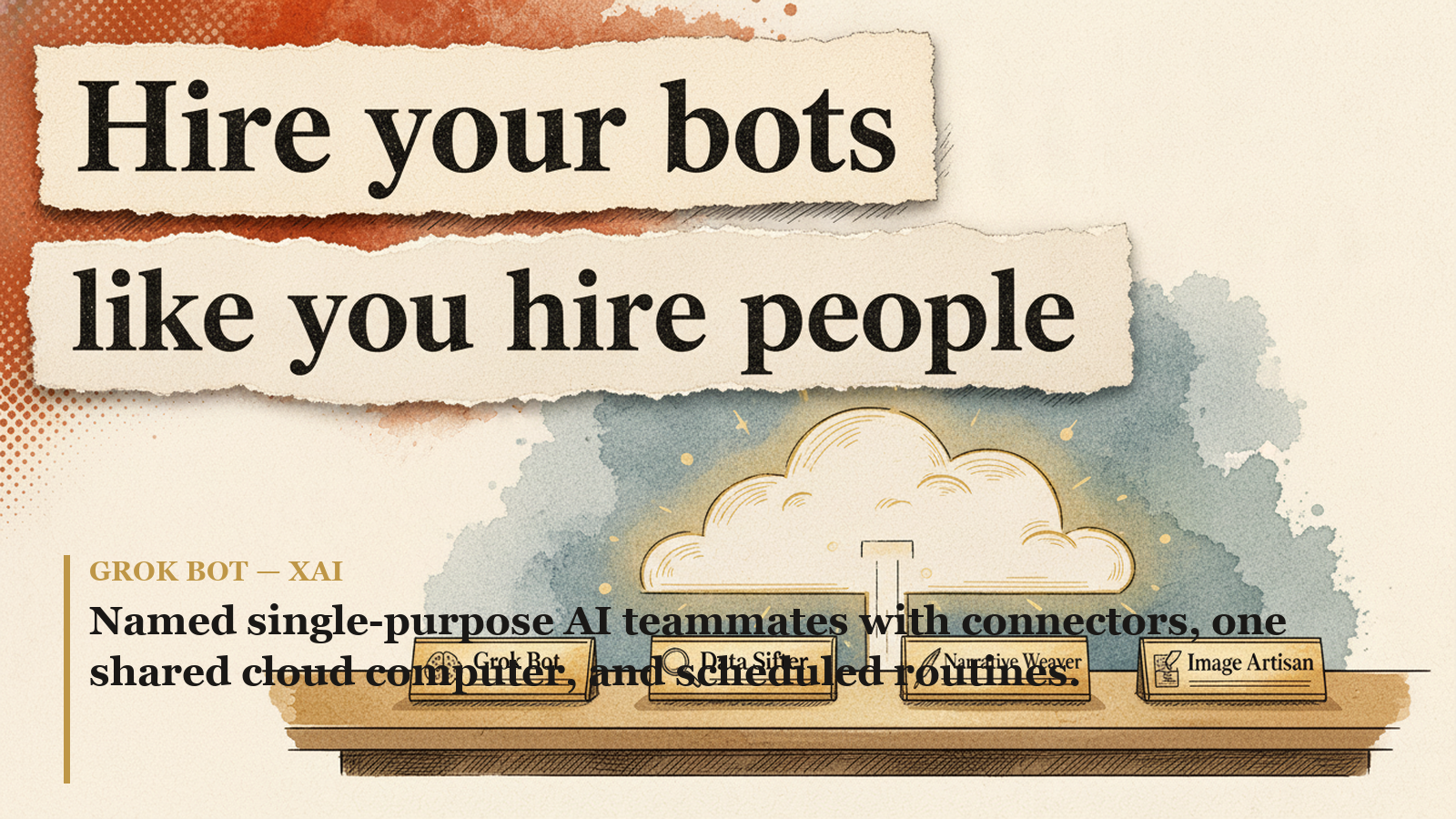
The second decision is the one competitors skipped. Grok Bot gives every bot its own computer and its own credentials.
You're onboarding these super intelligent new colleagues, these AI bots, and you're asking them to share the same computer that you have. It's crazy.
Roman Ugarte, SpaceXAI
You would never onboard a human hire by sitting them next to you, sharing one laptop, trading passwords, and tripping over each other all day. The reframe is the whole product: not "AI chat with a set of connectors" but "a colleague with a computer." Once a bot has its own environment, you stop asking it questions and start delegating jobs.
Ugarte's guess for why rivals missed it: they bolted agents onto an existing coding-assistant platform, while his team started from scratch for general knowledge work. Starting clean was the freeing, unobvious call.
Hide the machinery
The same instinct runs through the smaller choices. Competitors build automations through a trigger-builder sidebar: press plus, pick an event, pick an action, wire it up. It's clunky, so people rarely bother.
Grok Bot lets you say "remind me at 8am every day" in plain language and never see a builder interface. Ugarte claims that is now how 99% of automations on the platform get created — an internal number, worth treating as his, not gospel.
Power-user abstractions get buried too: a user should never need to know what a skill is or type a slash command. Those still exist; they're just primitives the bots reach for in the background, not homework for the user. The features that delight developers are the ones mainstream users should never have to configure.
What builders can copy
Ugarte's advice for founders is not "find a moat." It's make something that is not possible now possible, then ship fast enough that this quarter's hacks become next quarter's baseline — and get deleted. Doing that repeatedly is what earned user trust.
His summary, by way of Lenny: build something people are obsessed with, and don't over-think the moat. Cursor, where Ugarte led Growth, won in a market with arguably no moat by pairing a data feedback loop with a best-in-class daily experience.
One caution before you copy the playbook. This is the builder's account of his own product, and the "colleague with its own credentials" design that thrills a solo power user is exactly what an enterprise security owner scrutinizes hardest.