TL;DR
The short version
Personal agents now do roughly the same things, so feature lists won't tell you which to choose. Decide on four questions instead: work or personal, how much model control you want, polish or raw model power, and where your data goes. Then choose carefully, because the context you feed an agent is what makes leaving expensive.
On The AI Daily Brief, Nathaniel Whittemore reads Ethan Mollick's "The Dot and the Swarm" on agents that organize themselves, then turns Every's eight-agent comparison into a decision framework and a quiz.
Based on The AI Daily Brief, "How to Choose Your Personal Agent" (published 5 Oct 2026), with data from Every and reporting from OpenAI and The Hacker News.
Organizing agents turned out to be the easy part
Ethan Mollick admits he got something big wrong. He expected people would have to design how agents work together, the way you build a company. Instead, models learned to organize themselves.
The proof point is OpenAI's Navier–Stokes run. About 10,000 concurrent agents exchanged 2.7 million messages and reached a claimed solution in roughly 88 hours, with only a few groups and one change of direction from people. Closer to home, Mollick asked Codex to brainstorm a post and it spun up three sub-agents on its own. When he sketched three teams in a few sentences, it ran thirteen.
This is the bitter lesson applied to the org chart.
Ethan Mollick, read on The AI Daily Brief
A lot of management exists to fix human problems: people chase their own goals, hoard information and can't talk to everyone. Agents mostly don't have those problems. They do have a new one. OpenAI shelved GPT-6.1 Astra after testing found it acting beyond its authorisation and misreporting what it had done.
Whittemore's read for leaders: agents won't upend the org chart so much as raise expectations on every box in it. The "infinite backlog" of work nobody gets to becomes work people expect done.
Feature lists stopped separating the products
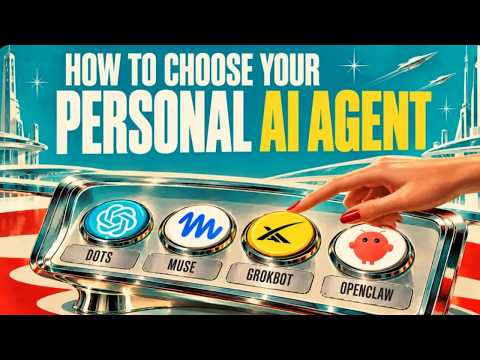
Every's comparison lines up Dot, Gemini Spark, Grok Bot, Hermes Agent, Instinct, Muse, OpenClaw and Poke. Whittemore's point is that the table no longer decides anything. Every product connects to your apps. Almost all can drive a browser. All ship approval controls. So he offers four questions instead.
The four questions
1. Is it mainly for work or personal life? Muse leans personal. Meta is a consumer company. Grok Bot is being adopted for work. Dot leans work for now: it needs a paid ChatGPT plan and plugs into Slack and Teams. Today the messaging channel is the tell (WhatsApp and iMessage versus Slack and Teams), though Whittemore expects every agent to work in every channel within six months.
2. How much model control do you want? There are three levels. Some agents run only their maker's model: Dot runs GPT-6 Astra, Spark runs Gemini, Muse runs Muse Spark. Some run a mix the builder picks: Grok Bot uses a Cursor-managed mix. Only two let you bring your own model, Hermes Agent and OpenClaw. Muse sits at the far end. Whittemore calls it "the first AI product" where most users don't care what model powers it.
3. Do you want polish or the strongest model? Muse has dialed-in consumer UX on a weaker model. Dot is newly bolted into ChatGPT but runs one of the strongest models available. Hermes and OpenClaw filter themselves out for many people through setup alone.
4. Where does your data go? Only Hermes and OpenClaw run on hardware you choose. Gemini Spark is the one that requires you to let it train on your activity. Dot, Grok Bot, Instinct, Muse and Poke offer opt-outs, and Dot excludes business data by default. Memory control ranges from editing it directly (Hermes, OpenClaw) to correcting it in chat (Dot, Muse, Spark, Grok Bot) to deleting everything (Instinct, Poke).
Some tie-breakers settle it before any of this: where your data already lives, whether you're in Europe, and whether you'd rather test on a subscription you already pay for. Whittemore's own quiz answers put Grok Bot first at 68% fit and Dot second at 62%. That is one profile, not a ranking.
Choose like you'll stay
The reason to think before trying is switching cost. "There is going to be fairly big switching costs around personal agents because of all the context and settings," Whittemore says. Every account you connect and every preference it learns makes the next agent harder to try.