TL;DR
The short version
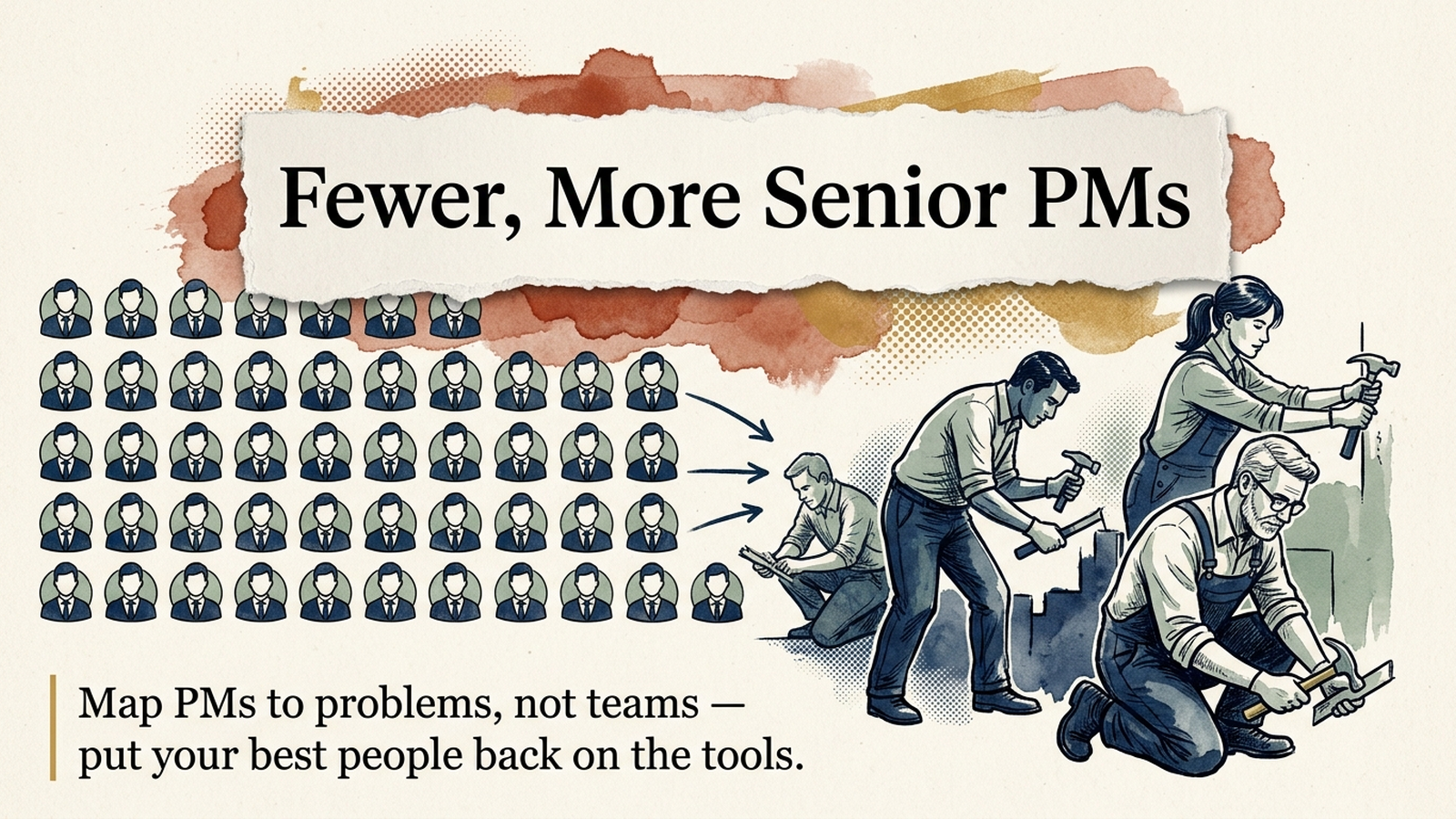
AI collapsed the cost of turning judgment into shipped software. So the winning product org isn't layers of PMs coordinating — it's fewer, more senior people making the calls hands-on. Map PMs to problems, not teams. Hire one only for a named need, never by default — and only if they beat "nobody."
Whatnot's CPO Tom Verrilli and Peter Sellis (Snap/Discord) land on the same density cut. Elena Verna (Lovable) adds the HI-IC seat: when build cost falls below coordination cost, change the org chart — information, authority, scope, short approvals, and pay decoupled from headcount.
Built on Tom Verrilli and Peter Sellis on Lenny's Podcast, plus Elena Verna's 2026 HI-IC summit cut (Lovable).
The pod ratio built the glut
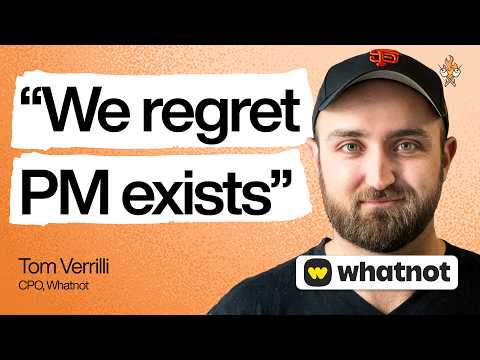
Scaling to billion-user products taught the industry one default: every six-engineer pod gets a product manager. Do that at scale and headcount explodes past need — most infrastructure work never needed a PM at all. Verrilli's deliberately provocative premise is that his org regrets product management exists: not a ban, but a forcing function against adding a PM by reflex.
The cost isn't just payroll. It's atrophy. When every decision routes through a PM, the people closest to the work stop making product calls.
Hiring so many PMs infantilizes the engineers and the designers who are perfectly capable of making good decisions, but just never had to because there was always a PM to babysit them.
Tom Verrilli, Lenny's Podcast
So the rule flips: hire a PM only for a specific, named need. Let engineers and designers keep the reps.
Map PMs to problems, not teams
The second move is to stop attaching PMs to standing teams. Whatnot replans every six months, names a directly-responsible individual per outcome, and reassigns PMs to wherever the hard problems are. A team can go a year with no attached PM despite shipping the whole time — because accountability tracks the problem, not the org chart. The DRI isn't always an engineer or a designer; it's whoever owns the outcome.
This also strips out the layer that rewards the wrong skill. Interviews heavy on "driving alignment" and stakeholder management screen for politics, not product — the thing a coordination-free org has no room for.
Seniors go back to IC because it's the leveraged move
The counterintuitive part: your best people should be doing the work, not managing people who do it. At Whatnot, managers spend 90%+ of their time on IC work and the CPO around half. One senior PM spanning several surfaces makes the naturally-aligned trade-off that would otherwise cost months of cross-team politics — Verrilli merged ads into discovery under a single owner and skipped the negotiation entirely.
We took all of our A players and then promoted them out of doing things. Why wouldn't you want Messi playing for your team rather than trying to have the academy coming along all the time?
Tom Verrilli, Lenny's Podcast
AI is what makes this pay off. Two unlocks do the heavy lifting: talking to Claude about the codebase instead of interrupting an engineer to scope work, and pulling nuanced cohort data in minutes — "Hex threads" that deliver what took an Amazon L7 a week back in 2017. The coordination tax that justified the management layer is gone, so a senior operator is more leveraged hands-on than supervising. The corollary: "hire great people and get out of their way" is the wrong model. Verify, then trust — stay in the weeds because AI now lets you query ground truth in real time.
The median is the problem — Sellis's power law
Verrilli's cut is org design. Sellis names the talent distribution underneath it. Skill among PMs is a power law once you select the right tail: the great ones leave to become founders and executives; the weaker ones cling — and ZIRP made PM the most lucrative non-technical tech job, which inflated the left side of the curve.
The great product managers are exiting the system. They're becoming founders. They're becoming executives. [...] the median product manager is actually probably pretty bad.
Peter Sellis, Lenny's Podcast
His hire rule matches Verrilli's forcing function almost one-to-one: Snap's baseline was that the product should run without a PM; a PM must add value over absence — the same skepticism Nikita Bier voices as "PM isn't real." Evaluate person × place for net-positive; don't hire by pod ratio. Same density thesis, Snap/Discord evidence — reinforcement of Verrilli, not a rival camp.
When build < coordinate — HI-IC as the rational seat
Elena Verna's Lovable cut is the same density thesis from the growth-IC seat. A high-impact IC finds the problem, decides, executes across functions, ships, and owns the outcome — a charter that needed a team five to ten years ago. AI is "average intelligence" in adjacent crafts; exceptional craft and learning loops stay human.
When the cost of building falls below the cost of coordinating, the org chart should change.
Elena Verna, Lenny's Podcast
HI-IC is an org operating system, not a title: information at fingertips, authority with accountability, scope not gated by function, short approval chains when experiments are cheap, and pay/status decoupled from headcount. Management should be a chosen career path with equal status — not the default promotion. A survey she ran found 42 of 51 people-managers wanted back to IC work (self-reported, unreplicated). Identity mourning after leaving management is real; name it.
A bet, not a law
This is a founder-side operating philosophy from a company actively recruiting PMs, presented as right for one culture. Verrilli explicitly says to assume at least half of what he's said is wrong, and expects the industry to bifurcate. Sellis's independent Snap/Discord framing — median-PM power law, hire only if they beat nobody — is reinforcement from another high-scale consumer seat, not proof the model is universal. The counter-case remains real: many product leaders argue AI raises the floor and makes more PMs viable by clearing away grunt work, not fewer. The durable skill underneath both camps is the same — understanding customer, business, and code well enough to make fast, correct calls.
Surface: "everyone must PM" vs fewer seniors
Anthropic's Ami Vora and Mike Krieger opened a 2026 Lenny summit panel on the vibe flip from "AI makes PMs obsolete" to "everyone needs to become a PM." That slogan tensions with this page's density thesis.
Possible reconciliations — not resolutions: (a) "everyone PM" means craft skills diffuse to eng/design, not more PM headcount; (b) labs need more convenors while scaled products need fewer coordinators; (c) the industry is bifurcating. Keep both citations. Panel content folds into AI-Native Product Management; do not overwrite this density thesis.