TL;DR
The short version
Anthropic economist Peter McCrory argues AI has caused no material rise in unemployment because, so far, it augments skilled workers instead of replacing them. True — but it's a description of what happened, not a law about what must.
The economics leave both paths open, so the deciding variable is the story leaders tell. An "augment and expand" narrative makes executives deploy AI to grow each person's scope; a "cut headcount in half" narrative makes them fire. The narrative shapes the deployment, the deployment produces the outcome, the outcome confirms the narrative — so pick it deliberately, and don't let the upbeat version hide the one place the data is already soft.
Drawn from The AI Daily Brief (Nathaniel Whittemore, 25 Jul 2026), reading Peter McCrory's essay "Why hasn't AI increased unemployment?"
A finding about the past, an instruction for the future
The headline is real: "In my view, AI has caused no material increase in the unemployment rate to date." The US sits near full employment (4.2% in June 2026, per the BLS), and even workers in highly AI-exposed roles show no unexpected jump in unemployment.
The mechanism McCrory names is that AI is skill-biased and labor-augmenting — it complements domain expertise rather than substituting for the worker. The reason it complements is the jagged frontier: capabilities are advancing fast but stay "stubbornly jagged," so expert oversight is still needed to steer the model and recover when it falters. The operator's move is to read that forward. It tells you augmentation is the available path — not that it's the automatic one.
The narrative is the lever
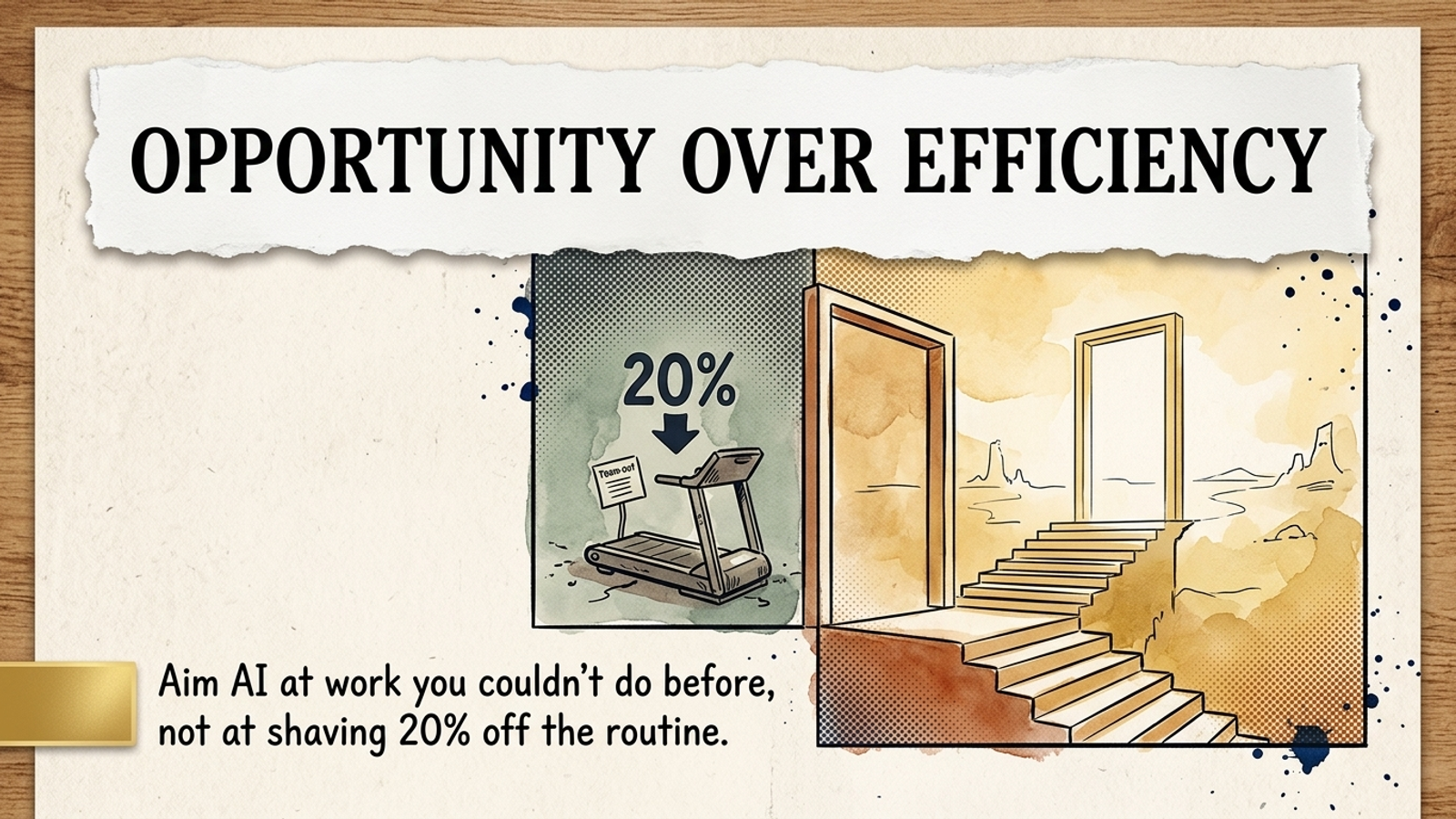
The sharpest point in the episode isn't the data — it's what a leader does with it. The story you adopt about AI and labor is an input to how you deploy AI, not just commentary on it.
The more that the discourse and narrative shifts from efficiency and cost cutting and headcount reduction to augmentation and expansion of responsibilities… it has a self-reinforcing impact in how executives and leaders think about how they should be using AI.
Nathaniel Whittemore, The AI Daily Brief
Point the same capability at "expand what each person can do" and you get bigger scopes, more ambitious projects, more work pulled in. Point it at "do the same with half the people" and you get layoffs. The technology is identical; the org outcome forks on the framing.
The economics leave the fork open — so retrain toward the premium
Augmentation isn't wishful thinking; it has a mechanism. Automating some of a role's tasks re-bundles the role and raises the marginal product of the labor left over, rather than deleting the job. But which part of a role is durable is not fixed — AI moves the line.
McCrory is explicit the pattern could break as agents get more autonomous and recursive self-improvement kicks in. The augmentation window is a choice available now, not a permanent guarantee.
Don't let the story bury the soft spot
The one place the data already bends is entry-level hiring. As one hiring-manager framing in the episode put it: "The real impact may show up first in hiring, not layoffs. Fewer junior roles, smaller teams, slower backfilling… One person using AI may increasingly replace several people who are not." The headline unemployment rate can stay flat while junior roles quietly stop being backfilled.
The honest version of the augmentation narrative grows senior scope and keeps a deliberate on-ramp for the juniors the market is no longer forcing you to hire.
"Power tool, not pink slip" — with a mandate attached. A 2026 instance: a finance-vertical AI aimed squarely at what junior bankers do all week, read not as a replacement but as "a power tool for junior bankers," with accountability and iteration keeping senior humans in the loop. The forcing function is now explicit on the worker side — UBS requires AI proficiency for its 2027 junior-banker and intern intake. The augmentation story made operational: the juniors keep their rung, but entry now demands the skill.