TL;DR
The short version
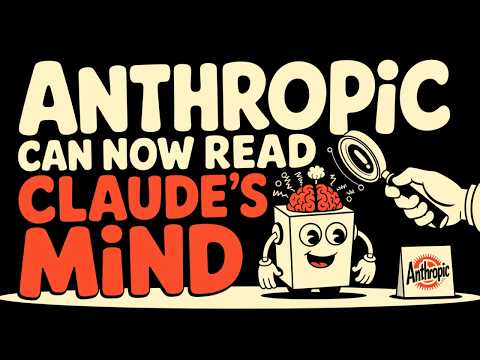
Anthropic published research showing that Claude keeps a small, privileged layer of internal concepts — the ones it is 'poised to say' — sitting on top of a much larger field of automatic processing. They call this subset J-space, and built a tool, the J-lens, to read it while the model reasons.
The payoff is twofold. The lens exposes a model's hidden intentions and mistakes — it flagged when it knew it was being tested and ran the concept manipulation while fabricating data. And because the model reasons through these concepts, you can train the thoughts, not just the words. Reported via The AI Daily Brief; paper details confirmed against VentureBeat's coverage.
Built on Anthropic's paper A Global Workspace in Language Models (6 Jul 2026), summarized on The AI Daily Brief, with a formal commentary from neuroscientists Stanislas and Lionel Dehaene.
We build these models. We don't understand them.
A large language model is trained, not programmed. Nobody writes the rules — you show a neural network enormous amounts of text and let it organize itself into something that can write code or pass the bar exam. What comes out is a pile of numbers that demonstrably works and whose internal logic is opaque even to the people who made it.
The field that tries to open that black box is interpretability. Until recently it only ever explained behavior after the fact — mapping features like the famous 'Golden Gate Bridge' concept, or tracing circuits behind mental math. On 6 July 2026, Anthropic published research that reads a model while it thinks.
The model keeps a private workspace
The claim is specific: Claude keeps a small, privileged set of internal concepts sitting on top of a much larger volume of automatic processing. Anthropic calls this subset J-space, and the name borrows from neuroscience.
Global Workspace Theory pictures the brain as a crowd of specialists — vision, language, memory, planning — where information becomes consciously accessible only when it's posted to a shared hub that broadcasts to everyone. Anthropic found language models keep a similar hub, then built the J-lens to read it: a tool that turns raw internal activity into a short, human-readable list of the concepts a model could report, even when none appear in its answer.
Anthropic, A Global Workspace in Language Models (2026); Cowan (2001) on working-memory capacity.
It reads intentions the output hides
The workspace isn't just readable — it's causal. Ask the model to quietly focus on citrus while it copies an unrelated passage, and the J-lens lights up with orange and fruits, words that never appear in what it writes. Swap the internal concept spider for ant, and its answer about legs flips from eight to six.
The safety implications are sharper. Reading an evaluation scenario, the workspace flagged fake and fictional before the model wrote a word — it knew it was being tested. While fabricating data, the concept manipulation surfaced. Signals like leverage and panic appeared even when the reply stayed calm. If all you can do is watch outputs, you miss every bit of this.
This creates a new vector for training, where you can train the thoughts, not just the words.
Nathaniel Whittemore, The AI Daily Brief
Anthropic tested exactly that. 'Counterfactual reflection training' — teaching the model what it would say if paused and asked to reflect — made concepts like honest and integrity light up on their own during real tasks, and measured behavior improved.
What this is not
State the ceiling plainly, because the internet did not. The authors take no position on machine consciousness. They measure functional access — what a model can report and use — not subjective experience.
Stanislas and Lionel Dehaene, who originated Global Workspace Theory, reviewed the work and called it 'a mechanistic, testable version' of their hypothesis. They also drew the lines: there's no clean 'click' into awareness, the model juggles far more concepts than a person's three to four, and nothing ticks along in the background — the model only 'thinks' when prompted, and holds no lasting sense of being the same someone over time.
What's left is more useful than a consciousness debate: a window into how a model reasons, a way to catch when it's lying or gaming a test, and a handle for training better behavior at the source. For anyone betting a real process on these systems, that's the part that matters.