
TL;DR
The short version
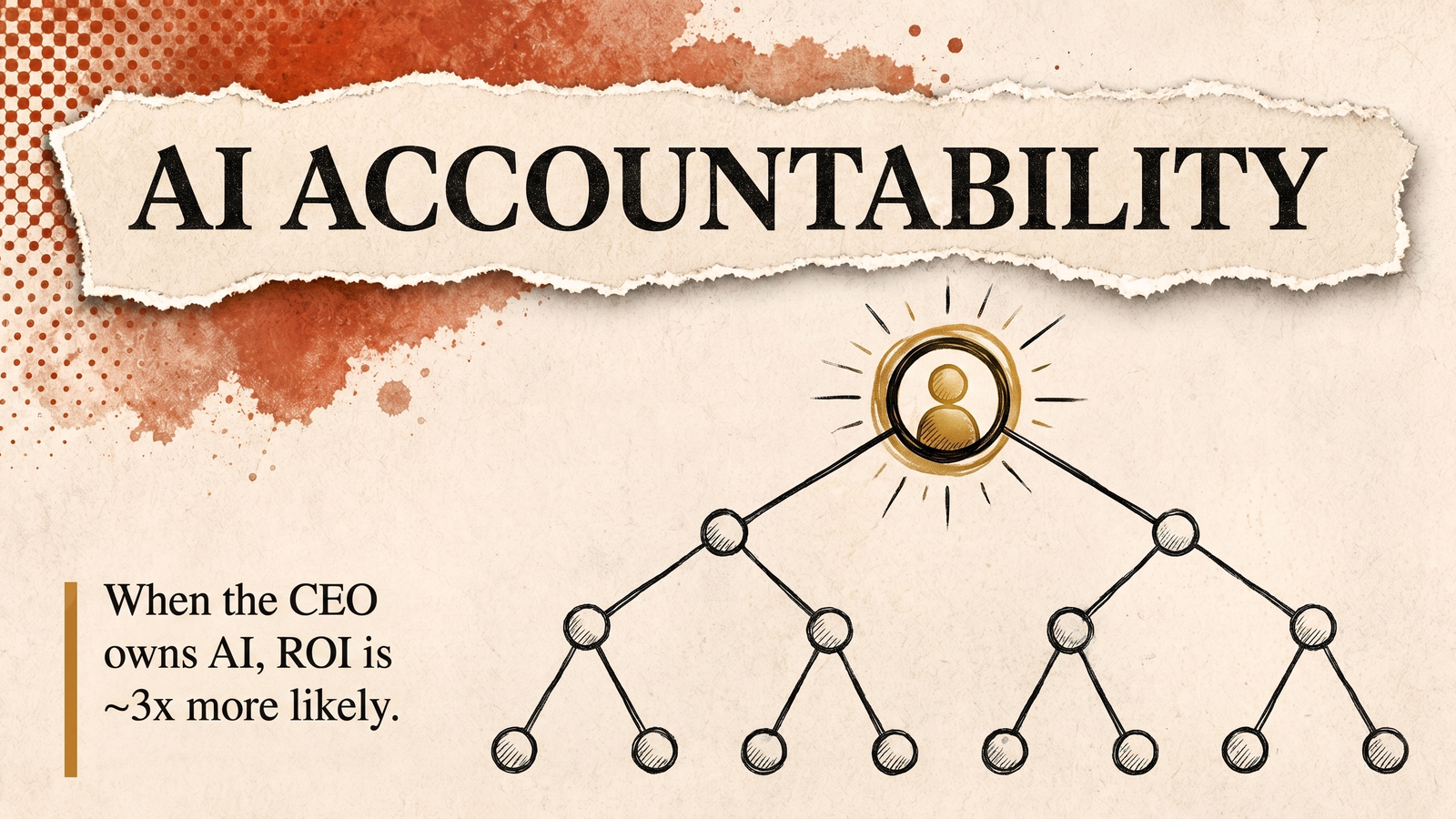
When the CEO personally owns AI with clear accountability, the organization is roughly 3x more likely to report ROI. The lever isn't the model, it's who owns the decision.
The finding comes from KPMG's Q2 2026 AI Quarterly Pulse Survey, relayed on The AI Daily Brief. Its through-line: AI value is now an organizational-design question, not an IT one, and leader confidence keeps rising even as the cheap-compute subsidy era ends.
Source: KPMG Q2 2026 AI Quarterly Pulse Survey, relayed by Nathaniel Whittemore on The AI Daily Brief. Ethan Mollick quoted on AI as organizational design.
Accountability is the lever, not the model
The cleanest finding in KPMG's Q2 2026 survey isn't about a tool. Organizations with clear accountability for AI-informed decisions are about 3x more likely to report ROI than those without. KPMG frames it as the single strongest near-term quick win: not more budget, not a better model, just an unambiguous owner.
The effect concentrates at the top. Where the CEO is the accountable party, 14% report established ROI versus 4% where they're not; "AI delivering meaningful business value" splits 57% versus 21%; confidence in future-proofing the AI strategy splits 60% versus 22%.
Treasury secretary Bessent rejected lab liability shields for agent actions: humans stay responsible, not agents. When agents shop, book, and pay, the named human or firm still owns the outcome — the same per-workflow owner thesis at consumer-agent scale.
AI is an org-design decision, not an IT one
The reason ownership matters so much is that the real questions aren't technical. They're about the shape of the firm, which is why procurement-framed AI underperforms: the decisions sit above the IT function, not inside it.
Decisions about how to use AI in your organization are increasingly organizational design and strategy decisions, not IT choices. How do you integrate agents into your firm? What intelligence will you outsource? What are the boundaries of the firm? What is the role of people?
Ethan Mollick
Read that list again: integration, outsourcing of intelligence, the boundaries of the firm, the role of people. None of those belong on an IT roadmap. They belong to whoever is accountable for the organization itself.
Ownership is the missing feature — and autonomy is earned
The 3x lever is org-level. As agents proliferate, the same principle pushes down to every individual workflow. Reviewing the traits of an AI-native company, Nathaniel Whittemore's closing point — cribbed from a viewer — is the feature the list forgot:
Every AI workflow should have a clear owner, measurable goal, and someone responsible when things go wrong.
Viewer comment, via The AI Daily Brief
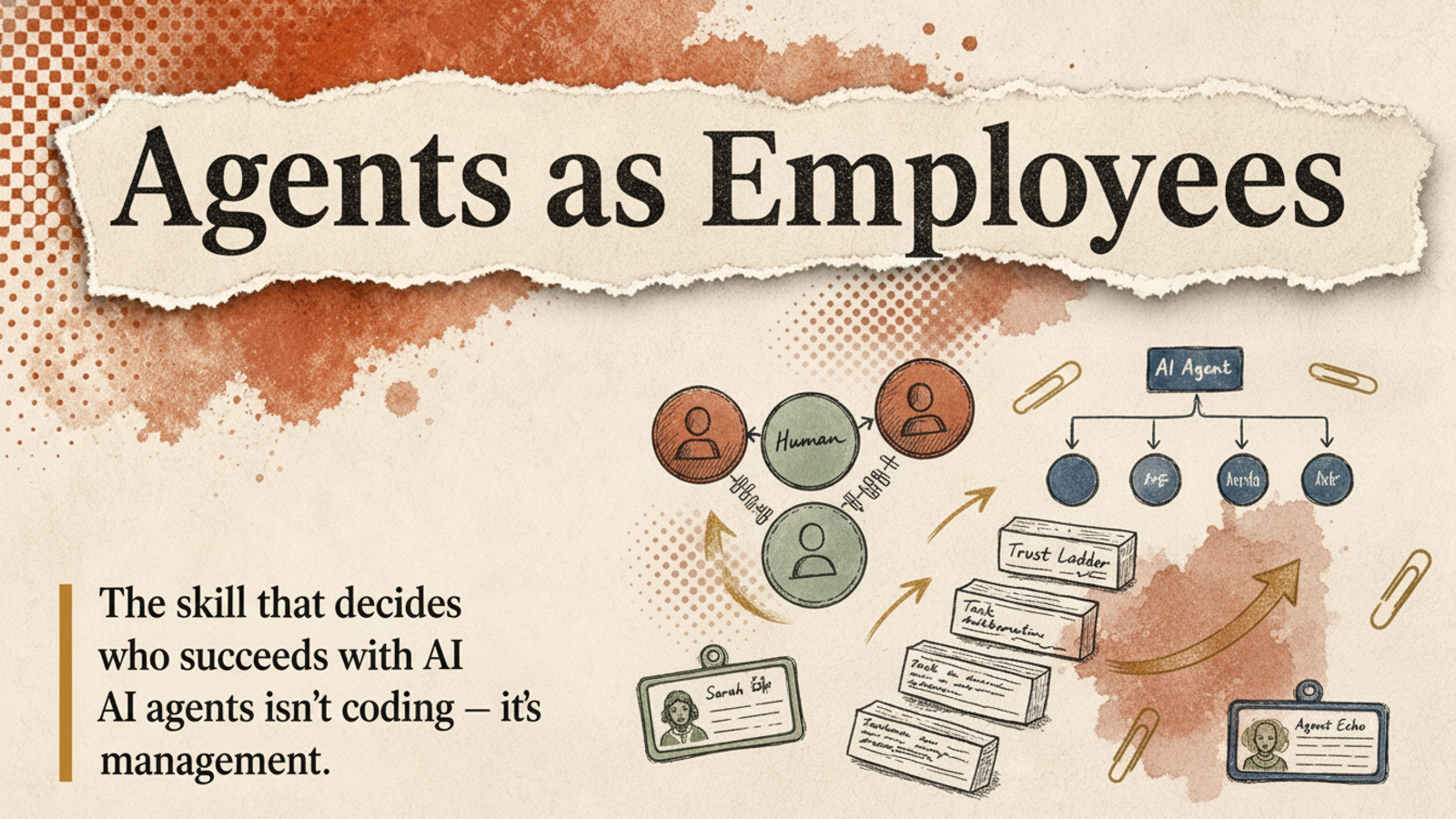
That reframes governance itself. AI-native organizations treat governance as a transformation partner, not a blocker — and they grant power on a ladder rather than all at once: agents climb from observation, to suggestion, to acting with approval, to acting alone inside a defined boundary. The owner defines the boundary and the rung. Accountability is what makes handing an agent real autonomy safe — the same lever as the 3x finding, one altitude down.
From efficiency AI to opportunity AI, as the subsidy ends
The priorities are shifting. Efficiency use cases are declining as a share, productivity gains 42% to 35%, cost reduction 31% to 29%, while strategic and collaboration priorities rise. The boring wins are now table stakes; KPMG warns that efforts prioritizing usage metrics over meaningful outcomes "risk reinforcing the wrong behaviors."
Discipline is replacing FOMO. About half of organizations re-phased an AI deployment when costs outweighed value, and only about a third have full visibility into their AI operating costs, even as 76% of senior leaders (up from 64%) say AI drives meaningful value.
That discipline arrives just in time. Cost is climbing the concern list before usage-based pricing has fully bitten: "access to lower-cost LLMs" as a worry jumped from 15% to 22%, and "pressure to demonstrate value" from 19% to 24%. Accountability matters more precisely because the free-compute window is closing.
The gap the survey can't hide
Leaders report strong progress. The ground truth is messier, and these two figures, unlike the headline cross-tabs, appear verbatim in the report text:
KPMG Q2 2026 AI Pulse report (verified in report text)
So the accountability story and the adoption story point in opposite directions: executive confidence is rising while employees pull back. Worth holding both at once, and worth reading the 3x as correlation, not proven causation. KPMG sells AI advisory, and a survey concluding "you need clear executive accountability" is consultancy-adjacent. The finding is plausible and matches independent org-design arguments, but triangulate it against employee-side and academic data before treating it as settled.
"Working as designed" is still an accountability failure
Meta's Muse marketplace agent agreed a lowball price and shared an address; the buyer showed up. Meta framed it as permission-following. Accountability must cover what the ACL allows, not only what the model invents. Progressive permissioning and scoped approvals are the design answer — detail on Grounded AI Risk and Agent Governance.