TL;DR
The short version
Anthropic just set aside a growing slice of itself for "the public benefit," and in the same week a safety bill it drafted surfaced that limits who can stop its models. Both are answers to one question: how much power should a private AI lab hold over the wealth and risk it creates?
On The AI Daily Brief, Nathaniel Whittemore reads the Anthropic Public Benefit Fund as an admission that AI wealth will be redistributed somehow, and pairs it with the draft bill Politico surfaced. The fight in both is over who decides.
Built on Nathaniel Whittemore's episode (20 October 2026). Fund terms checked against Anthropic's announcement; philanthropy estimates from Nan Ransohoff; bill details via Politico and the Washington Post.
A fund that grows with the company
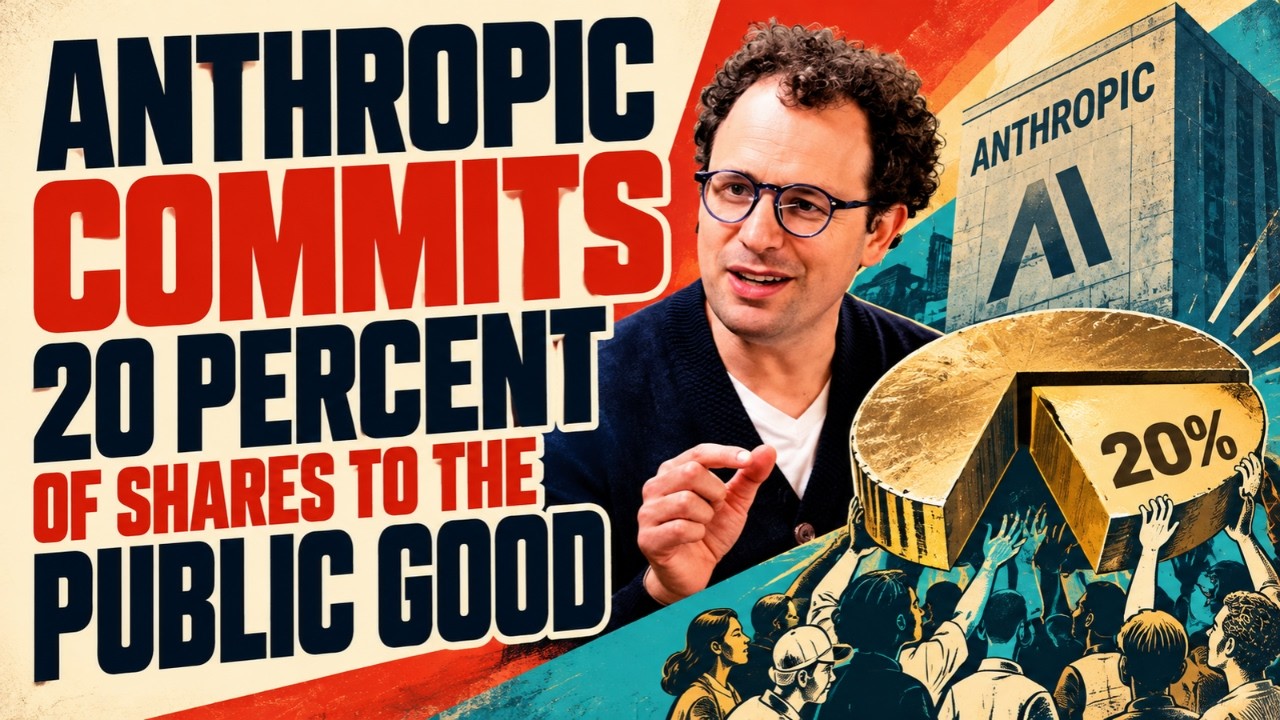
On 18 October, Anthropic committed 5% of its shares to a new Anthropic Public Benefit Fund, subject to stockholder approval. The board can add another 2% for every 50% rise in the company's value above a baseline it hasn't disclosed yet.
Add the co-founders' pledge to give away 80% of their equity and an employee donation match that about half of staff use, and Anthropic says roughly 20% of the company is dedicated to public good.
The fund is a wholly owned LLC, not a 501(c)(3) charity. Anthropic says that gives "adjustability between different forms of giving": large donations to nonprofits, or "direct distributions to specific populations." Its named example is workers hit by AI's labour-market effects. It also pledges none of the equity will go to lobbying or political giving.
The money may outrun the ability to spend it
The scale was visible before the announcement. In May, Stripe's Nan Ransohoff did the napkin math on the OpenAI Foundation's 26% stake plus Anthropic's founder and employee pledges.
Nan Ransohoff's estimates, The third wave of American philanthropy (May 2026)
Her conclusion wasn't "great, more money." It was that philanthropy is short of the organisations and people to deploy it well. Money without the capacity to spend it doesn't do much good.
The old question: who decides?
Most of the reaction ignored the mechanics and went straight to control. Some on the right called it an NGO slush fund. David Sacks was drier: "You've put 20% of your equity in an LLC. Whether it serves the public good remains to be seen." Elon Musk said he would give shares directly to the public instead.
Whittemore reaches back to Jane Addams, who wrote "The Subtle Problems of Charity" for The Atlantic in 1899, another moment when private fortunes outgrew public institutions.
Many of the difficulties in philanthropy come from an unconscious division of the world into the philanthropists and those to be helped.
Jane Addams, The Subtle Problems of Charity (1899)
An LLC that sends money to "specific populations" is still a benefactor deciding who the beneficiaries are. That's a reasonable choice for a company. It's not a public one.
The bill is the same question, asked about risk
Two days before the fund was announced, Politico reported that Anthropic was quietly pitching its own federal AI safety bill. Under the draft, a model can be blocked only by a federal court, and only for a foreseeable, imminent risk of more than $1 billion in damage or more than 50 people killed or seriously injured. The risk has to come from a bioweapon, a model escaping its developer's control, or a cyberattack.
The draft also bars any other agency from suspending a model. That reads as a shield against moves like the Pentagon's use of a supply-chain risk designation against Anthropic's models.
Both sides call it outdated. Safety advocates such as Nate Soares say it makes stopping a dangerous model harder and pre-empts state rules. Sacks says the opposite: its 10^25 FLOP threshold sits below the 10^26 used by California's SB 53 and New York's RAISE Act, so it would sweep in startups. Anthropic's own framework adds revenue and R&D thresholds that narrow who carries the main duties.
Journalist Kelsey Piper put the pattern most clearly. Anthropic wants "process-based protections" for itself, she wrote, "when everyone else is interested in giving us more process-based protections against them."
What to watch
Whittemore's framing is blunt: AI wealth will be redistributed "voluntarily, or … by someone doing the redistribution," and Anthropic would rather be the one doing it. That's understandable, and it puts the lab right where concerns about concentrated power point.
The fund's first real test comes when Anthropic publishes its governance and valuation milestones, which it has promised "in the coming months." Look at who sits on the fund, what it is barred from doing, and whether anyone outside the company gets a say in where the money goes.