TL;DR
The short version
Stop picking the best model; start building a learning loop. The durable asset isn't the AI you rent — it's the harness, private evals, and feedback traces that turn your company's judgment into IP that survives swapping any model out.
Every firm now carries two balance sheets: human capital (judgment, taste, relationships) and token capital (the AI capability it builds and owns). Value comes from the loop that compounds them. The test of control is simple: can you swap the generalist model without losing the company-veteran expertise baked into your system? If not, you don't own your AI.
Built on three The AI Daily Brief episodes (Nathaniel Whittemore), framed around Satya Nadella's essays on the AI-era firm and the "Reverse Information Paradox."
An AI strategy is the wrong unit
Picking the right vendor — the Magic Quadrant instinct — is a tiny part of real organisational change. AI's depth of interaction with existing systems demands systems-level thinking, not procurement. As Whittemore puts it, "you don't need an AI strategy, you need an AI learning system."
Nadella's framing splits the firm into two kinds of capital: human capital (knowledge, judgment, relationships, pattern recognition) and token capital — the AI capability the firm builds and owns. Token capital grows from human direction; without it, you have "compute running in circles." Where firms once owned people, processes, and IP, the new asset is a compounding cognition loop.
Why you must own the loop: the Reverse Information Paradox
Nadella's later essay names the mechanism. It inverts economist Kenneth Arrow's classic information paradox — a buyer can't value information until it's revealed, by which point it's already been given away. Here the model provider learns from your exhaust — your prompts, corrections, and traces — so value converges to whoever owns the learning infrastructure.
You essentially pay for intelligence twice: once with money, and again with something even more valuable — the proprietary knowledge you must reveal to make that intelligence useful.
Satya Nadella
The fix is to keep organisational memory in your own tenant and decouple orchestration from any single model. Vercel's Guillermo Rauch states the same instinct as a rule: make the model a cog in a machine you own; don't outsource your brain.
Model independence is the sovereignty test
The whole thesis reduces to one test: a company should be able to swap out a generalist model without losing the company-veteran expertise built into its learning system. If swapping the model resets your accumulated expertise, the expertise was never yours — it lived in the vendor's weights, not your system.
The learning loop is where that expertise lives. Capture workflow traces, corrections, accepted and rejected outputs; feed them into private evals and reinforcement environments so the system improves with every use. Nadella calls it a "hill climbing machine" that compounds and is hard to replicate. "You can offload a task or even a job, but you can never offload your learning."
Open weights make the loop trainable
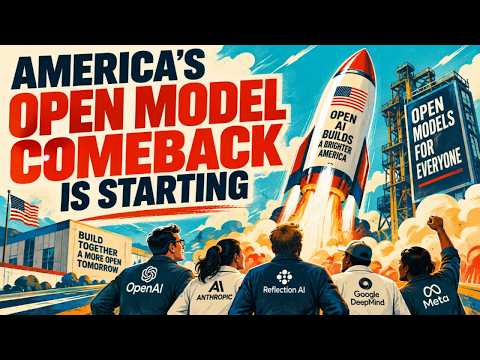
The open-model argument has a new frame. It used to be about market shocks and China. Now, as The AI Daily Brief puts it, it's also about enterprise tuning. Builders already run plenty of new work on Chinese open weights hosted in the US, and when someone pushed back that it didn't seem cheaper than a closed model, the answer was short: “You cannot fine-tune Luna.”
Nadella's essay turns the learning loop into a perimeter: a trust boundary where an organisation's “data, traces, evals, adapted weights, and memory accumulate and improve together,” and every firm's right to train its own models on model outputs.
Two routes are now for sale:
- An open model inside your boundary. Reflection's “AI factory” combines your data, its open model and your compute, on the logic, per Axios, that a lower-tier open model plus high-quality company data can rival frontier systems in certain situations.
- A closed model tuned for you. Microsoft's Frontier Tuning; Microsoft says a McKinsey-tuned model beat GPT-5.5 on quality at a tenth of the cost. That's a vendor claim from one customer.
Either way the sovereignty test holds: the adapted weights and traces have to stay yours.
Short-term arbitrage, long-term ownership
The operator move is two-sided. While the labs fight a subsidy war — trials extended, usage limits reset, tokens sold below cost — exploit the cheap capacity now. As one developer put it, capacity wars between labs are one of the best things that can happen to the people building with them.
But that arbitrage is temporary and vendor-controlled. The durable position is still to own the learning loop, so the value you generate doesn't accrue to the model provider when the subsidies stop. Cheap tokens are a tailwind to use, not a moat to rent — and the token-efficiency era brings a trap: a known-ROI bias that funds only what already pencils out, starving the experimentation the loop needs while practical agents are still only months old.