TL;DR
The short version
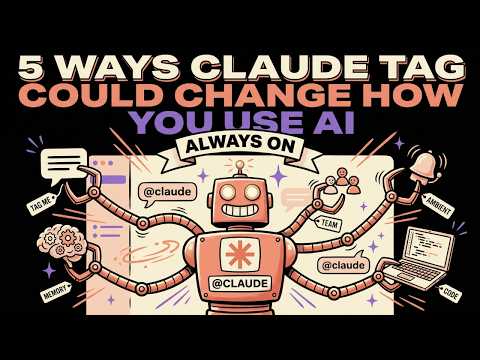
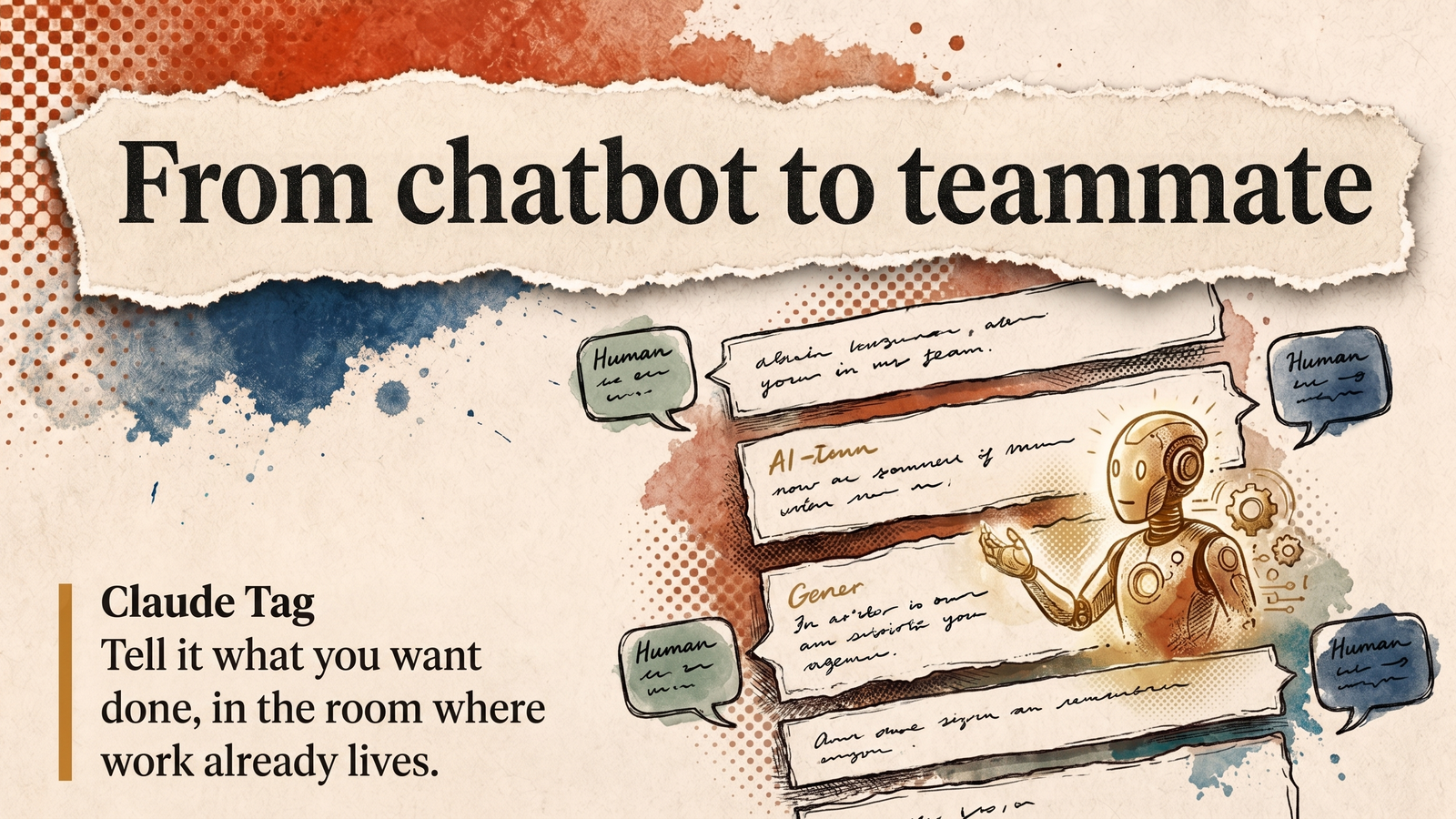
Anthropic shipped Claude Tag — Claude Code, made proactive, sitting inside Slack. You `@Claude` in a channel and one shared agent reads the team's context, runs its tools, and ships work back into the thread.
Read as a product it's unremarkable. Read as a signal it's five shifts at once: the interface moves to where work already happens, the agent becomes the team's rather than yours, delegation replaces prompting, and AI moves from a power-user habit to an organizational dependency. The hard part isn't the setup — it's the humans in the channel.
Built on Nathaniel Whittemore's breakdown on The AI Daily Brief, and Anthropic's Claude Tag announcement.
The mechanic, and the number that traveled
The mechanic is simple. You `@Claude` in a channel. One shared Claude per channel reads the context, breaks the request into stages, runs the tools it has access to, and replies in the thread with what it built — a merged pull request, a data pull, an incident write-up. It is Claude Code, made proactive, sitting where your team already works.
The figure that traveled: 65% of Anthropic's own product-team code now comes from its internal version of this, per the company's announcement. That's Anthropic reporting on itself, not an audited stat — hold it loosely. But the framing worth keeping is Andrej Karpathy's: this is the third redesign of how we interact with these models.
The first paradigm was that the LLM is a website you go to. The second was that it is an app you download on your computer. The third one is that it is a self-contained, persistent, asynchronous entity with org-wide tools and context working alongside teams of humans.
Andrej Karpathy
Five shifts, not one feature
If that's right, five things change about the job:
- Interface: from app-native to workplace-native. The full power of Claude Code now lives behind an `@` in the channel people already use, removing the biggest tax on adoption — leaving your tools to go somewhere else.
- Ownership: from private chatbot to shared teammate. There's one Claude per channel; anyone can see what it's working on and pick up where the last person left off.
- Context: from single-user to full-team. It builds context by following the channel, so nobody re-explains the project from scratch.
- Mode: from prompting to delegation. You tell it what you're trying to accomplish and hand it latitude — the same logic behind the long-horizon `/goal` commands now shipping across coding agents.
- Stakes: from personally useful to organizational dependency. AI stops being a few power users' habit and becomes something the whole team runs on.
Delegation is the one leaders should feel most. The bottleneck stops being can I write the prompt and becomes can I scope the goal and judge the output. That's a management skill, not a prompting skill.
The hard part is the humans, not the setup
The fifth shift is where the failure mode lives, and it isn't technical. The moment an agent joins a shared channel, it reads every message anyone types. One skeptic, Gail Weener, described the room honestly: the agent stops looking like a tool the team uses and starts looking like your tool, now sitting in everyone's workspace.
The power user can't win the frame — good output looks like outsourced thinking, bad output confirms the doubters. Dropping an agent into a shared space is a trust problem before it's a tooling problem.
Two things to watch
First, the "many Claudes" problem is real. Each channel's agent has different tools, permissions, and context, so as one early user put it, "none of the Claudes are mine." That gets confusing fast.
Second, weigh lock-in. Hugging Face's product head notes that building your own Slack agent is "quite simple" and buys you any model, no waitlist, and no single-provider dependency. The feature is easy to overestimate; the shift underneath it is easy to underestimate. Tell it what you want done, in the room where the work already lives — and manage the people watching it work.