TL;DR
The short version
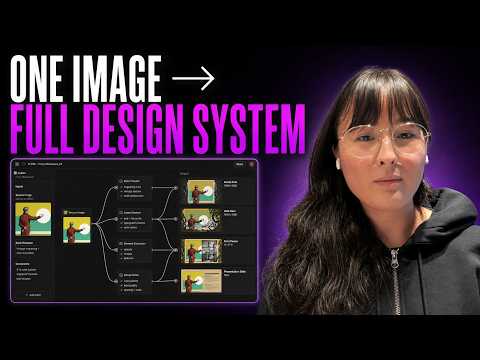
The leverage isn't the one-off AI output — it's packaging the process that made it into a reusable unit a non-expert can run. On a node-based creative canvas, a designer reverse-engineers a style prompt from a reference image, splits a model's variations into separate nodes, then codifies the whole graph into a named "technique" with defined inputs and outputs.
The payoff is the last step: she ships the technique as a one-field "app" where anyone types a theme and gets on-brand images without touching the canvas. The operator lens: your personal workflow is the asset, not the artifact. Separate the reusable template from the per-job input, make the process visible, then productize it so the bottleneck moves off you.
Drawn from Every's AI & I, Dan Shipper's interview with Katherine, a forward deployed creative at Flora. A vendor demo — capability shown, not independently evaluated.
Make the process visible, then split it
A node canvas lays each step — image, text, model call — out as connected nodes, so a private workflow becomes something you can inspect, edit, and hand off. You can't codify what you can't see; making the process legible is step one of turning it into an asset.
The move that makes one process serve many jobs is separating the reusable template from the per-job input. The extracted style prompt is the template — reverse-engineered once by asking the model to "write a system prompt that would recreate an image similar to the attached ones." A second node holds only the changeable context: a word, a paragraph, a whole article. Then let the model fan the template out into numbered variations, and split those into individual nodes.
Codify the graph, then ship it as an app
"Build technique" asks for named inputs and outputs, turning a one-off workflow into a repeatable, shareable unit. This is the productization step — the difference between doing the work and owning the machine that does the work.
The final move removes the expert from the loop entirely. "Open app" exposes the technique as a mini-website: enter context, hit generate, get images.
Without even having to open up a canvas or connect a single node, I'm able to just quickly visualize what that idea would look like through this technique.
Katherine, Flora
The same move shows up across tools
This isn't a quirk of one canvas. Nick Baumann, an engineer on OpenAI's developer-experience team, hand-steers a messy video-editing workflow once — aspect ratios, caption rules, redaction safe-zones — then uses ChatGPT's in-app plugin-creator to freeze that "happy path" into a reusable plugin anyone can run. Different tool, identical pattern: the messy exploratory thread is the raw material, the plugin is the packaged technique.
That the same move surfaces independently in a node canvas and in a chat thread is the tell — "capture the working process as a reusable unit" is becoming a first-class action across agent platforms, not a feature of any one product. (Baumann is an OpenAI employee demoing OpenAI tooling, so read it as capability, not evaluation.)
The bottleneck moves — it doesn't vanish
The fit is repetitive, high-concept work — teams stuck "throwing pasta at the wall" in ideation, where codifying the process cuts the burnout of re-deriving it each time. (Those burnout and wasted-time claims are the presenter's pitch, not measured — she works for the vendor.)