TL;DR
The short version
You don't build software with AI to become an engineer. You build it to do your own job better — and the people who build are pulling ahead of the people who only chat with AI.
Two axes tell you where to start: what the build changes (automate, upgrade, invent) and who it's for (prototype, personal, production, product). Pick one recurring task from your week and build the smallest version. The cost of finding out has collapsed.
Built on The AI Daily Brief (Nathaniel Whittemore), 31 Aug 2026, reading OpenAI's August 2026 enterprise report.
Coding stopped being an engineering-only skill
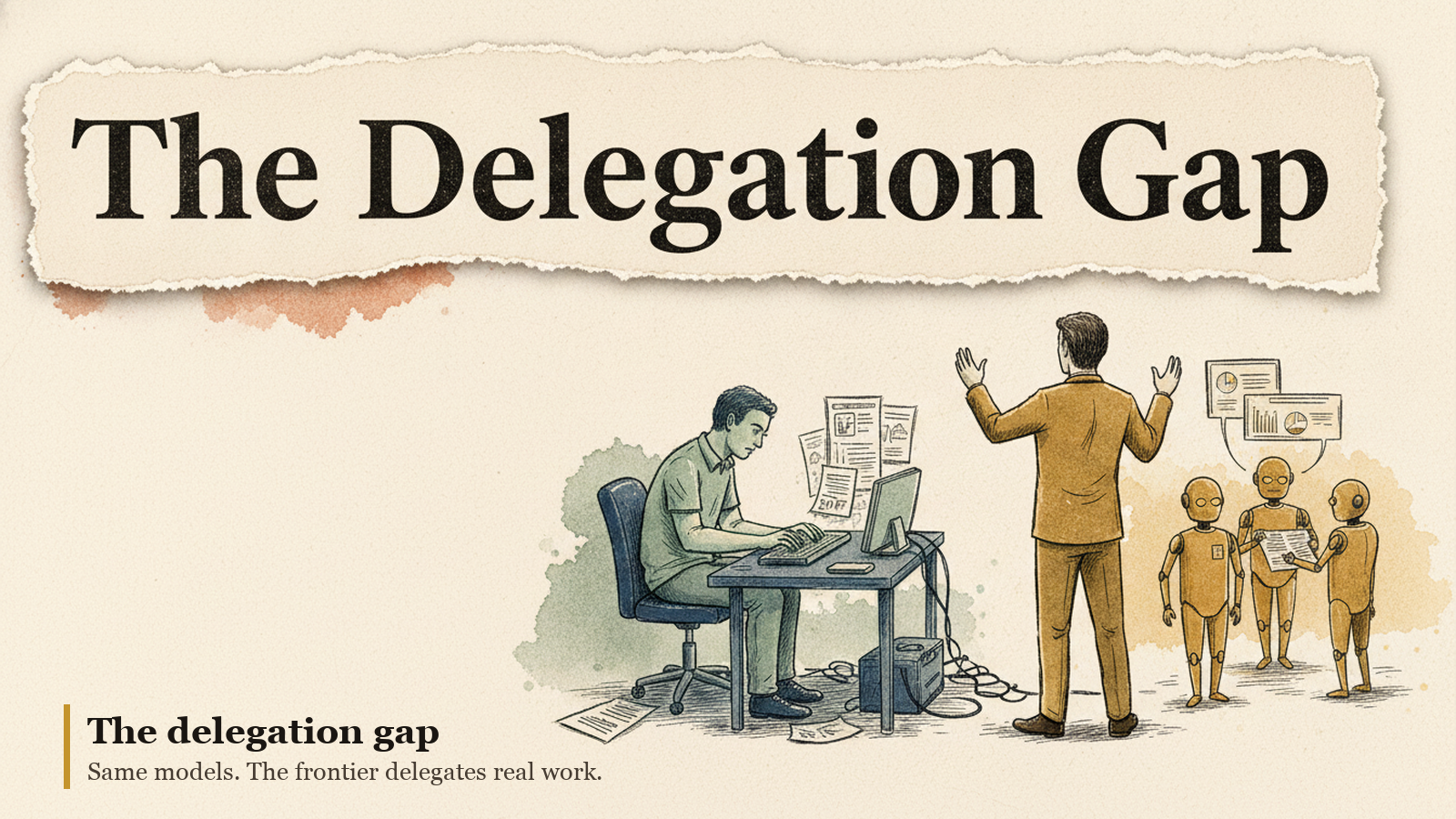
The fastest-growing users of AI coding tools aren't engineers. In OpenAI's August 2026 enterprise report, weekly-active Codex users since February grew 5x in engineering — and 20x in finance, 41x in sales, and 108x in legal (OpenAI). Most of these people aren't trying to become their company's developer. They're finding new ways to do the job they already have.
The real argument for deploying AI coding is not that you're going to become the software engineer, but because we're seeing that the people who are building are compounding their gains and their advantages relative to other AI users.
Nathaniel Whittemore, The AI Daily Brief
That reframes the whole question. The point isn't to ship products for strangers — it's that builders are pulling ahead of chatters, and the gap is widening. Treat the numbers as direction, not gospel: they're OpenAI's own product telemetry. But the direction is the part that matters.
Three build patterns: automate, upgrade, invent
Every build has a relationship to work that already exists. There are three.
Automate — same job, same output. You stop making something by hand: renaming files, filling templates, reworking exports. The test: if the person receiving the output couldn't tell anything changed, it's automation. Good first territory, because you already know what "correct" looks like.
Upgrade — same job, better output. A weekly report becomes a live dashboard. A status email becomes a page people check themselves. A recurring chore turns into an asset.
Invent — new job, new output. Work that manual effort never made practical: interviewing every customer, monitoring hundreds of sources, testing thousands of copy variants. There's nothing proven to copy, so you'll sometimes build things no one uses. That's the cost of the pattern, not a failure of it.
Delivery classes: match the effort to who's using it
The second axis is who the software is for, because that sets how much security, polish, and support it actually needs.
- Prototype — disposable; answers a question or moves a decision. Optimize for speed, not durability.
- Personal software — reliable for you or a small team. Compromise freely on UX and edge cases, because it's yours.
- Production software — used by a specific, known group where failure costs trust or money. Access control and support paths now matter.
- Product — built for a market of strangers. This is the tier where you really are acting like an engineer.
What changes here is disposability. Building something useful for one goal for one month was never worth the cost before, so you solved it another way. That equation flipped. Software you'll throw away in a quarter is now worth writing.
A worked example, from prototype to production
The AI Daily Brief's own site shows the ladder in one project. It started as a prototype: could the AI reliably extract themes and quotes from a transcript? It couldn't, until a good-enough model arrived. Once it worked, it became personal software — an extraction pipeline turning each transcript into a web edition, then a second pipeline posting the pieces to social. The next build, a sign-on reporting portal for sponsors, is production software: a real, known audience, but not the general public.
Notice what the pipeline didn't do. For auto-posting, it used a third-party service rather than wiring up the X and LinkedIn APIs directly. That's the boundary worth keeping.
Build less than you can
Once you start, you'll keep seeing tools you pay for and think "I could just build that." Usually you shouldn't. A vendor whose entire job is that product has more capacity to do it well than you do on your 68th priority. Check whether something already solves it before committing to build.