TL;DR
The short version
Today's consumer AI is stuck in single-player mode: ChatGPT is a power-user product most people use like Google, never touching the custom instructions and personas that deliver step-function gains. The opening is a multiplayer layer — a trusted community where the best power users share prompts and personas and everyone else copies them.
The timing bet is that base models are finally good enough that product-genius founders, not only deeply technical ones, can win. Status is the engine that makes it run. The honest counter: incumbent gravity — habit, ecosystem, and memory lock-in — may be too strong to escape. From Sarah Tavel on AI & I.
Built on Sarah Tavel (Benchmark) with Dan Shipper, AI & I / Every, re-released 5 Aug 2026.
Today's AI is single-player
Most people use ChatGPT like a search box, never touching custom instructions, projects, or the personas that deliver the real gains. The people who are genuinely good at it reinvent the wheel in private. The multiplayer opening is a user-generated layer where those power users make the tool easier for everyone else — knowledge propagating instead of being rediscovered one prompt at a time.
Someone's going to create a UGC type community where the people who are really really good make it so much easier for the rest of us to really take advantage of this technology.
Sarah Tavel, AI & I
Status is the engine
Social products need a north star — followers, authority, visible standing — that makes participants do the thing the product wants. Tavel leans on Eugene Wei's 'Status as a Service': people chase the most efficient path to social capital, and each network needs its own status token earned through proof of work.
The unsolved design problems are trust and visibility. What's actually inside this custom persona? A raw usage count doesn't confer trust on its own. Solve that, and the copy-the-best flywheel has somewhere to spin.
Why product genius wins now
Early in a technology paradigm, deeply technical founders win because they build the differentiating tech — Google, OpenAI. As the infrastructure matures, the advantage slides to product-experience founders who build the most engaging thing — Facebook, Pinterest, Snap, Instagram. Tavel's bet is that AI has matured enough for that slider to move.
There's an open 'personal' bucket, too. ChatGPT and Claude feel worky; AI friends, quantified-self, and everyday-life uses are a category a social-native team could own — and eventually cannibalize the incumbents from.
Terminology collision
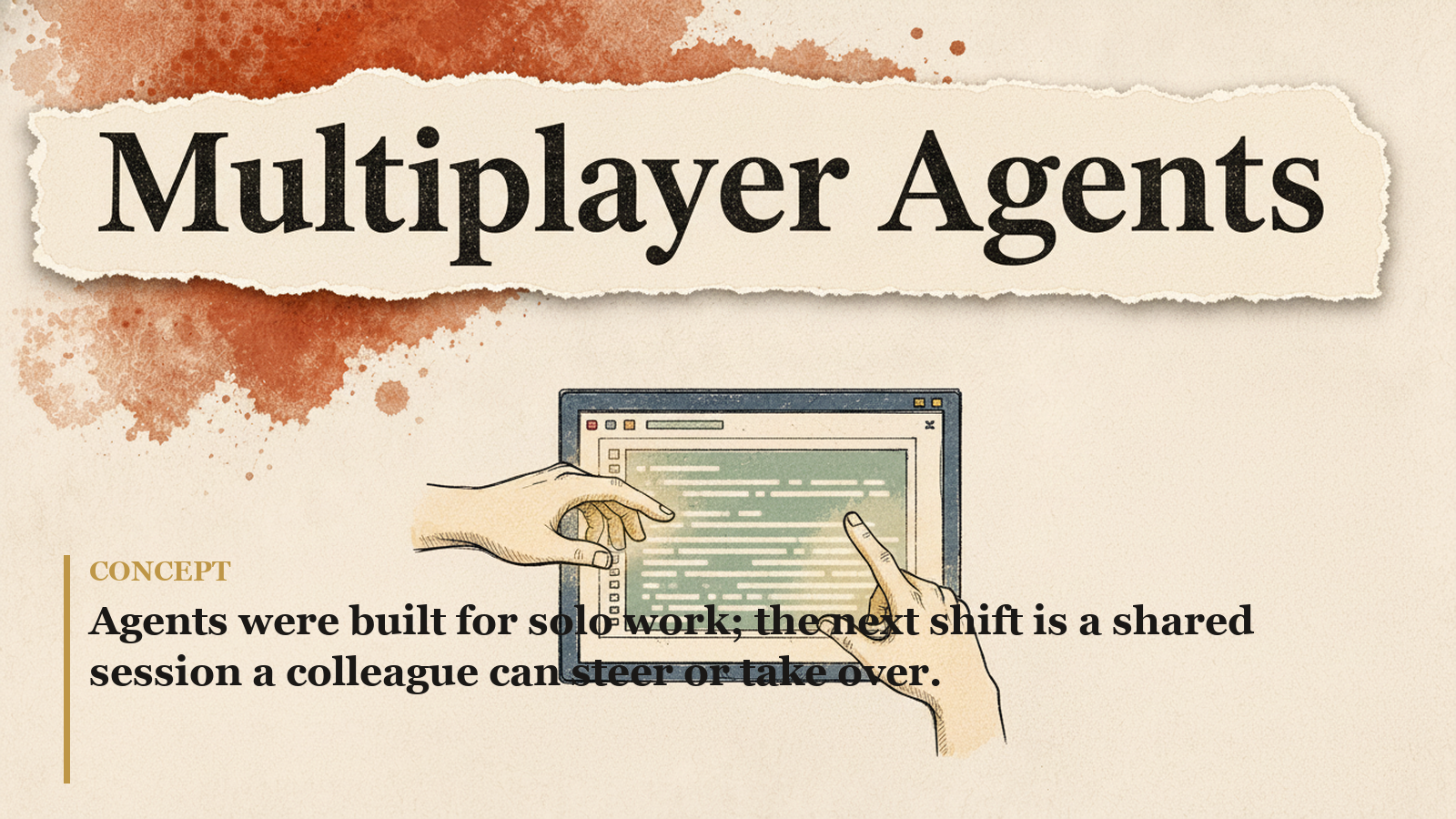
NLW's "7 Ways How We Use AI Is Changing" and Ethan Mollick both use "multiplayer AI" for shared team agents — Claude Tag, Mio, session handoff. That collaborative-session sense is tracked on Multiplayer Agents and Workplace-Native Agents, not this page's consumer-social UGC/status layer.
Multiplayer AI […] remains one of the biggest non-technical problems in using AI right now.
Ethan Mollick, via AI Daily Brief
Keep this page for the social/UGC thesis (Tavel). Route team-shared-agent claims to Multiplayer Agents. Same word; different product bet.