TL;DR
The short version
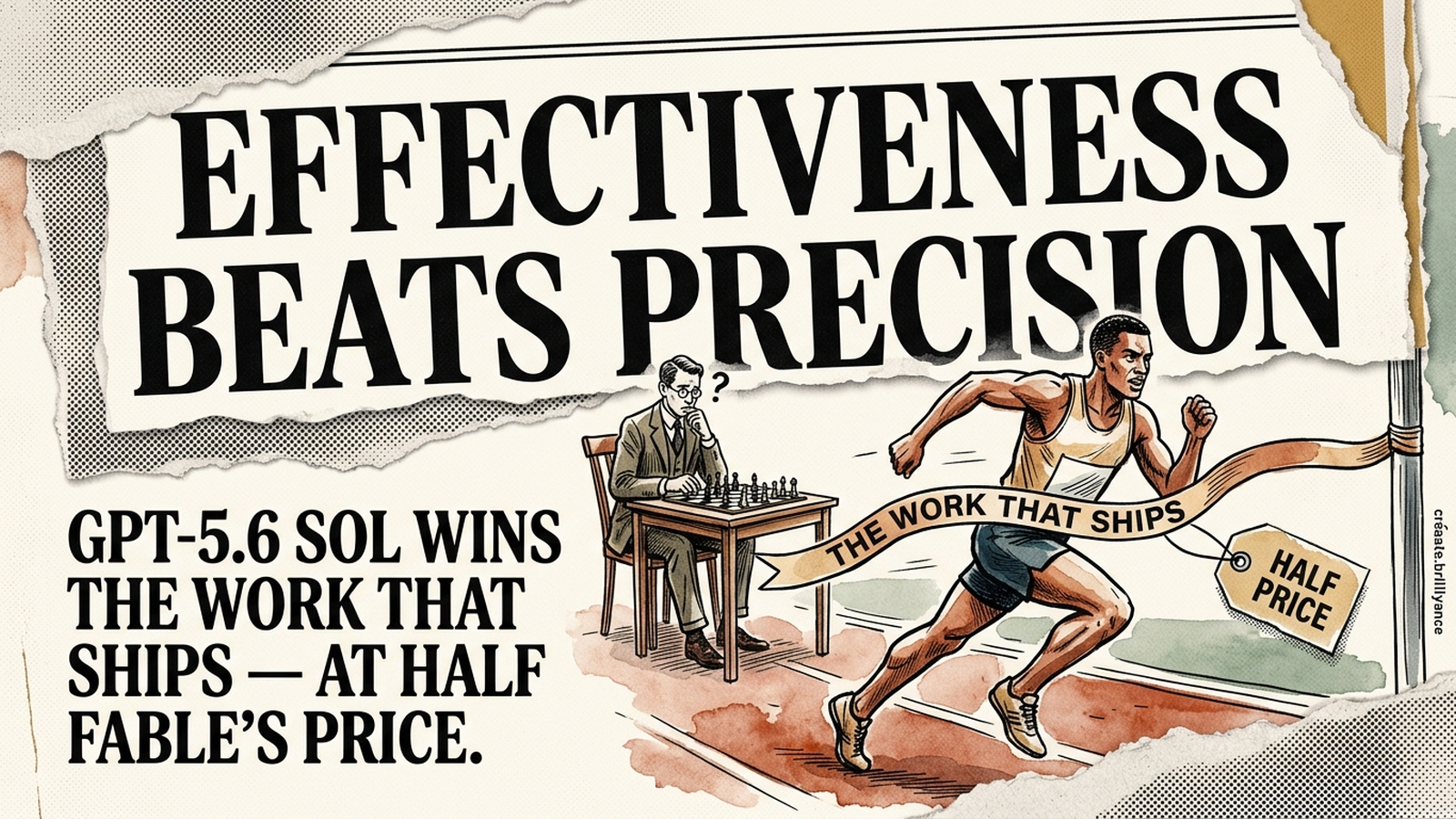
The useful signal about an agentic model is not its benchmark score. It is whether it can find a messy task, judge the data, ask the right questions, and finish with barely any hand-holding.
One real job — 46 CSVs buried in an email — sorted three frontier models faster than any leaderboard would. A power-user at Every ran the same task through OpenAI's GPT-5.5, its successor GPT-5.6, and Anthropic's Fable. They split on judgment, not output quality.
Built on a short clip from Every, where an Every team member walks through her three-model comparison. A single self-reported run, not a controlled eval — take the method, not the verdict.
The test that actually matters comes from your inbox
A power-user at Every needed to compile 46 CSVs someone had emailed her into a single analysis — a huge data dump that had to become one model with real nuance in it. She ran the same job through three models: OpenAI's GPT-5.5, its successor GPT-5.6, and Anthropic's Fable. This was not a benchmark. It was Tuesday.
That distinction is the whole point. A leaderboard tells you how a model does on a curated problem. A task from your own inbox tells you whether it can operate in the mess you actually work in: ambiguous instructions, data you have not cleaned, a file you have to go find first.
The models split on judgment, not output
The three did not fail or succeed on the quality of their writing. They split much earlier, on whether they could handle the shape of the task at all.
GPT-5.5 could not even retrieve the data. Told to find an email and pull in its attachments, it asked who the email was from and what the subject line was — after she had already told it. The result was totally unusable.
Fable stalled on plumbing. It said a connector was not working and wanted all 46 files uploaded to Drive. It got stuck in the weeds, though it did suggest a useful summary tab. Worth noting: that is an integration failure, not a reasoning one.
GPT-5.6 behaved like a competent analyst. It found the correct email, previewed all the data, and volunteered an assessment of the breadth and depth of the data and its quality. Then it asked intelligent scoping questions about how she wanted the work done.
Minimal intervention is the real selection criterion
Here is the line that should reframe how a leader picks tools: with 5.6, she had to respond only once, and it built something that passed the sniff test for accuracy and precision.
5.6 got me to something very usable very quickly with minimal intervention and a lot of good judgment.
Every team member, on GPT-5.6
Count the interventions. That is the metric. Not tokens per second, not a score two points above a rival on someone's index. How many times did you have to step in to keep the agent on the rails? A model that needs constant correction is not leverage; it is a junior who has to be re-briefed every five minutes.
This is where the vendors now compete too. OpenAI markets its GPT-5.6 flagship on a Coding Agent Index — multi-step task completion, not single-shot answers. The 46-CSV test is that same measure, run on your own work instead of theirs.
How to run your own version
Trust is earned on your data, not on a spec sheet. A few things this anecdote makes concrete:
- Pick one real, annoying task — messy input, a retrieval step, some ambiguity. The kind of job you would hand a capable new hire.
- Count interventions, not features. The best model is the one you had to correct least.
- Watch the setup phase. Two of the three models here never reached the analysis — they died on finding the email or wiring a connector. Judgment shows up before the output does.
- Separate plumbing from reasoning. Fable's stall was a broken connector, not bad thinking. Do not confuse an integration gap for a capability gap.
One caveat worth keeping honest: this is a single run by a self-described Codex power-user at Every, whose CEO Dan Shipper she credits for the habit. It is a testimonial, not a controlled eval — the 46-CSV figure and every outcome are self-reported. Take the method, not the verdict.