TL;DR
The short version
People don't buy because you solve a pain point. They buy when they have an urgent project and nothing they already have can get it done. You can't create that pull. You find it, sell to it before you build much, and drop any idea where you're still pushing after a handful of calls.
Rob Snyder calls this state "weird not to buy" and breaks it into four parts: a P*roject, that's *Unavoidable now, a L*ist of options, and the *Limitations that make those options useless. All four have to hold at once. After the sale the same logic applies to churn: every customer leaves until they reach the moment that makes leaving weird.
Built on Lenny Rachitsky's interview with Rob Snyder (25 October 2026) and Snyder's PULL framework write-up. Slack's retention figure checked against Stewart Butterfield's own account; outreach rates, call counts and most company stories are Snyder's own.
Pain points don't make people buy
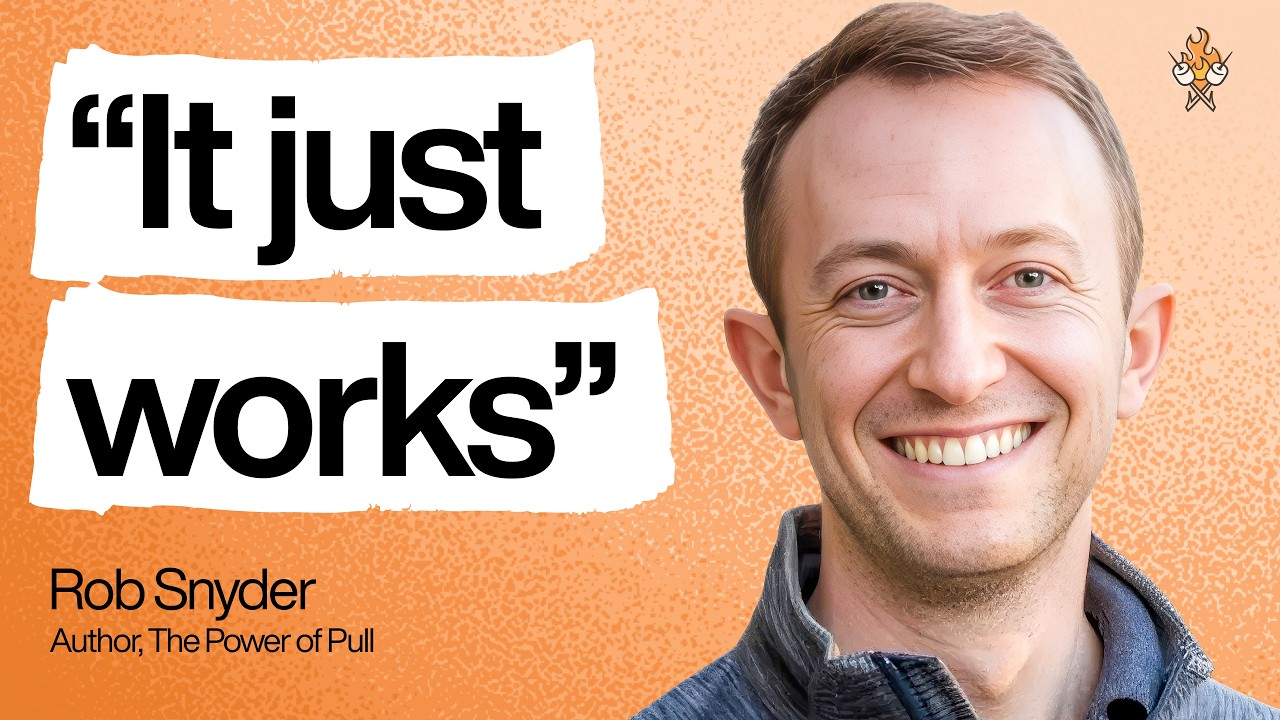
Rob Snyder spent two years as a founder doing what the advice says. He found "hair on fire" problems, offered a differentiated product, and had design partners using it every day. Then he tried to sell it and "got smashed into a wall," he told Lenny Rachitsky.
He decided the advice had the cause wrong. A buyer can agree that your product solves their problem and still not drop their priorities to buy it. What makes someone buy is a priority they're already stuck on. Snyder calls them "a coiled spring": stuck partway through something they have to do, and ready to grab whatever gets them moving.
His PULL framework breaks that state into four parts:
- Project: something on their to-do list, framed as a job ("hire more people"), not a purchase ("buy recruiting software").
- Unavoidable: a reason it has to happen now.
- List of options: the ways they could do it, including doing it themselves.
- Limitations: why none of those options are good enough.
All four have to be true at once. If the project isn't unavoidable, people complain but don't buy. If their current options are good enough, they tell you they're already handling it themselves.
The test: would it be weird not to buy?
Snyder's example is Jump, an AI notetaker for financial advisors. Advisors want to spend as little time as possible writing up client meetings. They can't skip it, because compliance rules make them keep records (SEC Rule 204-2 covers written communications about advice). General-purpose AI notetakers didn't connect to advisor CRMs and couldn't show they met SEC rules. So when Jump arrived, advisors grabbed it. (Snyder says it took Jump about 18 months of failing before it found this.)
Jump then tried insurance agents. They have the same note-taking chore, but nothing makes it unavoidable, so they just don't take notes. The idea was the same, but the pull wasn't there.
One of the main mistakes people make is thinking that pull is a thing that a company has. It's a thing a person has.
Rob Snyder, Lenny's Podcast
You're not selling to SpaceX, he says. You're selling to the head of legal at SpaceX, who has a project she can't finish on her own.
Sell before you build
Snyder says pull exists before you show up, so you can't convince anyone to have it. You can only find it. Most of the 50-odd startups he says he has advised got their idea by doing the customer's job firsthand. One founder rode along with solar installers and then physical therapists until he spotted something a physical therapist was trying to do and couldn't.
Write that up as a hypothesis and show it to the person on two slides. The first says what you think they're trying to do, why now, and why their current options fall short. The second sketches how you'd help. You want "Oh my god, yes" on the first slide and "How does it work?" on the second.
The only signal that counts is a buying move: "How do we get started?" A request to "send more info," or a "maybe in Q4," is pushing the decision away. Snyder's check is to run about five calls and see if anyone pulled. If nobody did, ask the Hail Mary: "Is there anything on your to-do list that you would pay me to do right now?" One startup selling applicant tracking to governments got its first contract from that question, for a job-description problem it hadn't been pitching.
After the sale, find the moment they'd be weird to churn
Pull explains the purchase. Retention needs its own trigger. "Everybody who buys is guaranteed to churn until X," Snyder says, where X is the point after which leaving would be strange. At his restaurant startup, X was an alert, within two weeks, about an employee who was about to quit that the owner could still stop. Slack's version was a team reaching 2,000 messages. (On the podcast it was misremembered as 10,000 or 1,000.)
Once you know X, Snyder thinks of the company as a "case study factory." It has three stages, pipeline, sales and delivery, and its job is to repeat one hell-yes customer story. "We don't make software here. We make case studies." Whichever stage is slowest gets all the attention until it isn't.
Where it stops
The framework is Snyder's own, and so are its benchmarks: the outreach rates, the five-call check, the share of ideas that came from firsthand work. Most of his stories are about unnamed friends' companies. Investors such as a16z argue that design partners with clear commitments do work.
The core test still holds: "You could give me a [...] 100x better printer for my house and I won't buy it because [...] I'm not blocked."