TL;DR
The short version
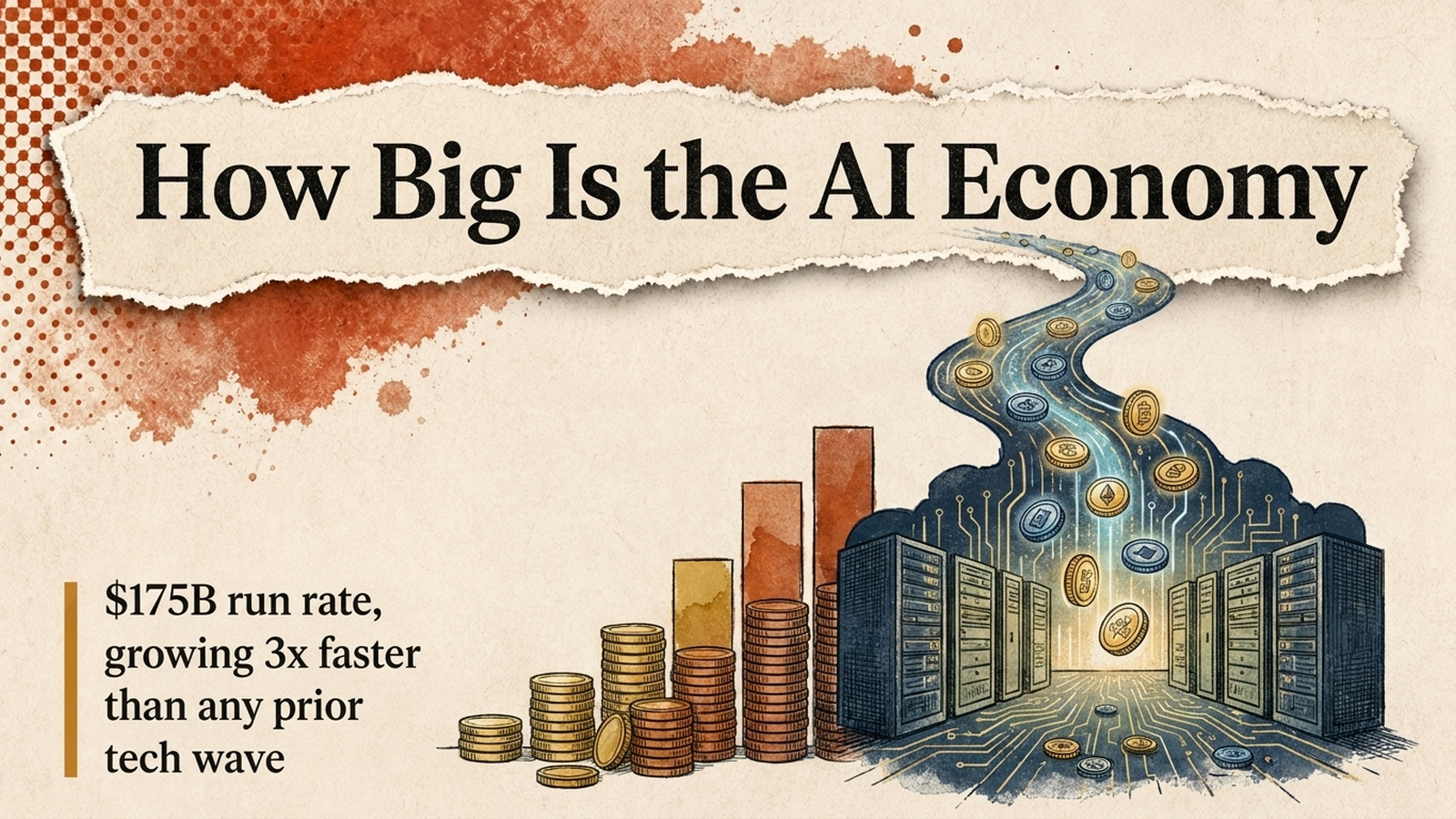
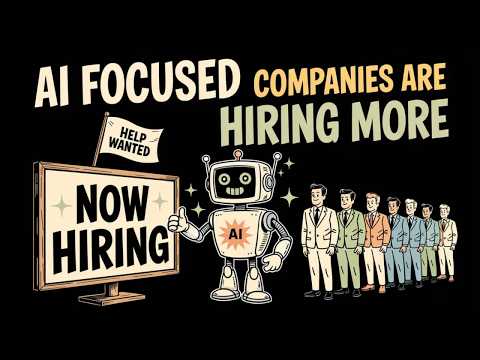
New firm-level data shows the businesses spending most on AI grew headcount about 10% over two years, while low adopters stayed flat. AI capability is climbing fast, but the heaviest adopters are hiring more people, not fewer.
The read comes from The AI Daily Brief, stitching together the Ramp/Revelio hiring study, the Remote Labor Index, and BLS payroll data into one picture of AI and jobs.
Built on Nathaniel Whittemore's AI Daily Brief episode and the underlying Ramp/Revelio, CAIS/Scale, and Challenger data.
The data cuts against the doom case
The fear was simple: buy AI, cut staff. The first large dataset that actually links AI spending to hiring says the opposite is happening at the firms leaning in hardest.
Ramp and Revelio Labs matched real AI vendor spend against workforce records for 21,559 US firms from 2021 through early 2026. Companies with high AI adoption grew headcount about 10% over the two years after they started; low adopters were basically flat. Headcount growth began 6 to 12 months after adoption, not immediately — there is a learning curve before the hiring shows up.
Ramp Economics Lab × Revelio Labs, 2021–early 2026
The detail that cuts hardest is where the growth landed. Entry-level roles grew faster than the overall average. The "AI eats junior jobs first" story is the one most people assume is already true. This data points the other way.
Capability is rising fast — and still a minority share
None of this means AI cannot do the work. It increasingly can.
The Remote Labor Index, built by the Center for AI Safety with Scale AI, tests whether AI can complete real freelance projects — 3D modeling, ad videos, floor-plan renders, data analysis — at a quality a paying client would actually accept. Human evaluators score each deliverable against work produced by a paid professional. It is a harder bar than the usual capability benchmarks.
Eight months ago the top score was 2.5%. It is now around 16%. The frontier has "more than quadrupled in under eight months," the researchers wrote — a real signal, not hype. But read the number both ways: a 16% automation rate means a human is still needed 84% of the time.
Even at a 16% automation rate, that means 84% of the time a human is needed. The real work has complexities orthogonal to what current AI systems can cover.
Practitioner reaction to the Remote Labor Index, quoted on The AI Daily Brief
Tasks are not jobs
The cleaner way to hold the contradiction is a distinction finally reaching the mainstream: a task being exposed to AI is not the same as a worker being replaced.
OpenAI's chief economist Ronnie Chatterji made the point at a European Central Bank event: just because a task is exposed to AI does not mean it substitutes for the worker. His example was his own field — economists were "about to be automated" by the personal computer in the 1980s. Instead the PC made them more productive and they kept working.
A job is a bundle of tasks. Automate some, and you can raise a person's output rather than remove them. That is the mechanism the Ramp data appears to be picking up.
The displacement is real, just concentrated
This is not a clean win, and it is worth being honest about the mess.
BLS payroll data shows tech and finance shedding jobs even as overall US hiring stays positive. Challenger, Gray & Christmas has logged more than 100,000 job-cut announcements this year that cite AI. The hard part is separating genuine AI replacement from AI as a convenient cover story for correcting the overhiring of 2022 — a Barclays economist quoted in the episode leans toward the latter.
There is also a countercurrent — firms walking back AI-first cuts. Ford rehired 350 veteran "greybeard" engineers over three years, partly to retrain the AI tools that were not hitting quality on their own. As Ford's engineering VP put it, AI "is only as good as the information you use to train it." Companies are recalibrating where AI sits in the labor stack rather than swapping people out wholesale.
What to take from it
Read past the framing before acting on any of this. The Ramp study is a corporate lab's own publication — carefully done, with like-for-like control firms, but its own economist warns that companies adopting AI were already fast-growing, and nearly all the headcount gains showed up in tech-sector firms. The loudest optimism in the coverage comes from people, including the host, who say plainly that they are optimists.
The operating read for a leader: the bar to be a "high adopter" was modest — roughly $30 per employee per month, not a million-dollar token budget. The firms getting a hiring tailwind are not the ones spending the most in raw dollars. They are the ones far enough up the learning curve to know what to do with the capacity AI frees up.