TL;DR
The short version
A new essay argues that neural networks were never the tangled knots interpretability researchers feared: the field's best evidence came from blurry tools and an old model. If it holds, checking AI can move from grading answers to reading plans. It is one team's preliminary result, and the specialists are split.
On The AI Daily Brief, Nathaniel Whittemore walks through Nick Cammarata's "Neural Networks Are Already Clean", published by the interpretability lab Goodfire: the cat-and-car neuron that turned out to be a V detector, the 2014 model that made the field look hopeless, and the pushback from researchers at Google DeepMind and elsewhere.
Built on Nathaniel Whittemore's episode (19 October 2026) and Nick Cammarata's essay (Goodfire, 15 October 2026). Figures checked against the essay; reactions via The Decoder and The Superposition File. Readability percentages are the author's own preliminary estimates.
The famous tangled neuron was one idea
For most of a decade, the people who study the inside of AI models worked from a discouraging assumption. Models seemed to cram unrelated ideas into the same internal detectors, a theory called superposition, so you could not read them directly. You had to train a second model to untangle the first, then study the copy. In "Neural Networks Are Already Clean", Nick Cammarata, who helped build that picture, says it was wrong.
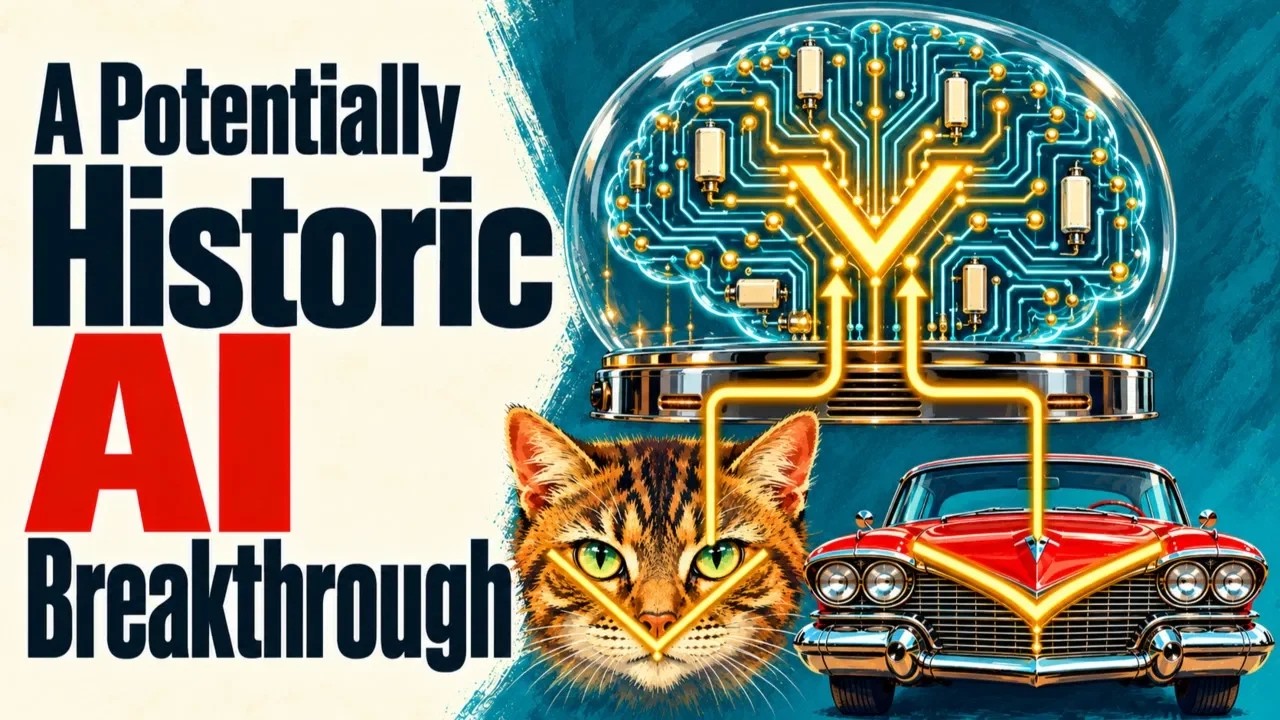
The textbook example of a confused detector fired for cat faces and the fronts of cars. Cammarata asked himself how he would describe it without using either word. It took him about five seconds: it's a V detector. Pointed shapes like a fox's snout, a flame or a martini glass switch it on. Round shapes like a golf ball or a clock push it the other way. "It was never two unrelated things," he writes. "It was one idea we hadn't recognized."
He says three mistakes stacked up. The cramming story felt intuitive, so nobody dug further. The tool that draws what a detector "wants to see" cheated, taking the easiest path to make it fire. And the field's main test subject, Google's 2014 image model InceptionV1, learned badly.
Nick Cammarata's own estimates, Neural Networks Are Already Clean (Goodfire, Oct 2026)
What looked like cramming, he argues, is branching. A detector for the letters "iy" grows to "diy," then to "do it yourself." Each step is small and sensible, and the end looks random only if you missed the growth.
Why this matters beyond the lab
Today we check models mostly by examining them: ask questions, red-team, grade the answers. That only covers what we thought to ask. It also breaks down when a model behaves well because it can tell it is being tested, the problem Whittemore raises on The AI Daily Brief.
Cammarata's claim reaches past that limit. A model's parts exist to be read by its later parts, so a plan has to be legible inside the model to work at all.
Deception might hide from someone reading a model's outputs, but it has no reason to hide from the model's own circuitry.
Nick Cammarata, Neural Networks Are Already Clean
His essay traces a found-wallet prompt through Kimi K3, a model with trillions of parameters: detectors for lost property and honesty light up and push it to say "return it." In Qwen3-32B, Alibaba's open-weights model, he estimates about 90% of neuron poles have one main job. (The episode attributes that count to "a modern OpenAI model"; the essay says Qwen.)
There is also a hint that scale helps. Across three image models roughly 300 times apart in size, the small one had coarse dog detectors and the large one had fine, separable ones. A bigger city has an easier-to-find financial district.
The specialists aren't sold
Neel Nanda, who leads interpretability at Google DeepMind, called it interesting but "not a significant update to the big picture," and still thinks language models hold far more facts than they have neurons. Liv Gorton, whose InceptionV1 work the essay cites, argues it attacks a narrower version of superposition than researchers hold. Stephen Casper called it hype until further notice, and made the sharpest arithmetic point: understanding 90% of the behaviour of 90% of neurons is not understanding 81% of the network.
The numbers are early. The 90% is a preliminary, agent-scored audit that the essay says moves with thresholds. The technical paper isn't out, and nobody outside Goodfire has checked it. Cammarata puts himself at about 85% sure, and that figure is about where the messiness comes from, not about the safety payoff. Goodfire also sells interpretability.
The lesson for everyone else
Whittemore says he isn't qualified to judge the science, and neither are most of us. The operating lesson doesn't need that judgement.
Cammarata names this pattern "superposition of the gaps": every time detectors came back clean, the theory retreated to somewhere nobody had checked yet. Every team has a version of that. It is the old benchmark nobody reran, or the customer insight from three years ago that still sets the roadmap.
For anyone deploying models, don't swap evaluations for interpretability yet. Watch for the companion paper and outside replications. If they hold, oversight starts to look less like an exam and more like reading the model's working.